




Từ Vựng Events Management B2: 60 Từ Và Cụm Từ Giúp Tổ Chức Sự Kiện Chuyên Nghiệp
Events Management (quản lý và tổ chức sự kiện) là chủ đề tiếng Anh quan trọng trong lĩnh vực Marketing, Truyền thông, Quan hệ công chúng và quản trị kinh doanh. Ở trình độ B2, người học cần biết cách trình bày kế hoạch sự kiện, phân bổ ngân sách, phối hợp nhân sự, xử lý tình huống phát sinh và đánh giá kết quả bằng tiếng Anh.
Bài học tại Anh Ngữ SEC tổng hợp 60 từ và cụm từ Events Management B2, kèm nghĩa tiếng Việt, ví dụ thực tế, collocations, word family, cách phân biệt từ dễ nhầm và 5 dạng bài tập có đáp án. Nội dung giúp người học phát triển khả năng giao tiếp trong môi trường làm việc, viết email chuyên nghiệp và vận dụng vào IELTS, TOEIC, VSTEP.
Key takeaways:
- Nắm vững 60 từ và cụm từ B2 về lập kế hoạch, ngân sách, nhân sự, truyền thông, hậu cần và đánh giá sự kiện.
- Sử dụng các collocations tự nhiên như allocate a budget, coordinate with suppliers, manage logistics và evaluate event outcomes.
- Hiểu word family của những từ quan trọng như organize, coordinate, promote, allocate và evaluate.
- Phân biệt các từ dễ nhầm như event – occasion, venue – location, attendee – participant.
- Nhận diện các lỗi về collocations, giới từ, từ loại và văn phong công việc.
- Luyện đọc hiểu, hoàn thành câu, chọn đáp án và ứng dụng từ vựng vào giao tiếp hoặc bài thi B2.
Chủ đề Events Management ở level B2 cần học những gì?
Events Management là quá trình lập kế hoạch, triển khai, điều phối và đánh giá các hoạt động như hội nghị, hội thảo, triển lãm, lễ ra mắt sản phẩm, sự kiện doanh nghiệp hoặc chương trình cộng đồng.
Ở trình độ A2–B1, người học thường biết các từ quen thuộc như event, meeting, guest, invitation, schedule hoặc organizer. Những từ này giúp mô tả một sự kiện, thông báo thời gian, địa điểm và các hoạt động cơ bản.
Khi đạt B2, trọng tâm chuyển sang khả năng quản lý quy trình và giải thích quyết định. Thay vì chỉ nói về việc một sự kiện diễn ra như thế nào, người học cần diễn đạt được lý do lựa chọn địa điểm, cách tối ưu chi phí, phương án giảm thiểu rủi ro và các tiêu chí đánh giá hiệu quả.
Ví dụ:
- B1: We need to prepare the venue before the event.
- B2: We need to coordinate with the venue staff to ensure that all technical requirements are met before the event.
(Dịch: Chúng ta cần phối hợp với nhân viên tại địa điểm tổ chức để bảo đảm tất cả yêu cầu kỹ thuật được đáp ứng trước sự kiện.)
Tương tự:
- B1: The event was successful because many people attended.
- B2: The event achieved its objectives by attracting the target audience and generating positive feedback from participants.
(Dịch: Sự kiện đã đạt được mục tiêu nhờ thu hút đúng đối tượng và nhận được phản hồi tích cực từ người tham gia.)
Phạm vi từ vựng B2 tập trung vào sáu nhóm chính: lập kế hoạch, ngân sách, nhân sự, truyền thông, vận hành sự kiện và đánh giá kết quả. Đây cũng là những nhóm kiến thức thường xuất hiện trong email công việc, báo cáo dự án và các tình huống thảo luận bằng tiếng Anh.
Tham khảo thêm: Từ vựng Events B2 về các loại sự kiện và hoạt động tham dự
Cách học từ vựng Events Management level B2 hiệu quả
Học từ vựng Events Management ở trình độ B2 không chỉ là ghi nhớ logistics nghĩa là công tác hậu cần hay sponsorship nghĩa là sự tài trợ. Điều quan trọng hơn là hiểu những từ này thường kết hợp với từ nào và xuất hiện trong tình huống thực tế ra sao.
1. Học theo từng giai đoạn tổ chức sự kiện
Một sự kiện thường trải qua các bước lập kế hoạch, chuẩn bị nguồn lực, triển khai và đánh giá. Việc học từ theo những giai đoạn này giúp xây dựng mối liên hệ rõ ràng giữa các khái niệm.
Ví dụ:
- Trước sự kiện: set objectives, allocate resources, select a venue.
- Trong sự kiện: coordinate staff, manage logistics, deal with unexpected issues.
- Sau sự kiện: collect feedback, assess performance, evaluate outcomes.
2. Học theo collocations thay vì dịch từng từ
Một từ thường kết hợp tự nhiên với một số động từ hoặc danh từ nhất định.
Ví dụ với budget:
- set a budget: thiết lập ngân sách.
- allocate a budget: phân bổ một khoản ngân sách.
- stay within budget: không vượt ngân sách.
- exceed the budget: vượt quá ngân sách.
Những cụm này giúp diễn đạt chính xác hơn khi giải thích công việc hoặc viết báo cáo.
3. Mở rộng vốn từ bằng word family
Thay vì chỉ ghi nhớ organize, người học cần hiểu thêm:
- Organize (v): tổ chức, sắp xếp.
- Organization (n): tổ chức; việc tổ chức, sắp xếp.
- Organizer (n): người hoặc đơn vị tổ chức.
- Organized (adj): có tổ chức, ngăn nắp.
- Organizational (adj): thuộc về tổ chức.
Ví dụ:
The event organizer needs strong organizational skills.
(Người tổ chức sự kiện cần có kỹ năng tổ chức tốt.)
4. Luyện paraphrase để diễn đạt linh hoạt
Ở B2, cùng một ý tưởng có thể được thể hiện qua nhiều cách diễn đạt.
- The event attracted many people.
- The event drew a large audience.
- The event achieved a strong turnout.
Cả ba câu đều nói về việc có nhiều người tham dự, nhưng cách thứ hai nhấn mạnh khả năng thu hút khán giả, còn cách thứ ba nhấn mạnh số lượng người thực tế có mặt.
5. Đưa từ vựng vào một tình huống hoàn chỉnh
Ví dụ:
We had to revise the schedule because one of the speakers was unavailable. The organizing team quickly adjusted the programme and informed all participants.
(Chúng tôi phải điều chỉnh lịch trình vì một diễn giả không thể tham dự. Ban tổ chức nhanh chóng thay đổi chương trình và thông báo đến toàn bộ người tham gia.)
Một tình huống ngắn như vậy giúp ghi nhớ đồng thời revise the schedule, organizing team, adjust the programme và inform participants.
Tham khảo thêm: 11 cách học từ vựng tiếng Anh hiệu quả và ghi nhớ lâu
Bảng từ vựng Events Management level B2
Bảng gồm 60 từ và cụm từ được chia theo sáu giai đoạn hoặc chức năng quan trọng trong quản lý sự kiện. Các thuật ngữ được học theo ngữ cảnh B2, tập trung vào khả năng lập kế hoạch, giải thích quy trình, thảo luận vấn đề và giao tiếp trong công việc.
Ký hiệu: n. = danh từ, v. = động từ, adj. = tính từ, n. phrase = cụm danh từ, v. phrase = cụm động từ.
Nhóm 1: Event Planning – Lập kế hoạch và xây dựng sự kiện
| Word/Phrase | Level | Loại từ | Nghĩa tiếng Việt | Word family | Collocation/Cụm dùng tự nhiên | Ví dụ |
|---|---|---|---|---|---|---|
| 1. Event brief | B2 | n. phrase | Bản tóm tắt yêu cầu tổ chức sự kiện | brief, briefing | prepare an event brief | The client provided an event brief outlining the main requirements. |
| 2. Event objectives | B2 | n. phrase | Những mục tiêu của sự kiện | objective | set clear event objectives | We need to set clear event objectives before planning activities. |
| 3. Event concept | B2 | n. phrase | Ý tưởng chủ đạo của sự kiện | conceptual | develop an event concept | The team developed an event concept around sustainability. |
| 4. Target audience | B2 | n. phrase | Đối tượng mục tiêu | target, targeting | identify the target audience | The event is designed for young professionals. |
| 5. Event scope | B2 | n. phrase | Phạm vi công việc của sự kiện | scope | define the event scope | The manager defined the event scope to avoid unnecessary costs. |
| 6. Stakeholder | B2 | n. | Bên liên quan, người có quyền lợi hoặc trách nhiệm liên quan | stake | engage key stakeholders | All stakeholders should approve the final proposal. |
| 7. Project timeline | B2 | n. phrase | Tiến độ và mốc thời gian dự án | time, timeline | establish a project timeline | A detailed timeline helps us track progress. |
| 8. Milestone | B2 | n. | Cột mốc quan trọng | — | meet a project milestone | Booking the venue was our first major milestone. |
| 9. Event proposal | B2 | n. phrase | Bản đề xuất tổ chức sự kiện | propose, proposal | submit an event proposal | We submitted the event proposal to the client on Monday. |
| 10. Run of show | B2 | n. phrase | Kịch bản điều hành chi tiết theo thời gian | — | finalise the run of show | The production team reviewed the run of show before rehearsals. |
Nhóm 2: Event Budgeting – Ngân sách và nguồn tài chính
| Word/Phrase | Level | Loại từ | Nghĩa tiếng Việt | Word family | Collocation/Cụm dùng tự nhiên | Ví dụ |
|---|---|---|---|---|---|---|
| 11. Budget allocation | B2 | n. phrase | Việc phân bổ ngân sách | allocate, allocation | review budget allocation | Budget allocation should reflect the event’s priorities. |
| 12. Cost estimate | B2 | n. phrase | Dự toán chi phí | estimate, estimation | prepare a cost estimate | The supplier provided a cost estimate for the equipment. |
| 13. Financial constraint | B2 | n. phrase | Hạn chế về tài chính | finance, financial | face financial constraints | Financial constraints forced us to reduce unnecessary expenses. |
| 14. Contingency fund | B2 | n. phrase | Quỹ dự phòng cho chi phí phát sinh | contingency | set aside a contingency fund | We set aside a contingency fund for unexpected costs. |
| 15. Sponsorship | B2 | n. | Sự tài trợ | sponsor, sponsored | secure sponsorship | The organizers secured sponsorship from local businesses. |
| 16. Sponsor | B2 | n./v. | Nhà tài trợ; tài trợ | sponsorship | attract potential sponsors | Several sponsors supported the student conference. |
| 17. Funding proposal | B2 | n. phrase | Đề xuất xin kinh phí hoặc tài trợ | fund, funding | submit a funding proposal | The committee submitted a funding proposal to the university. |
| 18. Expense tracking | B2 | n. phrase | Việc theo dõi các khoản chi | expense, track | maintain accurate expense tracking | Accurate expense tracking helps prevent overspending. |
| 19. Cost-effective | B2 | adj. | Hiệu quả về mặt chi phí | cost, effectiveness | find a cost-effective solution | Using digital invitations is a cost-effective option. |
| 20. Return on investment (ROI) | B2 | n. phrase | Hiệu quả thu được so với chi phí đầu tư | invest, investment | measure return on investment | The company evaluated the event’s return on investment. |
Nhóm 3: Team Coordination – Nhân sự và phối hợp công việc
| Word/Phrase | Level | Loại từ | Nghĩa tiếng Việt | Word family | Collocation/Cụm dùng tự nhiên | Ví dụ |
|---|---|---|---|---|---|---|
| 21. Organizing committee | B2 | n. phrase | Ban tổ chức | organize, organizer | form an organizing committee | The university formed an organizing committee for the conference. |
| 22. Event coordinator | B2 | n. phrase | Điều phối viên sự kiện | coordinate, coordination | appoint an event coordinator | The event coordinator checked every department’s progress. |
| 23. Supplier | B2 | n. | Đơn vị cung cấp hàng hóa hoặc dịch vụ | supply, supplies | negotiate with suppliers | We negotiated with suppliers to reduce equipment costs. |
| 24. Vendor | B2 | n. | Bên bán hoặc cung cấp sản phẩm, dịch vụ | — | select reliable vendors | The organizers selected vendors for food and merchandise. |
| 25. Contractor | B2 | n. | Nhà thầu hoặc đơn vị nhận thực hiện công việc theo hợp đồng | contract, contractual | hire a contractor | We hired a contractor to install the stage. |
| 26. Staff briefing | B2 | n. phrase | Buổi phổ biến nhiệm vụ cho nhân sự | brief, briefing | conduct a staff briefing | A staff briefing will take place before the doors open. |
| 27. Task delegation | B2 | n. phrase | Việc phân công, giao nhiệm vụ | delegate, delegation | ensure effective task delegation | Effective task delegation prevents confusion among volunteers. |
| 28. Volunteer recruitment | B2 | n. phrase | Hoạt động tuyển tình nguyện viên | volunteer, recruit, recruitment | coordinate volunteer recruitment | Volunteer recruitment began six weeks before the festival. |
| 29. Stakeholder communication | B2 | n. phrase | Hoạt động trao đổi thông tin với các bên liên quan | communicate, communication | maintain stakeholder communication | Clear stakeholder communication helps prevent misunderstandings. |
| 30. Cross-functional team | B2 | n. phrase | Nhóm nhân sự đến từ nhiều bộ phận chuyên môn | function, functional | work in a cross-functional team | A cross-functional team handled marketing, logistics and finance. |
Nhóm 4: Event Promotion – Truyền thông và thu hút người tham dự
| Word/Phrase | Level | Loại từ | Nghĩa tiếng Việt | Word family | Collocation/Cụm dùng tự nhiên | Ví dụ |
|---|---|---|---|---|---|---|
| 31. Promotional campaign | B2 | n. phrase | Chiến dịch quảng bá | promote, promotion | launch a promotional campaign | The team launched a promotional campaign on social media. |
| 32. Outreach strategy | B2 | n. phrase | Chiến lược tiếp cận đối tượng mục tiêu | reach, outreach | develop an outreach strategy | Our outreach strategy focuses on university students. |
| 33. Registration platform | B2 | n. phrase | Nền tảng hoặc hệ thống đăng ký | register, registration | set up a registration platform | Participants can sign up through the registration platform. |
| 34. Registration deadline | B2 | n. phrase | Hạn chót đăng ký | register, registration | extend the registration deadline | The organizers extended the registration deadline by two days. |
| 35. Ticket sales | B2 | n. phrase | Hoạt động hoặc số lượng vé bán ra | ticket, sale, sell | boost ticket sales | Early promotion helped boost ticket sales. |
| 36. Early-bird offer | B2 | n. phrase | Ưu đãi dành cho người đăng ký hoặc mua vé sớm | offer | introduce an early-bird offer | The early-bird offer ends at midnight on Sunday. |
| 37. Attendee engagement | B2 | n. phrase | Mức độ tham gia và tương tác của người dự sự kiện | attend, attendee, engage | increase attendee engagement | Interactive workshops increased attendee engagement. |
| 38. Brand exposure | B2 | n. phrase | Mức độ thương hiệu được công chúng tiếp xúc, nhìn thấy | expose, exposure | increase brand exposure | The exhibition provided valuable brand exposure for sponsors. |
| 39. Press release | B2 | n. phrase | Thông cáo báo chí | press, release | issue a press release | The communications team issued a press release before the launch. |
| 40. Media coverage | B2 | n. phrase | Hoạt động hoặc mức độ đưa tin của truyền thông | cover, coverage | gain media coverage | The event gained media coverage from several local newspapers. |
Nhóm 5: Event Logistics – Hậu cần và vận hành tại sự kiện
| Word/Phrase | Level | Loại từ | Nghĩa tiếng Việt | Word family | Collocation/Cụm dùng tự nhiên | Ví dụ |
|---|---|---|---|---|---|---|
| 41. Venue capacity | B2 | n. phrase | Sức chứa của địa điểm tổ chức | capacity | check venue capacity | We must check venue capacity before confirming registrations. |
| 42. Floor plan | B2 | n. phrase | Sơ đồ bố trí mặt bằng | plan, planning | finalise the floor plan | The floor plan includes registration desks and emergency exits. |
| 43. Seating arrangement | B2 | n. phrase | Sơ đồ hoặc cách bố trí chỗ ngồi | arrange, arrangement | adjust seating arrangements | The seating arrangement was changed to improve visibility. |
| 44. Audiovisual equipment | B2 | n. phrase | Thiết bị âm thanh và hình ảnh | audiovisual, equip | test audiovisual equipment | All audiovisual equipment must be tested before the conference. |
| 45. Technical rehearsal | B2 | n. phrase | Buổi chạy thử các hạng mục kỹ thuật | rehearse, rehearsal | conduct a technical rehearsal | The team conducted a technical rehearsal the night before. |
| 46. Crowd management | B2 | n. phrase | Việc điều tiết và kiểm soát đám đông | manage, management | improve crowd management | Clear signage is essential for effective crowd management. |
| 47. Accessibility | B2 | n. | Khả năng tiếp cận, sử dụng của mọi đối tượng | access, accessible | improve venue accessibility | The organizers improved accessibility for wheelchair users. |
| 48. Contingency plan | B2 | n. phrase | Phương án dự phòng khi có sự cố | contingency | develop a contingency plan | We developed a contingency plan in case of heavy rain. |
| 49. Risk assessment | B2 | n. phrase | Việc đánh giá các rủi ro có thể xảy ra | risk, assess, assessment | carry out a risk assessment | The safety officer carried out a risk assessment. |
| 50. On-site support | B2 | n. phrase | Hoạt động hỗ trợ trực tiếp tại địa điểm | support, supportive | provide on-site support | The technical team provided on-site support throughout the event. |
Nhóm 6: Event Evaluation – Đánh giá hiệu quả sau sự kiện
| Word/Phrase | Level | Loại từ | Nghĩa tiếng Việt | Word family | Collocation/Cụm dùng tự nhiên | Ví dụ |
|---|---|---|---|---|---|---|
| 51. Post-event evaluation | B2 | n. phrase | Hoạt động đánh giá sau sự kiện | evaluate, evaluation | conduct a post-event evaluation | A post-event evaluation helps identify areas for improvement. |
| 52. Attendee feedback | B2 | n. phrase | Phản hồi của người tham dự | attend, attendee, feed back | collect attendee feedback | We collected attendee feedback through an online form. |
| 53. Satisfaction survey | B2 | n. phrase | Khảo sát mức độ hài lòng | satisfy, satisfaction | conduct a satisfaction survey | A satisfaction survey was sent to all participants. |
| 54. Attendance rate | B2 | n. phrase | Tỷ lệ tham dự | attend, attendance | calculate the attendance rate | The attendance rate was higher than expected. |
| 55. Key performance indicator (KPI) | B2 | n. phrase | Chỉ số đo lường hiệu quả quan trọng | perform, performance | monitor key performance indicators | The team monitored registration and attendance as key performance indicators. |
| 56. Event outcome | B2 | n. phrase | Kết quả thực tế của sự kiện | outcome | evaluate event outcomes | The event outcomes were compared with the original objectives. |
| 57. Lessons learned | B2 | n. phrase | Những bài học rút ra sau quá trình thực hiện | learn, learning | document lessons learned | The team documented lessons learned for future events. |
| 58. Follow-up email | B2 | n. phrase | Email gửi tiếp sau sự kiện để cảm ơn, cập nhật hoặc duy trì liên hệ | follow up | send a follow-up email | The organizer sent a follow-up email to every speaker. |
| 59. Improvement plan | B2 | n. phrase | Kế hoạch cải thiện | improve, improvement | develop an improvement plan | The feedback helped us develop an improvement plan. |
| 60. Event report | B2 | n. phrase | Báo cáo tổng kết sự kiện | report, reporting | compile an event report | The manager compiled an event report for the client. |
Trong toàn bộ 60 mục, các từ đơn như supplier, sponsor, scope hoặc risk có thể xuất hiện ở mức thấp hơn B2. Tuy nhiên, cách kết hợp và vận dụng chúng để quản lý dự án, giải thích vấn đề và đánh giá hiệu quả hướng đến năng lực sử dụng tiếng Anh B2.
Các nhóm từ vựng quan trọng trong chủ đề Events Management
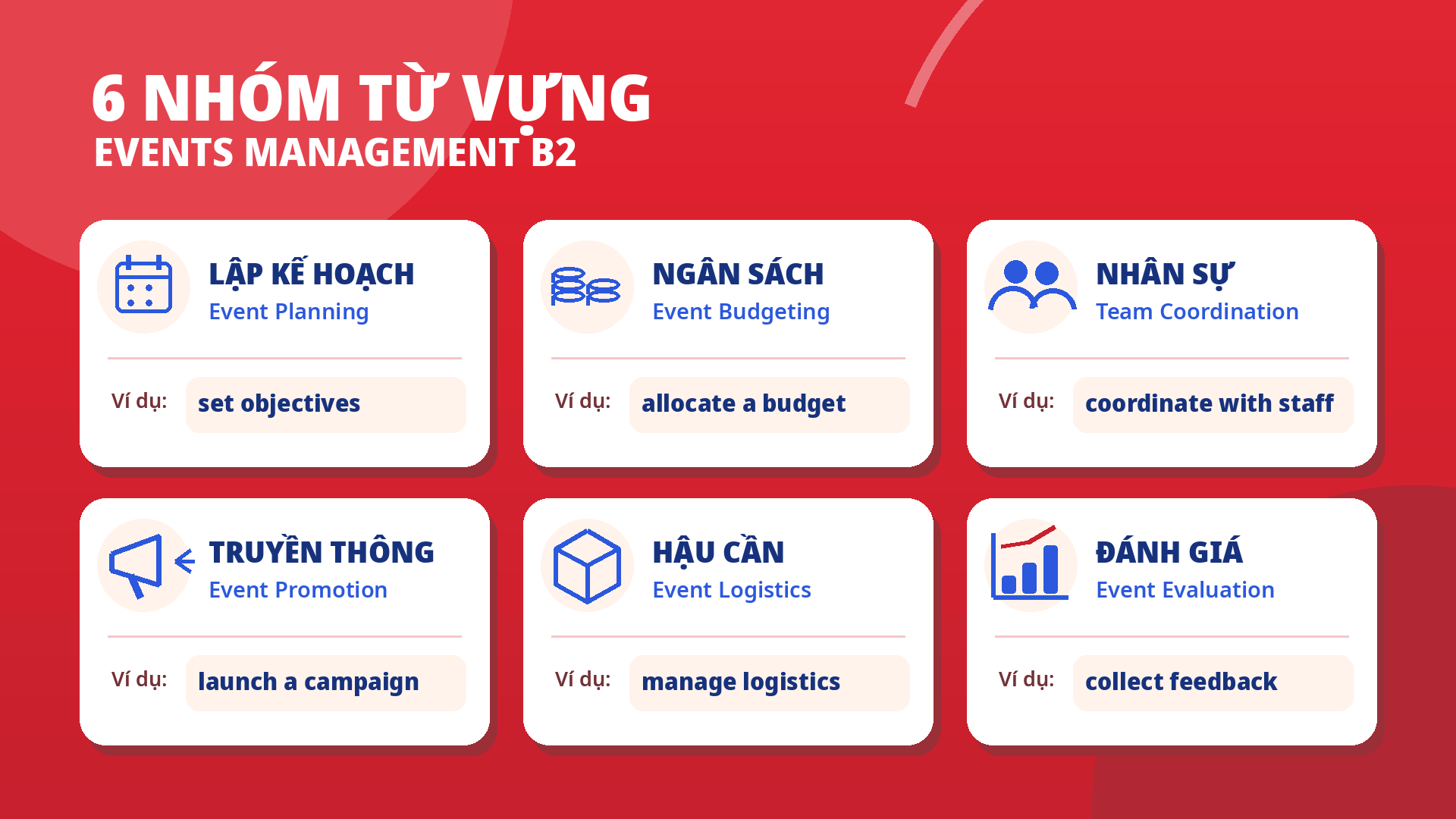
Học từ vựng theo chức năng công việc giúp hình dung được một sự kiện vận hành từ lúc hình thành ý tưởng đến khi hoàn thành báo cáo.
Nhóm 1: Lập kế hoạch và xác định mục tiêu
- Event brief: bản tóm tắt yêu cầu tổ chức sự kiện.
- Event objectives: các mục tiêu cần đạt được.
- Event concept: ý tưởng hoặc chủ đề xuyên suốt sự kiện.
- Target audience: đối tượng mục tiêu.
- Event scope: phạm vi triển khai công việc.
- Stakeholder: bên liên quan.
- Project timeline: tiến độ công việc.
- Milestone: mốc quan trọng.
- Event proposal: bản đề xuất tổ chức.
- Run of show: kịch bản điều hành chi tiết.
Ví dụ:
The event proposal must clearly explain the objectives, target audience, timeline and expected outcomes.
(Bản đề xuất sự kiện phải giải thích rõ mục tiêu, đối tượng, tiến độ và kết quả dự kiến.)
Nhóm 2: Ngân sách và nguồn lực tài chính
- Budget allocation: phân bổ ngân sách.
- Cost estimate: dự toán chi phí.
- Financial constraint: hạn chế tài chính.
- Contingency fund: quỹ dự phòng.
- Sponsorship: sự tài trợ.
- Sponsor: nhà tài trợ.
- Funding proposal: đề xuất xin kinh phí.
- Expense tracking: theo dõi chi phí.
- Cost-effective: hiệu quả về chi phí.
- Return on investment: hiệu quả thu được so với khoản đầu tư.
Ví dụ:
To stay within budget, the committee negotiated with suppliers and selected more cost-effective options.
(Để không vượt ngân sách, ban tổ chức đã thương lượng với các nhà cung cấp và lựa chọn những phương án tiết kiệm hơn.)
Nhóm 3: Điều phối nhân sự và các bên liên quan
- Organizing committee: ban tổ chức.
- Event coordinator: điều phối viên sự kiện.
- Supplier: nhà cung cấp.
- Vendor: đơn vị bán hoặc cung cấp sản phẩm, dịch vụ.
- Contractor: nhà thầu.
- Staff briefing: buổi phổ biến nhiệm vụ.
- Task delegation: việc phân công công việc.
- Volunteer recruitment: tuyển tình nguyện viên.
- Stakeholder communication: giao tiếp với các bên liên quan.
- Cross-functional team: nhóm gồm nhân sự từ nhiều bộ phận.
Ví dụ:
The event coordinator conducted a staff briefing to make sure everyone understood their responsibilities.
(Điều phối viên đã tổ chức buổi phổ biến nhiệm vụ để bảo đảm mọi người hiểu rõ trách nhiệm.)
Nhóm 4: Quảng bá và phát triển người tham dự
- Promotional campaign: chiến dịch quảng bá.
- Outreach strategy: chiến lược tiếp cận đối tượng mục tiêu.
- Registration platform: nền tảng đăng ký.
- Registration deadline: hạn đăng ký.
- Ticket sales: hoạt động bán vé.
- Early-bird offer: ưu đãi đăng ký sớm.
- Attendee engagement: mức độ tương tác của người tham dự.
- Brand exposure: khả năng thương hiệu được nhìn thấy.
- Press release: thông cáo báo chí.
- Media coverage: hoạt động đưa tin của truyền thông.
Ví dụ:
The promotional campaign increased brand exposure and encouraged more students to register for the conference.
(Chiến dịch quảng bá giúp tăng mức độ nhận diện thương hiệu và khuyến khích nhiều sinh viên đăng ký hội nghị.)
Nhóm 5: Quản lý hậu cần và rủi ro
- Venue capacity: sức chứa địa điểm.
- Floor plan: sơ đồ mặt bằng.
- Seating arrangement: cách bố trí chỗ ngồi.
- Audiovisual equipment: thiết bị âm thanh, hình ảnh.
- Technical rehearsal: buổi chạy thử kỹ thuật.
- Crowd management: quản lý đám đông.
- Accessibility: khả năng tiếp cận.
- Contingency plan: phương án dự phòng.
- Risk assessment: đánh giá rủi ro.
- On-site support: hỗ trợ trực tiếp tại sự kiện.
Ví dụ:
The organizing team carried out a risk assessment and prepared a contingency plan for possible technical failures.
(Ban tổ chức đã đánh giá rủi ro và chuẩn bị phương án dự phòng cho những trục trặc kỹ thuật có thể xảy ra.)
Nhóm 6: Đánh giá và cải thiện chất lượng
- Post-event evaluation: đánh giá sau sự kiện.
- Attendee feedback: phản hồi của người tham dự.
- Satisfaction survey: khảo sát mức độ hài lòng.
- Attendance rate: tỷ lệ tham dự.
- Key performance indicator: chỉ số hiệu quả quan trọng.
- Event outcome: kết quả sự kiện.
- Lessons learned: những bài học rút ra.
- Follow-up email: email liên hệ sau sự kiện.
- Improvement plan: kế hoạch cải thiện.
- Event report: báo cáo tổng kết sự kiện.
Ví dụ:
The post-event evaluation showed that attendee engagement was high, but the registration process needed improvement.
(Bản đánh giá sau sự kiện cho thấy mức độ tương tác của người tham dự cao, nhưng quy trình đăng ký cần được cải thiện.)
Word family cần nhớ trong chủ đề Events Management
Word family là nhóm những từ có chung gốc, nhưng có thể đảm nhận các chức năng ngữ pháp khác nhau. Trong tiếng Anh quản lý sự kiện, việc nhận diện đúng từ loại giúp viết email, kế hoạch, báo cáo và bài luận chính xác hơn.
| Từ gốc | Danh từ | Động từ | Tính từ | Trạng từ | Ví dụ ứng dụng |
|---|---|---|---|---|---|
| Organize | organization, organizer | organize | organized, organizational | — | The organizer created a well-organized event schedule. |
| Coordinate | coordination, coordinator | coordinate | coordinated | — | Effective coordination is essential for a successful event. |
| Allocate | allocation | allocate | allocated | — | The allocated budget was sufficient for essential equipment. |
| Promote | promotion, promoter | promote | promotional | — | The team prepared promotional materials for the conference. |
| Register | registration, registrant | register | registered | — | All registered participants received a confirmation email. |
| Sponsor | sponsor, sponsorship | sponsor | sponsored | — | The sponsored event attracted a wider audience. |
| Evaluate | evaluation, evaluator | evaluate | evaluative | — | The evaluation identified several operational weaknesses. |
| Assess | assessment, assessor | assess | assessed | — | The team assessed potential safety risks. |
| Engage | engagement | engage | engaging, engaged | — | Engaging activities encouraged greater audience participation. |
| Plan | plan, planning, planner | plan | planned | — | A carefully planned event is easier to manage. |
Những cách dùng dễ nhầm:
1. Organize – Organizer – Organization
- Organize là động từ chỉ hành động tổ chức.
- Organizer là người hoặc đơn vị tổ chức.
- Organization thường chỉ một tổ chức, cơ quan hoặc hoạt động tổ chức, sắp xếp.
Ví dụ:
The organizers are responsible for organizing the annual conference.
(Những người tổ chức chịu trách nhiệm tổ chức hội nghị thường niên.)
2. Coordinate – Coordination – Coordinator
- Coordinate là động từ chỉ việc phối hợp.
- Coordination là danh từ chỉ sự phối hợp.
- Coordinator là người chịu trách nhiệm điều phối.
Ví dụ:
Good coordination between the technical team and the event coordinator prevented delays.
(Sự phối hợp tốt giữa nhóm kỹ thuật và điều phối viên đã giúp tránh chậm trễ.)
3. Promote – Promotion – Promotional
- Promote là động từ, nghĩa là quảng bá hoặc thúc đẩy.
- Promotion là danh từ chỉ hoạt động quảng bá, xúc tiến.
- Promotional là tính từ, thường dùng trong promotional campaign hoặc promotional materials.
Ví dụ:
The promotional campaign was designed to promote the event.
(Chiến dịch quảng bá được xây dựng nhằm quảng bá sự kiện.)
4. Evaluate – Evaluation
Evaluate là động từ, thường đứng sau chủ ngữ khi mô tả hành động đánh giá. Evaluation là danh từ, thường xuất hiện trong cụm post-event evaluation.
- Đúng: We will evaluate the results.
- Đúng: The evaluation will take place next week.
5. Engage – Engaging – Engaged
- Engage participants: thu hút và khiến người tham gia tương tác.
- Engaging activities: các hoạt động hấp dẫn, có khả năng thu hút.
- Engaged participants: những người tham gia tích cực, có sự quan tâm.
Ví dụ:
The engaging workshop kept participants actively engaged throughout the session.
(Buổi workshop hấp dẫn giúp người tham gia duy trì sự tương tác tích cực trong suốt chương trình.)
Tham khảo thêm: Tính từ trong tiếng Anh – Vị trí, phân loại và cách dùng
Collocations và cụm từ tự nhiên chủ đề Events Management
Collocations là những cách kết hợp từ thường xuyên xuất hiện cùng nhau trong tiếng Anh. Đối với quản lý sự kiện, sử dụng đúng collocations giúp nội dung giao tiếp rõ ràng và mang tính chuyên nghiệp hơn.
| Collocation/Phrase | Nghĩa tiếng Việt | Dùng trong ngữ cảnh nào? | Ví dụ |
|---|---|---|---|
| 1. Set event objectives | Thiết lập mục tiêu sự kiện | Xây dựng kế hoạch | We need to set measurable event objectives. |
| 2. Draw up an event proposal | Soạn thảo bản đề xuất sự kiện | Trình bày phương án cho khách hàng | The team drew up an event proposal for the client. |
| 3. Develop an event concept | Phát triển ý tưởng chủ đạo | Sáng tạo nội dung sự kiện | We developed a concept for an educational conference. |
| 4. Establish a project timeline | Thiết lập tiến độ dự án | Quản lý thời gian | The manager established a realistic project timeline. |
| 5. Meet a milestone | Hoàn thành đúng một cột mốc | Theo dõi tiến độ | We met the first project milestone on time. |
| 6. Allocate a budget | Phân bổ ngân sách | Quản lý tài chính | The company allocated a budget for promotion. |
| 7. Stay within budget | Không vượt ngân sách | Kiểm soát chi phí | We must stay within budget without compromising safety. |
| 8. Secure sponsorship | Nhận được hoặc bảo đảm nguồn tài trợ | Tìm kiếm nhà tài trợ | The committee secured sponsorship from two businesses. |
| 9. Negotiate with suppliers | Thương lượng với nhà cung cấp | Mua sắm và ký hợp đồng | We negotiated with suppliers over equipment costs. |
| 10. Brief the event staff | Phổ biến công việc cho nhân sự | Chuẩn bị trước sự kiện | The coordinator briefed the event staff before opening. |
| 11. Delegate tasks | Giao, phân công nhiệm vụ | Quản lý đội nhóm | The manager delegated tasks according to experience. |
| 12. Coordinate with stakeholders | Phối hợp với các bên liên quan | Giao tiếp dự án | We coordinated with stakeholders throughout the planning process. |
| 13. Launch a promotional campaign | Triển khai chiến dịch quảng bá | Truyền thông sự kiện | The organizers launched a promotional campaign in September. |
| 14. Boost ticket sales | Tăng doanh số bán vé | Đánh giá hoạt động quảng bá | Early-bird offers helped boost ticket sales. |
| 15. Confirm registrations | Xác nhận đăng ký | Quản lý danh sách khách | The team confirmed all registrations by email. |
| 16. Maximise attendee engagement | Tối đa hóa tương tác của người tham dự | Thiết kế trải nghiệm sự kiện | Interactive sessions can maximise attendee engagement. |
| 17. Check venue capacity | Kiểm tra sức chứa địa điểm | Lựa chọn địa điểm | Check venue capacity before selling tickets. |
| 18. Finalise the floor plan | Hoàn thiện sơ đồ mặt bằng | Bố trí không gian | We finalised the floor plan with the venue manager. |
| 19. Conduct a technical rehearsal | Tiến hành chạy thử kỹ thuật | Chuẩn bị vận hành | The team conducted a technical rehearsal before the show. |
| 20. Carry out a risk assessment | Tiến hành đánh giá rủi ro | An toàn và quản trị rủi ro | The safety team carried out a detailed risk assessment. |
| 21. Put a contingency plan in place | Thiết lập phương án dự phòng | Xử lý tình huống bất ngờ | We put a contingency plan in place for severe weather. |
| 22. Collect attendee feedback | Thu thập phản hồi người tham dự | Khảo sát sau sự kiện | We collected attendee feedback using an online survey. |
| 23. Evaluate event outcomes | Đánh giá kết quả sự kiện | Tổng kết hiệu quả | The manager evaluated the event outcomes against the objectives. |
| 24. Compile a post-event report | Tổng hợp báo cáo sau sự kiện | Báo cáo cho khách hàng hoặc quản lý | The team compiled a post-event report within a week. |
Paraphrase các cụm từ quan trọng ở B2
Khi diễn đạt cùng một nội dung bằng nhiều cách, người học cần chú ý sự tương đương về nghĩa và sắc thái.
| Cách diễn đạt ban đầu | Paraphrase phù hợp | Khác biệt cần chú ý |
|---|---|---|
| Organize an event | Plan and coordinate an event | Cách thứ hai nhấn mạnh quá trình lập kế hoạch và phối hợp. |
| Reduce expenses | Cut costs | Reduce expenses phù hợp với báo cáo; cut costs trực tiếp và thông dụng hơn. |
| Attract more attendees | Increase event turnout | Turnout nhấn mạnh số người thực tế đến tham dự. |
| Prepare for unexpected problems | Develop contingency plans | Cách thứ hai nhấn mạnh việc xây dựng phương án dự phòng. |
| Check whether the event was successful | Evaluate event outcomes | Cách thứ hai phù hợp với báo cáo và đánh giá chuyên nghiệp. |
Ví dụ:
- We need to reduce expenses without affecting event quality.
- We need to cut costs while maintaining event quality.
Hai câu đều đề cập đến việc giảm chi phí nhưng không làm suy giảm chất lượng sự kiện.
Đặc biệt, cut costs không đồng nghĩa với cut corners. Cut corners thường mang nghĩa tiêu cực: bỏ qua những bước cần thiết để tiết kiệm thời gian hoặc tiền bạc, có thể làm ảnh hưởng đến chất lượng hoặc an toàn.
Lỗi sai thường gặp khi dùng từ vựng Events Management
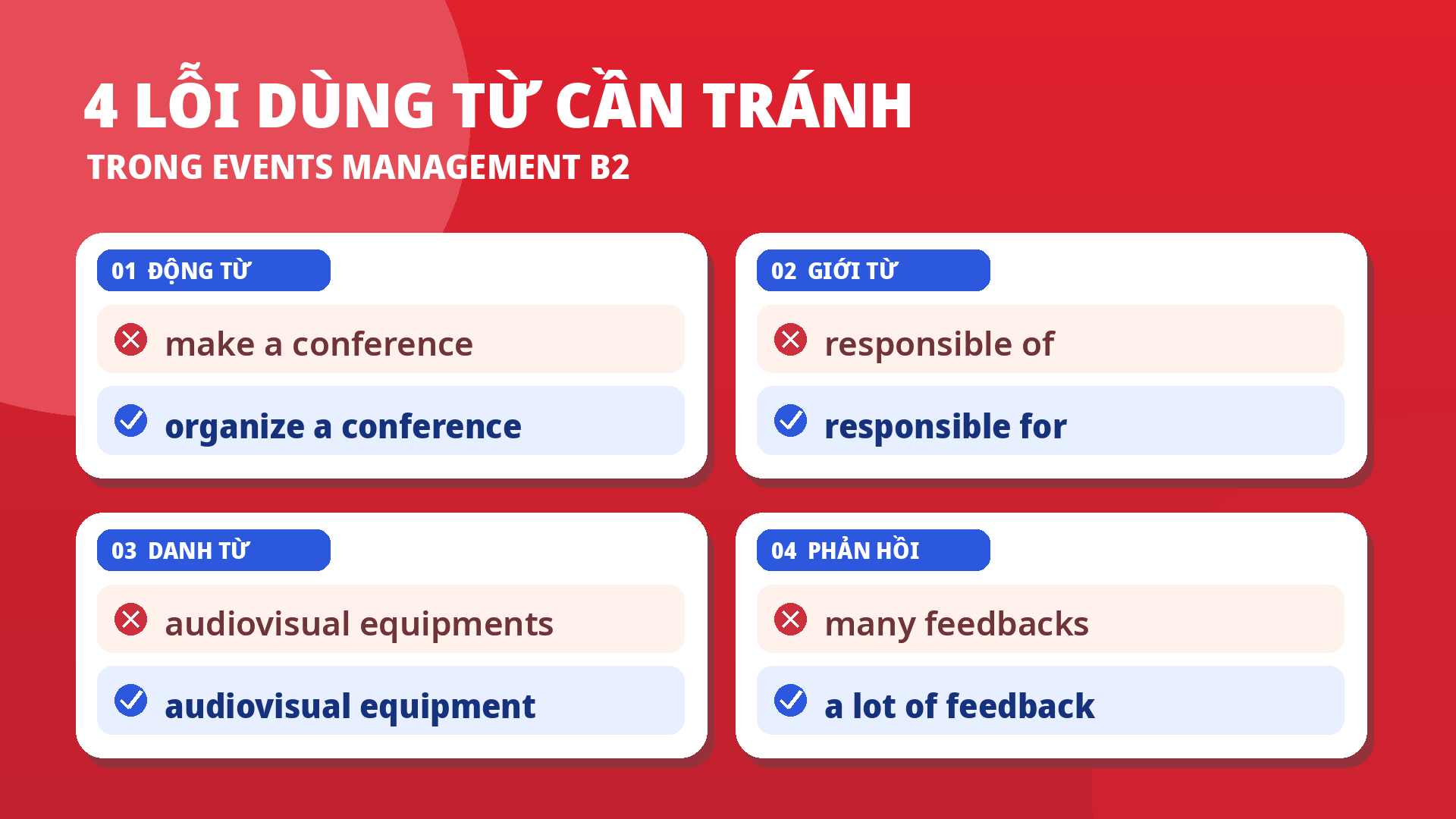
1. Dùng sai động từ khi nói về việc tổ chức sự kiện
- Câu sai: Our company will make a conference next month.
- Câu đúng: Our company will organize a conference next month.
- Giải thích: Khi nói về việc tổ chức hội nghị, sự kiện hoặc workshop, những động từ thông dụng là organize, hold và host. Không dùng make a conference theo cách dịch trực tiếp từ tiếng Việt.
2. Thêm giới từ không cần thiết sau attend
- Câu sai: More than 200 students attended to the workshop.
- Câu đúng: More than 200 students attended the workshop.
- Giải thích: Attend đi trực tiếp với danh từ chỉ sự kiện. Attend to có nghĩa khác, thường là chú ý hoặc xử lý một vấn đề, nhu cầu nào đó.
Ví dụ: The technician attended to a technical problem.
3. Nhầm responsible of với responsible for
- Câu sai: The coordinator is responsible of managing volunteers.
- Câu đúng: The coordinator is responsible for managing volunteers.
- Giải thích: Cấu trúc đúng là be responsible for + noun/V-ing. Đây là cách diễn đạt rất phổ biến khi nói về nhiệm vụ trong công việc.
4. Sử dụng feedback như danh từ đếm được
- Câu sai: We collected many feedbacks after the event.
- Câu đúng: We collected a lot of feedback after the event.
- Giải thích: Feedback thường là danh từ không đếm được. Khi muốn đề cập đến từng phản hồi, sử dụng pieces of feedback, comments hoặc responses tùy ngữ cảnh.
5. Dùng sai collocation với budget
- Câu sai: The team made a budget to the marketing department.
- Câu đúng: The team allocated a budget to the marketing department.
- Giải thích: Allocate a budget to là phân bổ ngân sách cho một bộ phận hoặc mục đích. Prepare a budget nghĩa là lập dự toán ngân sách, không đồng nghĩa với phân bổ tiền.
6. Nhầm equipment với equipments
- Câu sai: The venue does not have enough audiovisual equipments.
- Câu đúng: The venue does not have enough audiovisual equipment.
- Giải thích: Equipment là danh từ không đếm được trong tiếng Anh thông dụng. Khi nói về các thiết bị riêng lẻ, sử dụng pieces of equipment hoặc tên thiết bị cụ thể.
7. Nhầm động từ evaluate với danh từ evaluation
- Câu sai: We will conduct an evaluate after the conference.
- Câu đúng: We will conduct an evaluation after the conference.
- Câu đúng: We will evaluate the conference after it ends.
- Giải thích: Conduct đi với danh từ evaluation. Khi sử dụng động từ evaluate, không cần thêm conduct.
8. Sử dụng văn phong quá trực tiếp trong email công việc
- Câu kém phù hợp: Send me the final schedule ASAP.
- Câu phù hợp hơn: Could you please send me the final schedule at your earliest convenience?
- Giải thích: Câu đầu không sai ngữ pháp nhưng có thể tạo cảm giác thúc ép. Trong email gửi đối tác hoặc khách hàng, cấu trúc yêu cầu lịch sự giúp giao tiếp chuyên nghiệp hơn. Nếu có thời hạn cụ thể, cách diễn đạt rõ ràng hơn là Could you please send me the final schedule by 3 p.m. on Friday?
Việc phân biệt lỗi ngữ pháp, từ loại và collocations giúp người học tránh diễn đạt thiếu tự nhiên, đặc biệt khi viết email điều phối công việc hoặc báo cáo sự kiện.
Tham khảo thêm: Bộ từ vựng Collocations tiếng Anh và cách kết hợp từ tự nhiên
Phân biệt các từ dễ nhầm trong chủ đề Events Management
Một số thuật ngữ trong quản lý sự kiện có nghĩa gần nhau nhưng không thể thay thế hoàn toàn. Nắm được sự khác biệt giúp chọn từ chính xác theo ngữ cảnh.
| Từ dễ nhầm | Khác nhau thế nào? | Ví dụ đúng |
|---|---|---|
| Event – Occasion | Event là một sự kiện hoặc hoạt động diễn ra, thường có thể được lên kế hoạch. Occasion nhấn mạnh một dịp hoặc hoàn cảnh đặc biệt. | The company organized a networking event to celebrate a special occasion. |
| Venue – Location | Venue là địa điểm được chọn để tổ chức một hoạt động. Location chỉ vị trí địa lý nói chung. | The venue is a conference hall in a convenient central location. |
| Attendee – Participant | Attendee là người có mặt tại sự kiện. Participant nhấn mạnh người trực tiếp tham gia một hoạt động, thảo luận hoặc chương trình. | The conference attracted 300 attendees, including 80 workshop participants. |
| Sponsor – Supplier | Sponsor cung cấp tiền hoặc nguồn lực để hỗ trợ sự kiện, thường đổi lấy quyền lợi tài trợ. Supplier cung cấp hàng hóa hoặc dịch vụ, thường theo thỏa thuận mua bán. | The sponsor funded the conference, while the supplier provided the equipment. |
| Schedule – Agenda – Run of show | Schedule thể hiện thời gian các hoạt động. Agenda liệt kê nội dung và thứ tự chủ đề, đặc biệt trong cuộc họp hoặc hội nghị. Run of show là kịch bản điều hành chi tiết cho ekip sản xuất sự kiện. | The agenda lists the topics, while the run of show includes technical cues. |
| Postpone – Reschedule – Cancel | Postpone là hoãn đến thời điểm muộn hơn. Reschedule là sắp xếp lại lịch, có thể sớm hoặc muộn hơn. Cancel là hủy bỏ. | We postponed the event until Friday and rescheduled the speakers’ sessions. |
| Funding – Sponsorship | Funding là nguồn tiền hỗ trợ hoặc tài trợ cho hoạt động. Sponsorship là hình thức tài trợ, có thể bao gồm tiền, hiện vật hoặc dịch vụ, thường gắn với quyền lợi của nhà tài trợ. | The event received university funding and additional corporate sponsorship. |
| Outcome – Output | Output là sản phẩm hoặc kết quả trực tiếp tạo ra, chẳng hạn số buổi workshop đã tổ chức. Outcome là kết quả hoặc thay đổi đạt được, chẳng hạn mức độ kiến thức hoặc sự hài lòng tăng lên. | The main output was three workshops, while the desired outcome was greater awareness of sustainability. |
Lưu ý về sắc thái nghĩa
Trong báo cáo công việc, cần phân biệt kết quả hoạt động với tác động thực tế.
Ví dụ:
The event attracted 500 attendees.
Câu này mô tả số lượng người tham dự, một chỉ số đầu ra hoặc mức độ tham dự.
The event helped participants develop a better understanding of environmental issues.
Câu này tập trung vào kết quả về nhận thức mà chương trình mong muốn tạo ra.
Tương tự, high attendance không tự động có nghĩa là high attendee satisfaction. Một sự kiện đông người vẫn có thể nhận đánh giá chưa tích cực về nội dung, quy trình đăng ký hoặc khâu tổ chức.
Đoạn mẫu sử dụng từ vựng Events Management level B2
Situation: Organizing a university career networking event
A university communications club is preparing a career networking event for final-year students. The organizing committee begins by identifying the target audience and setting clear event objectives. After developing an event proposal, the team establishes a project timeline and reviews the budget allocation.
To reduce expenses, the coordinator negotiates with suppliers and seeks sponsorship from local businesses. Meanwhile, the marketing team launches a promotional campaign to increase registrations.
As the event approaches, the organizers conduct a technical rehearsal and carry out a risk assessment. They also prepare a contingency plan in case a speaker becomes unavailable or technical equipment fails.
Following the event, the team collects attendee feedback through an online survey. A post-event evaluation helps determine whether the original objectives were achieved. The organizers then compile an event report and identify improvements for future activities.
Giải thích nhanh các từ và cụm từ nổi bật:
- Organizing committee: ban tổ chức, nhóm chịu trách nhiệm điều hành chung.
- Target audience: nhóm đối tượng mà sự kiện hướng đến.
- Event objectives: những mục tiêu cụ thể cần đạt được.
- Event proposal: bản đề xuất trình bày ý tưởng, nội dung và phương án tổ chức.
- Project timeline: tiến độ công việc theo từng giai đoạn.
- Budget allocation: việc phân bổ ngân sách cho các hạng mục.
- Sponsorship: sự hỗ trợ hoặc tài trợ cho sự kiện.
- Promotional campaign: chiến dịch truyền thông quảng bá.
- Technical rehearsal: buổi kiểm tra, chạy thử thiết bị và quy trình kỹ thuật.
- Risk assessment: quá trình xác định, đánh giá rủi ro.
- Contingency plan: phương án dự phòng khi xuất hiện tình huống bất ngờ.
- Attendee feedback: ý kiến, đánh giá của người tham dự.
- Post-event evaluation: hoạt động tổng kết, phân tích hiệu quả sau sự kiện.
Đoạn văn sử dụng trình tự công việc thực tế, từ lập kế hoạch đến đánh giá, đồng thời kết hợp các cấu trúc phù hợp B2:
- Begin by + V-ing: bắt đầu bằng việc thực hiện một hoạt động.
- To + infinitive: diễn đạt mục đích.
- In case + clause: đề cập đến tình huống có thể xảy ra.
- Whether + clause: diễn đạt sự không chắc chắn hoặc việc kiểm tra một điều có đúng hay không.
Cách viết này cũng giúp hình thành một đoạn báo cáo ngắn, có sự liên kết và thể hiện rõ trình tự công việc.
Bài tập từ vựng Events Management level B2
Năm bài tập giúp kiểm tra khả năng nhận biết nghĩa từ, sử dụng collocations, lựa chọn từ trong câu, đọc hiểu theo ngữ cảnh và vận dụng tiếng Anh vào tình huống thực tế.
Task 1: Match words with meanings
Nối từ hoặc cụm từ ở cột A với nghĩa phù hợp ở cột B.
| Cột A | Cột B |
|---|---|
| 1. Event brief | A. Việc đánh giá các rủi ro có thể xảy ra |
| 2. Budget allocation | B. Kịch bản điều hành chi tiết |
| 3. Stakeholder | C. Nguồn lực được cung cấp để tài trợ sự kiện |
| 4. Contingency plan | D. Việc phân bổ ngân sách |
| 5. Attendee engagement | E. Bản tóm tắt yêu cầu tổ chức sự kiện |
| 6. Venue capacity | F. Một bên có liên quan đến hoạt động hoặc dự án |
| 7. Risk assessment | G. Mức độ tương tác của người tham dự |
| 8. Sponsorship | H. Phương án dự phòng khi có sự cố |
| 9. Post-event evaluation | I. Sức chứa của địa điểm tổ chức |
| 10. Run of show | J. Hoạt động đánh giá sau sự kiện |
Task 2: Fill in the blanks
Điền từ hoặc cụm từ thích hợp vào chỗ trống. Mỗi đáp án được sử dụng một lần.
Word bank: allocate – coordinate – contingency plan – sponsorship – promotional campaign – registration deadline – technical rehearsal – venue capacity – attendee feedback – post-event evaluation
- The organizers need to __________ sufficient funds for marketing and equipment.
- The company secured __________ from three local businesses to support the conference.
- Before confirming ticket sales, the team must check the __________ of the main hall.
- The event coordinator will __________ with suppliers to ensure that all equipment arrives on time.
- We launched a __________ on social media to attract more participants.
- The __________ is Friday, so all participants must complete the online form before then.
- The organizing committee prepared a __________ in case the outdoor venue became unavailable.
- The production team conducted a __________ to test microphones, lighting and presentation slides.
- The team collected __________ to understand which sessions participants enjoyed most.
- A detailed __________ helped the organizers identify strengths and weaknesses after the conference.
Task 3: Choose the correct answer
Chọn A, B, C hoặc D để hoàn thành câu.
1. The committee decided to ______ a larger budget to the technical department.
A. deliver
B. allocate
C. attend
D. postpone
2. The event coordinator is responsible ______ managing volunteers and suppliers.
A. of
B. on
C. for
D. with
3. The conference was ______ until the following week because the venue was unavailable.
A. postponed
B. sponsored
C. evaluated
D. promoted
4. The company wants to ______ sponsorship from several potential partners.
A. make
B. attend
C. conduct
D. secure
5. All audiovisual ______ must be tested before the opening ceremony.
A. equipments
B. equipment
C. equip
D. equipped
6. The team conducted a ______ to identify possible safety issues.
A. promotional campaign
B. registration platform
C. risk assessment
D. funding proposal
7. The new online registration platform is designed to improve attendee ______.
A. engagement
B. engaged
C. engaging
D. engage
8. The communications team issued a press ______ before the event.
A. coverage
B. management
C. rehearsal
D. release
9. We received valuable ______ from participants after the workshop.
A. feedbacks
B. feedback
C. a feedbacks
D. many feedback
10. The organizers will carry ______ a post-event evaluation next week.
A. to
B. at
C. out
D. with
Task 4: Vocabulary in context
Đọc đoạn văn và trả lời năm câu hỏi.
Reading passage: Managing an unexpected event disruption
A university planned to host a technology conference for students and local businesses. The organizing committee had already finalised the programme, confirmed the speakers and launched a promotional campaign.
However, two days before the event, the main venue reported a technical problem with its sound system. Rather than cancelling the conference, the event coordinator reviewed the contingency plan and contacted an alternative supplier.
The team carried out a technical rehearsal the following morning to ensure that the replacement equipment worked properly. Organizers also informed speakers about the revised preparation schedule.
Despite the disruption, the conference took place as planned. Afterwards, the committee collected attendee feedback and conducted a post-event evaluation. The feedback highlighted the team’s responsiveness but also suggested that clearer instructions at the registration desk would improve future events.
Questions
1. What caused the unexpected disruption?
A. A lack of sponsorship
B. A problem with the sound system
C. Low ticket sales
D. A speaker’s cancellation
2. What does contingency plan most nearly mean in the passage?
A. A list of invited guests
B. A promotional strategy
C. A financial report
D. A backup plan for unexpected situations
3. Why did the team conduct a technical rehearsal?
A. To check whether the replacement equipment worked
B. To attract additional sponsors
C. To change the event’s main objectives
D. To calculate the total expenses
4. Which phrase is closest in meaning to the team’s responsiveness?
A. The team’s ability to reduce event costs
B. The team’s willingness to cancel the conference
C. The team’s ability to respond quickly and appropriately
D. The team’s ability to attract media attention
5. Which improvement did participants suggest?
A. More expensive tickets
B. Clearer registration instructions
C. Fewer conference speakers
D. A different event concept
Task 5: Application practice
Sử dụng từ vựng và collocations đã học để trả lời năm câu hỏi. Mỗi câu trả lời cần có ý chính, giải thích và ví dụ phù hợp.
1. IELTS Speaking Part 2 – Describe an event you helped organize
You should say:
- What the event was.
- Who was involved in organizing it.
- What responsibilities you had.
- What challenges you faced and how you dealt with them.
Yêu cầu: Sử dụng ít nhất 4 cụm trong nhóm organizing committee, coordinate with, project timeline, contingency plan, event outcomes.
2. IELTS Speaking Part 3 – Event organization
What factors contribute most to the success of a large public event?
Yêu cầu: Phân tích ít nhất hai yếu tố và sử dụng risk assessment, attendee engagement, budget allocation hoặc stakeholder communication.
3. VSTEP Writing – Professional email
Your organization is planning a seminar, but the original venue is no longer available. Write an email to your manager explaining the problem and proposing a solution.
Yêu cầu: Viết khoảng 100–120 từ, sử dụng venue, contingency plan, alternative supplier và revised schedule.
4. Workplace communication – Event planning meeting
Your manager asks how to reduce event costs without affecting the quality of the programme. Present three practical suggestions.
Yêu cầu: Sử dụng ít nhất 3 cụm trong stay within budget, negotiate with suppliers, allocate resources, cost-effective solutions.
5. IELTS/VSTEP Discussion – Measuring event success
Do you think the number of attendees is the best way to measure the success of an event? Why or why not?
Yêu cầu: Trình bày quan điểm, phân tích ít nhất hai tiêu chí đánh giá và sử dụng attendance rate, attendee feedback, event objectives và post-event evaluation.
Tham khảo thêm: Từ vựng Customer Experience B2 về phản hồi, đánh giá và trải nghiệm khách hàng
Đáp án bài tập từ vựng Events Management level B2
Task 1: Match words with meanings
| Câu | Đáp án |
|---|---|
| 1 | E |
| 2 | D |
| 3 | F |
| 4 | H |
| 5 | G |
| 6 | I |
| 7 | A |
| 8 | C |
| 9 | J |
| 10 | B |
Task 2: Fill in the blanks
| Câu | Đáp án | Giải thích |
|---|---|---|
| 1 | allocate | Allocate funds nghĩa là phân bổ nguồn tiền cho một mục đích cụ thể. |
| 2 | sponsorship | Secure sponsorship là nhận được hoặc bảo đảm nguồn tài trợ. |
| 3 | venue capacity | Chỉ sức chứa tối đa của địa điểm tổ chức. |
| 4 | coordinate | Coordinate with suppliers nghĩa là phối hợp với các nhà cung cấp. |
| 5 | promotional campaign | Chỉ chiến dịch quảng bá nhằm thu hút người tham gia. |
| 6 | registration deadline | Là hạn chót hoàn tất việc đăng ký. |
| 7 | contingency plan | Là phương án dự phòng khi xuất hiện tình huống bất ngờ. |
| 8 | technical rehearsal | Chỉ hoạt động chạy thử và kiểm tra hệ thống kỹ thuật. |
| 9 | attendee feedback | Là những phản hồi từ người tham dự. |
| 10 | post-event evaluation | Chỉ hoạt động đánh giá hiệu quả sau khi sự kiện kết thúc. |
Giải thích các câu dễ nhầm:
Câu 1 sử dụng allocate thay vì spend vì hành động được nhấn mạnh là phân bổ tiền cho từng hạng mục, không phải trực tiếp chi tiêu.
Câu 4 sử dụng coordinate with để nói về việc phối hợp giữa các bên. Cấu trúc này khác với coordinate an event, nghĩa là trực tiếp điều phối sự kiện.
Câu 7 cần contingency plan vì nội dung đề cập đến việc chuẩn bị giải pháp trong trường hợp địa điểm không còn sử dụng được.
Câu 10 sử dụng post-event evaluation thay vì attendee feedback vì yêu cầu là đánh giá toàn diện những điểm mạnh và điểm yếu của sự kiện.
Task 3: Choose the correct answer
| Câu | Đáp án | Giải thích |
|---|---|---|
| 1 | B. allocate | Allocate a budget to a department là phân bổ ngân sách cho một bộ phận. |
| 2 | C. for | Cấu trúc đúng là be responsible for + V-ing. |
| 3 | A. postponed | Postpone until diễn tả việc hoãn một hoạt động đến thời điểm muộn hơn. |
| 4 | D. secure | Secure sponsorship nghĩa là bảo đảm hoặc nhận được tài trợ. |
| 5 | B. equipment | Equipment là danh từ không đếm được trong cách dùng thông thường. |
| 6 | C. risk assessment | Conduct a risk assessment là tiến hành đánh giá rủi ro. |
| 7 | A. engagement | Sau attendee cần danh từ engagement. |
| 8 | D. release | Press release là thông cáo báo chí. |
| 9 | B. feedback | Feedback không dùng dạng số nhiều feedbacks trong trường hợp này. |
| 10 | C. out | Carry out an evaluation nghĩa là tiến hành hoạt động đánh giá. |
Giải thích thêm:
- Câu 3: Postponed đúng vì hội nghị được chuyển đến tuần sau. Sponsored liên quan đến tài trợ, còn promoted liên quan đến quảng bá.
- Câu 5: Không sử dụng equipments. Nếu cần đếm từng thiết bị, dùng pieces of equipment.
- Câu 7: Engagement là danh từ. Engaging là tính từ diễn tả sự hấp dẫn, còn engaged miêu tả trạng thái quan tâm hoặc tham gia tích cực.
- Câu 8: Media coverage là việc truyền thông đưa tin; press release là thông cáo báo chí do một tổ chức phát hành.
- Câu 10: Carry out là cụm động từ mang nghĩa tiến hành hoặc thực hiện một hoạt động có kế hoạch.
Task 4: Vocabulary in context
1. B. A problem with the sound system
Giải thích: Đoạn đọc nêu rõ địa điểm chính gặp sự cố với hệ thống âm thanh hai ngày trước hội nghị.
2. D. A backup plan for unexpected situations
Giải thích: Contingency plan là kế hoạch dự phòng cho những tình huống không mong đợi. Trong đoạn văn, ban tổ chức sử dụng kế hoạch này để xử lý vấn đề kỹ thuật.
3. A. To check whether the replacement equipment worked
Giải thích: Buổi chạy thử được tổ chức để kiểm tra thiết bị thay thế trước khi hội nghị bắt đầu.
4. C. The team’s ability to respond quickly and appropriately
Giải thích: Responsiveness diễn tả khả năng phản ứng và đáp ứng nhanh chóng, phù hợp khi xuất hiện yêu cầu hoặc vấn đề mới.
5. B. Clearer registration instructions
Giải thích: Phản hồi sau sự kiện chỉ ra rằng những hướng dẫn tại bàn đăng ký cần rõ ràng hơn.
Từ vựng mở rộng trong đoạn đọc:
- Unexpected disruption: sự gián đoạn bất ngờ.
- Replacement equipment: thiết bị thay thế.
- Revised schedule: lịch trình đã được điều chỉnh.
- Despite the disruption: mặc dù có sự gián đoạn.
- Highlight a problem: làm nổi bật hoặc chỉ ra một vấn đề.
Task 5: Application practice – Bài trả lời mẫu
Đối với Task 5, các câu hỏi mở không có duy nhất một đáp án đúng. Những đoạn mẫu sau thể hiện cách triển khai ý và sử dụng từ vựng phù hợp với B2.
1. IELTS Speaking Part 2 – Describe an event you helped organize
Sample answer:
One event I would like to describe is a career workshop that I helped organize at university.
I was part of the organizing committee, and my main responsibility was coordinating with speakers and volunteers. We established a project timeline to make sure all preparations were completed on schedule.
One major challenge was that a guest speaker became unavailable shortly before the event. Fortunately, we had prepared a contingency plan, so we quickly contacted another speaker and revised the programme.
Overall, the event went smoothly, and the participants seemed satisfied with the activities. It was a valuable experience because I learned how important teamwork and effective communication are in event management.
Các cụm từ B2 được sử dụng:
Organizing committee, coordinating with, project timeline, contingency plan, revised the programme, went smoothly.
2. IELTS Speaking Part 3 – What makes a public event successful?
Sample answer:
I believe successful event management depends on several factors, particularly careful planning and effective communication.
First, organizers need to carry out a risk assessment to identify potential problems. This allows them to prepare suitable solutions before the event takes place.
Second, attendee engagement is essential because a well-organized event should provide meaningful experiences rather than simply attract a large audience.
Finally, effective budget allocation ensures that important activities receive sufficient resources without unnecessary spending.
Các cụm từ B2 được sử dụng:
Careful planning, risk assessment, attendee engagement, budget allocation, sufficient resources.
3. VSTEP Writing – Email about a venue problem
Sample answer:
Subject: Venue Change for the Upcoming Seminar
Dear Ms. Brown,
I am writing to inform you that our original venue is no longer available due to an unexpected technical issue.
Fortunately, we have already reviewed our contingency plan and identified an alternative venue near the university. The new location can accommodate all registered participants and provides the necessary audiovisual equipment.
We have also contacted an alternative supplier to arrange additional technical support if required.
I propose confirming the new venue today so that we can inform speakers and participants without delay. The revised schedule will remain largely unchanged.
Please let me know if you approve this arrangement.
Best regards,
Minh
Các cụm từ B2 được sử dụng:
Original venue, unexpected technical issue, contingency plan, alternative venue, audiovisual equipment, alternative supplier, revised schedule.
4. Workplace communication – How to reduce event costs
Sample answer:
To reduce event costs while maintaining quality, I would recommend three measures.
First, we should negotiate with suppliers to obtain better prices for equipment and catering services.
Second, the team could use digital invitations and online registration forms as cost-effective solutions.
Finally, we should allocate resources according to the event’s main objectives. This would help us stay within budget while protecting the quality of essential activities.
Các cụm từ B2 được sử dụng:
Negotiate with suppliers, cost-effective solutions, allocate resources, stay within budget.
5. IELTS/VSTEP Discussion – Is attendance the best measure of success?
Sample answer:
In my opinion, attendance rate is an important indicator of event success, but it should not be the only criterion.
A large audience does not necessarily mean that participants enjoyed the programme or gained valuable knowledge.
For this reason, organizers should collect attendee feedback and compare the event outcomes with the original objectives.
A post-event evaluation can provide a more complete picture of performance by considering participant satisfaction, learning outcomes and financial efficiency.
Các cụm từ B2 được sử dụng:
Attendance rate, indicator of success, attendee feedback, event outcomes, original objectives, post-event evaluation.
Ứng dụng từ vựng Events Management level B2 vào giao tiếp và bài thi
Từ vựng Events Management không chỉ phục vụ người làm công việc tổ chức sự kiện mà còn được ứng dụng trong giao tiếp công sở, thuyết trình, trao đổi nhóm và một số dạng bài thi tiếng Anh.
| Mục tiêu học | Cách ứng dụng | Ví dụ |
|---|---|---|
| Giao tiếp hằng ngày và công việc | Trao đổi về kế hoạch workshop, hoạt động câu lạc bộ, hội nghị hoặc chương trình cộng đồng | We need to finalise the schedule and coordinate with volunteers before the event. |
| IELTS Speaking/Writing | Mô tả một sự kiện đáng nhớ, thảo luận về hoạt động cộng đồng, vai trò của lễ hội hoặc các yếu tố tạo nên sự kiện thành công | Public events can strengthen community relationships when they are carefully planned and accessible to everyone. |
| TOEIC Reading/Listening | Đọc email, lịch trình, thông báo thay đổi địa điểm, yêu cầu từ nhà cung cấp và nghe cuộc trao đổi về chuẩn bị hội nghị | Due to technical difficulties, the conference has been rescheduled for Friday. |
| VSTEP Speaking/Writing | Trình bày kế hoạch tổ chức hoạt động, thảo luận giải pháp, viết email thay đổi lịch hoặc giải thích một vấn đề phát sinh | We have arranged an alternative venue and prepared a contingency plan to avoid further disruption. |
Ứng dụng vào IELTS Speaking
Với IELTS Speaking Part 2, chủ đề liên quan đến sự kiện có thể xuất hiện dưới dạng mô tả một hoạt động đã tham gia, một lễ hội hoặc một chương trình đáng nhớ.
Cấu trúc triển khai:
Event → Responsibilities → Challenges → Solutions → Outcomes
Ví dụ:
I helped organize a university workshop. My responsibilities included coordinating with volunteers and managing registrations. Although we faced several technical challenges, the contingency plan allowed us to resolve the issues quickly. Overall, the event achieved its objectives.
Ở Part 3, người học có thể mở rộng sang những vấn đề như giá trị của sự kiện cộng đồng, việc sử dụng ngân sách công cho lễ hội hoặc tác động kinh tế của các hoạt động văn hóa.
Ví dụ:
Public events can generate economic benefits for local communities. However, organizers should also consider environmental impacts and financial constraints.
Ứng dụng vào IELTS Writing
Events Management có thể hỗ trợ các bài viết về hoạt động văn hóa, cộng đồng, giáo dục và chi tiêu công.
Ví dụ:
Although large cultural events can attract tourists and generate revenue, careful budget allocation and effective crowd management are essential to ensure their long-term benefits.
(Mặc dù các sự kiện văn hóa quy mô lớn có thể thu hút khách du lịch và tạo doanh thu, việc phân bổ ngân sách hợp lý và quản lý đám đông hiệu quả vẫn rất cần thiết để bảo đảm lợi ích lâu dài.)
Ứng dụng vào TOEIC Reading và Listening
Trong TOEIC, từ vựng liên quan đến tổ chức sự kiện phù hợp với ngữ cảnh công việc như hội nghị, cuộc họp, lịch trình, đăng ký tham dự và thay đổi địa điểm.
Ví dụ trong email:
Please confirm your attendance by Thursday. The organizing committee will send the final agenda and venue details once all registrations have been processed.
Khi đọc, cần xác định:
- Purpose: Mục đích của email là gì?
- Deadline: Thời hạn được đề cập là khi nào?
- Action required: Người nhận phải thực hiện hành động gì?
- Change: Có thông tin hoặc lịch trình nào được điều chỉnh không?
Các kỹ năng này liên quan trực tiếp đến việc xử lý thông báo, email và tài liệu công việc trong TOEIC Reading, đồng thời hỗ trợ nhận diện thông tin chính trong các đoạn hội thoại và thông báo ở phần Listening.
Ứng dụng vào VSTEP Speaking/Writing
Ở VSTEP Speaking, người học có thể gặp tình huống cần lựa chọn phương án tổ chức một hoạt động và giải thích lý do.
Ví dụ:
I would choose the university auditorium because it offers sufficient seating capacity, modern audiovisual equipment and convenient access for participants.
Trong VSTEP Writing, các từ như venue, revised schedule, contingency plan và confirm attendance rất hữu ích khi viết email thông báo thay đổi hoặc giải quyết vấn đề.
Đối với dạng bài nêu quan điểm, những cấu trúc sau giúp phát triển lập luận rõ ràng:
- One important consideration is…
- Another factor worth considering is…
- This approach would allow organizers to…
- As a result, the event could…
Tham khảo thêm: Bộ từ vựng IELTS Reading theo chủ đề và cách nhận diện paraphrase
FAQ về từ vựng Events Management level B2
1. Chủ đề Events Management ở trình độ B2 cần học bao nhiêu từ?
Khoảng 50–65 từ và cụm từ trọng tâm là phạm vi phù hợp cho một bài học chuyên đề B2. Với 60 mục trong bài này, người học tiếp cận được các giai đoạn từ lập kế hoạch, vận hành đến đánh giá sự kiện. Khả năng sử dụng từ đúng ngữ cảnh quan trọng hơn việc chỉ ghi nhớ số lượng.
2. Events và Events Management có khác nhau không?
Có. Events tập trung vào các loại sự kiện, hoạt động diễn ra và trải nghiệm của người tham dự. Events Management tập trung vào công việc tổ chức, bao gồm lập kế hoạch, quản lý ngân sách, điều phối nhân sự, hậu cần và đánh giá hiệu quả.
3. Có cần học collocations khi học Events Management B2 không?
Có. Những cụm như allocate a budget, coordinate with suppliers, conduct a risk assessment và evaluate event outcomes giúp người học diễn đạt tự nhiên hơn trong giao tiếp công việc và các bài thi yêu cầu trình bày ý tưởng.
4. Từ vựng Events Management B2 có dùng được cho IELTS, TOEIC và VSTEP không?
Có. Trong IELTS và VSTEP, từ vựng phù hợp với nội dung về sự kiện, văn hóa, cộng đồng, kế hoạch và giải pháp. Trong TOEIC, chúng hữu ích khi xử lý email, thông báo, lịch trình và hội thoại công việc. Tuy nhiên, không phải bài thi nào cũng trực tiếp xuất hiện chủ đề quản lý sự kiện.
5. Làm thế nào để nhớ từ vựng Events Management lâu hơn?
Việc ghi nhớ hiệu quả bắt đầu bằng cách học theo nhóm nghĩa, ghi nhớ collocations, nhận diện word family và đặt câu trong tình huống cụ thể.
Một chu trình ôn tập gồm đọc từ, tự đặt câu, sử dụng trong đoạn hội thoại và làm bài tập sau một khoảng thời gian sẽ giúp củng cố kiến thức.
Ví dụ, với từ sponsorship, người học có thể thực hành:
- Seek sponsorship.
- Secure sponsorship.
- Receive sponsorship.
- Evaluate sponsorship benefits.
6. Có cần học idioms nâng cao ở trình độ B2 không?
Không cần ưu tiên quá nhiều idioms chuyên sâu. Ở B2, việc sử dụng chính xác các collocations, từ vựng theo ngành và cấu trúc paraphrase quan trọng hơn. Một số thành ngữ thông dụng như run smoothly hoặc get the ball rolling có thể xuất hiện trong giao tiếp, nhưng cần lựa chọn phù hợp với ngữ cảnh trang trọng hoặc thân mật.
Kết luận
Từ vựng Events Management B2 giúp người học phát triển khả năng diễn đạt về toàn bộ quy trình tổ chức sự kiện, từ xác định mục tiêu, xây dựng kế hoạch, quản lý nguồn lực đến xử lý rủi ro và đánh giá kết quả.
Với 60 từ và cụm từ được hệ thống theo sáu nhóm, cùng các phần word family, collocations, phân biệt từ dễ nhầm và bài tập có đáp án, người học có nền tảng để giao tiếp chính xác hơn trong môi trường học tập và công việc.
Sau khi hoàn thành bài, hãy luyện lại những câu đã trả lời sai và thử tự xây dựng một kế hoạch sự kiện bằng tiếng Anh, sử dụng ít nhất 10 từ hoặc cụm từ đã học. Khi cần củng cố nền tảng và phát triển khả năng sử dụng tiếng Anh trong tình huống thực tế, các chương trình học tại Anh Ngữ SEC sẽ giúp người học tiếp tục rèn luyện theo lộ trình phù hợp.
Xem thêm
- Từ vựng Work B1 về nhiệm vụ, đồng nghiệp và môi trường làm việc
- Từ vựng Career Development B2 về kỹ năng và phát triển sự nghiệp
- Từ vựng Tourism B2 về du lịch và tác động của các hoạt động du lịch
- Từ vựng Travel B2 về hành trình, lịch trình và trải nghiệm du lịch
- Cambridge Dictionary – Định nghĩa và cách dùng Logistics
- British Council – Các trình độ tiếng Anh theo CEFR, bao gồm B2


Bài viết liên quan
Hướng Dẫn Viết Topic Sentence Trong IELTS Writing Task 2 Mạch Lạc, Dễ Áp Dụng
Hướng Dẫn Cách Viết Thesis Statement Rõ Quan Điểm Trong IELTS Writing Task 2
Cách phân tích đề IELTS Writing Task 2 theo keyword và instruction words
Cách viết Map có sự thay đổi theo thời gian trong IELTS Writing Task 1
Cách đưa ví dụ trong IELTS Writing Task 2 thuyết phục: 3 cách kèm bài mẫu và bài tập
Cách viết Supporting Ideas trong IELTS Writing Task 2 logic và thuyết phục hơn