





Từ vựng Finance B2: 60 từ và cụm từ giúp giao tiếp, thảo luận tài chính tự tin
Từ vựng Finance B2 giúp người học diễn đạt những vấn đề liên quan đến thu nhập, chi tiêu, tiết kiệm, ngân hàng, đầu tư và tình hình tài chính trong đời sống. Ở trình độ B2, việc hiểu nghĩa của từ chưa đủ; người học còn cần biết cách sử dụng collocations, phân biệt từ gần nghĩa và trình bày quan điểm bằng tiếng Anh.
Bài viết tổng hợp 60 từ và cụm từ Finance B2 theo 6 nhóm chủ đề, kèm ví dụ thực tế, word family, collocations, những lỗi sai thường gặp, bài tập vận dụng và đáp án. Nội dung phù hợp với người học muốn nâng cao khả năng giao tiếp, đọc hiểu thông tin tài chính và luyện IELTS, TOEIC hoặc VSTEP.
Key takeaways:
- Nắm được 6 nhóm từ vựng quan trọng về tài chính cá nhân, ngân hàng, thanh toán, đầu tư, doanh nghiệp và kinh tế.
- Sử dụng các collocations như manage personal finances, take out a loan, diversify investments và manage cash flow.
- Hiểu cách chuyển đổi word family và paraphrase các cách diễn đạt tài chính thông dụng.
- Phân biệt những từ dễ nhầm như income, revenue, profit và borrow, lend.
- Nhận diện lỗi sai về giới từ, collocation, số ít – số nhiều và văn phong.
- Luyện tập và ứng dụng từ vựng vào giao tiếp, IELTS Speaking/Writing, TOEIC Reading và VSTEP Speaking/Writing.
Chủ đề Finance ở level B2 cần học những gì?
Finance là chủ đề liên quan đến việc quản lý, sử dụng và phân bổ tiền bạc của cá nhân, doanh nghiệp hoặc tổ chức. Trong tiếng Anh, chủ đề này xuất hiện trong những tình huống quen thuộc như lập ngân sách, tiết kiệm, thanh toán hóa đơn, vay vốn hoặc thảo luận về tình hình kinh tế.
Ở trình độ A1–A2, người học chủ yếu sử dụng các từ cơ bản như money, price, cash, bank và save. Khi lên B1, phạm vi mở rộng sang income, expenses, budget và các giao dịch tài chính thông thường.
Ở level B2, người học cần tiến xa hơn việc mô tả hoạt động tài chính. Trọng tâm là khả năng giải thích nguyên nhân, đánh giá tác động và trình bày quan điểm về những vấn đề như:
- Quản lý tài chính cá nhân và xây dựng kế hoạch tiết kiệm.
- Các khoản vay, lãi suất và khả năng trả nợ.
- Lợi ích và rủi ro của các hình thức đầu tư.
- Tình hình tài chính và hiệu quả hoạt động của doanh nghiệp.
- Ảnh hưởng của lạm phát, chi phí sinh hoạt và bất bình đẳng thu nhập.
Ví dụ, thay vì chỉ nói Prices are high (Giá cả cao), người học B2 có thể diễn đạt:
Rising inflation has reduced consumers’ purchasing power and increased financial pressure on low-income households.
(Lạm phát gia tăng đã làm giảm sức mua của người tiêu dùng và tăng áp lực tài chính đối với các hộ gia đình thu nhập thấp.)
Cách diễn đạt này thể hiện rõ nguyên nhân, tác động và đối tượng chịu ảnh hưởng, phù hợp với yêu cầu thảo luận ở trình độ B2.
Tham khảo thêm: Từ vựng Business and Economy B2
Cách học từ vựng Finance level B2 hiệu quả
Học từ vựng Finance theo danh sách riêng lẻ thường khiến người học nhớ nghĩa nhưng khó vận dụng. Để sử dụng từ chính xác trong giao tiếp và bài viết, mỗi từ cần được học cùng cụm từ, cấu trúc ngữ pháp và ngữ cảnh phù hợp.
1. Học từ theo nhóm nghĩa
Chia từ vựng thành các nhóm như thu nhập, chi tiêu, ngân hàng, khoản vay, đầu tư và kinh tế.
Ví dụ:
- Income: thu nhập.
- Expenses: các khoản chi tiêu.
- Savings: tiền tiết kiệm.
- Debt: khoản nợ.
- Investment: khoản đầu tư.
Những từ này có liên hệ trực tiếp với quá trình quản lý tài chính cá nhân nên dễ được sử dụng trong cùng một đoạn nói hoặc viết.
2. Ghi nhớ từ thông qua collocations
Collocations là các từ thường kết hợp với nhau một cách tự nhiên.
Ví dụ:
- Manage finances: quản lý tài chính.
- Draw up a budget: lập ngân sách.
- Reduce expenses: giảm chi phí.
- Repay a loan: trả khoản vay.
- Make an investment: thực hiện một khoản đầu tư.
Thay vì ghi nhớ riêng từ budget, hãy học thêm set a budget, stick to a budget và go over budget.
3. Mở rộng từ vựng bằng word family
Word family giúp người học thay đổi từ loại để phù hợp với cấu trúc câu.
Ví dụ:
- Finance (n/v): tài chính; cấp vốn.
- Financial (adj): thuộc về tài chính.
- Financially (adv): về mặt tài chính.
- Financing (n): việc cấp vốn, nguồn tài trợ vốn.
Ví dụ:
The project is financially sustainable.
(Dự án có khả năng duy trì bền vững về mặt tài chính.)
4. Luyện paraphrase để diễn đạt linh hoạt
Ở level B2, người học cần biết thay thế cách diễn đạt đơn giản bằng từ hoặc cụm từ phù hợp hơn.
| Cách diễn đạt đơn giản | Paraphrase phù hợp B2 |
|---|---|
| Money problems | Financial difficulties |
| Money people earn | Personal income |
| Prices are rising | The cost of living is increasing |
| Spend less money | Reduce spending |
| Money for emergencies | An emergency fund |
| People cannot afford things | Consumers have limited purchasing power |
Các cụm trên không phải lúc nào cũng thay thế được cho nhau trong mọi câu. Khi paraphrase, cần giữ nguyên ý nghĩa chính và kiểm tra ngữ cảnh.
5. Đặt câu và luyện sử dụng trong tình huống thực tế
Ví dụ:
I try to set aside a portion of my monthly income to build an emergency fund.
(Tôi cố gắng dành ra một phần thu nhập hằng tháng để xây dựng quỹ dự phòng khẩn cấp.)
Câu này kết hợp đồng thời ba nội dung quan trọng: thu nhập, tiết kiệm và mục tiêu tài chính.
Tham khảo thêm: Bộ từ vựng Collocations tiếng Anh
Bảng từ vựng Finance level B2
Bảng tổng hợp 60 từ và cụm từ trọng tâm, được lựa chọn để người học B2 xây dựng cách diễn đạt về tài chính cá nhân, các giao dịch ngân hàng, đầu tư và những vấn đề kinh tế. Một số từ đơn là nền tảng đã gặp ở B1 nhưng được mở rộng bằng cụm từ và ngữ cảnh sử dụng ở B2.
| Word/Phrase | Level | Loại từ | Nghĩa tiếng Việt | Word family | Collocation/Cụm dùng tự nhiên | Ví dụ |
|---|---|---|---|---|---|---|
| personal finance | B2 | n phrase | tài chính cá nhân | finance, financial | manage personal finances | Personal finance should be taught at school. |
| disposable income | B2 | n phrase | thu nhập khả dụng | dispose, disposable | increase disposable income | Rising prices can reduce disposable income. |
| household budget | B2 | n phrase | ngân sách gia đình | budget | manage a household budget | We review our household budget every month. |
| living expenses | B2 | n phrase | chi phí sinh hoạt | expense, expensive | cover living expenses | Her salary covers most of her living expenses. |
| essential spending | B2 | n phrase | chi tiêu thiết yếu | spend, spending | prioritise essential spending | Families prioritise essential spending during difficult times. |
| non-essential spending | B2 | n phrase | chi tiêu không thiết yếu | spend, spending | reduce non-essential spending | He reduced non-essential spending to save money. |
| emergency fund | B2 | n phrase | quỹ dự phòng khẩn cấp | emergency | build an emergency fund | An emergency fund can cover unexpected bills. |
| financial security | B2 | n phrase | sự an toàn tài chính | finance, financial | achieve financial security | Regular saving can improve financial security. |
| purchasing power | B2 | n phrase | sức mua | purchase, purchasing | lose purchasing power | Inflation reduces purchasing power. |
| make ends meet | B2 | idiom | trang trải đủ chi phí sinh hoạt | — | struggle to make ends meet | Some families struggle to make ends meet. |
| interest rate | B2 | n phrase | lãi suất | interest | raise interest rates | Higher interest rates increase borrowing costs. |
| fixed rate | B2 | n phrase | lãi suất cố định | fix, fixed | a fixed-rate loan | They chose a fixed-rate loan for stability. |
| variable rate | B2 | n phrase | lãi suất thay đổi | vary, variable | a variable-rate mortgage | A variable-rate mortgage may become more expensive. |
| mortgage | B2 | n/v | khoản vay thế chấp; thế chấp | — | apply for a mortgage | The couple applied for a mortgage. |
| loan repayment | B2 | n phrase | việc trả nợ vay | loan, repay, repayment | make loan repayments | She makes regular loan repayments. |
| outstanding debt | B2 | n phrase | khoản nợ chưa thanh toán | owe, outstanding | reduce outstanding debt | The company is trying to reduce its outstanding debt. |
| credit score | B2 | n phrase | điểm tín dụng | credit | improve a credit score | Late payments may affect your credit score. |
| repayment period | B2 | n phrase | kỳ hạn trả nợ | repay, repayment | extend the repayment period | A longer repayment period may reduce monthly payments. |
| monthly instalment | B2 | n phrase | khoản trả góp hằng tháng | instalment | pay monthly instalments | The loan requires monthly instalments. |
| default on a loan | B2 | v phrase | không thực hiện nghĩa vụ trả nợ vay | default | risk defaulting on a loan | Borrowers may default on a loan if they lose their income. |
| bank statement | B2 | n phrase | sao kê ngân hàng | state, statement | check a bank statement | I checked my bank statement for errors. |
| transaction fee | B2 | n phrase | phí giao dịch | transact, transaction | charge a transaction fee | The bank charges a small transaction fee. |
| online transfer | B2 | n phrase | chuyển tiền trực tuyến | transfer | make an online transfer | She made an online transfer to pay the bill. |
| direct debit | B2 | n phrase | hình thức trích nợ tự động | debit | pay by direct debit | The electricity bill is paid by direct debit. |
| exchange rate | B2 | n phrase | tỷ giá hối đoái | exchange | monitor exchange rates | Exchange rates can affect the cost of travelling abroad. |
| service charge | B2 | n phrase | phí dịch vụ | charge | include a service charge | The payment includes a service charge. |
| refund policy | B2 | n phrase | chính sách hoàn tiền | refund | check the refund policy | Read the refund policy before paying. |
| payment deadline | B2 | n phrase | hạn thanh toán | pay, payment | meet a payment deadline | Please meet the payment deadline. |
| overdraft | B2 | n | khoản thấu chi | — | use an overdraft | An overdraft may involve additional fees. |
| account balance | B2 | n phrase | số dư tài khoản | balance | check an account balance | She checked her account balance after the transfer. |
| investment portfolio | B2 | n phrase | danh mục đầu tư | invest, investment | manage an investment portfolio | Investors often review their investment portfolios. |
| financial asset | B2 | n phrase | tài sản tài chính | finance, financial | hold financial assets | Shares are one type of financial asset. |
| financial risk | B2 | n phrase | rủi ro tài chính | risk, risky | assess financial risk | Investors should assess financial risk carefully. |
| potential return | B2 | n phrase | lợi nhuận hoặc mức sinh lời tiềm năng | return | generate a potential return | Higher potential returns often involve greater risk. |
| long-term investment | B2 | n phrase | khoản đầu tư dài hạn | invest, investment | make long-term investments | She prefers long-term investments. |
| diversify investments | B2 | v phrase | đa dạng hóa các khoản đầu tư | diverse, diversity, diversify | diversify investments across sectors | Investors diversify investments to spread risk. |
| stock market | B2 | n phrase | thị trường chứng khoán | stock | invest in the stock market | The stock market fell sharply yesterday. |
| investment strategy | B2 | n phrase | chiến lược đầu tư | invest, investment | develop an investment strategy | He developed a long-term investment strategy. |
| risk tolerance | B2 | n phrase | mức độ chấp nhận rủi ro | risk, tolerate, tolerance | assess risk tolerance | Your risk tolerance should influence your investment choices. |
| lose value | B2 | v phrase | mất giá trị, giảm giá trị | value, valuable | assets lose value | Some investments may lose value over time. |
| revenue | B2 | n | doanh thu | — | generate revenue | Online sales generate significant revenue. |
| operating expenses | B2 | n phrase | chi phí vận hành | operate, operation, expense | reduce operating expenses | The firm reduced operating expenses. |
| profit margin | B2 | n phrase | biên lợi nhuận | profit, profitable | improve a profit margin | Higher costs may reduce the profit margin. |
| cash flow | B2 | n phrase | dòng tiền | cash, flow | manage cash flow | Small businesses must manage cash flow carefully. |
| break even | B2 | v phrase | hòa vốn | break-even | reach the break-even point | The café hopes to break even this year. |
| financial forecast | B2 | n phrase | dự báo tài chính | finance, forecast | prepare a financial forecast | The manager prepared a financial forecast. |
| funding | B2 | n | nguồn vốn, việc tài trợ vốn | fund, funded | secure funding | The start-up secured funding for expansion. |
| raise capital | B2 | v phrase | huy động vốn | capital | raise additional capital | The company raised capital to open a new branch. |
| budget deficit | B2 | n phrase | thâm hụt ngân sách | budget, deficit | reduce a budget deficit | The government aims to reduce the budget deficit. |
| cost-cutting measure | B2 | n phrase | biện pháp cắt giảm chi phí | cost, cut | introduce cost-cutting measures | The firm introduced cost-cutting measures. |
| inflation | B2 | n | lạm phát | inflate, inflationary | rising inflation | Rising inflation has affected household spending. |
| cost of living | B2 | n phrase | chi phí sinh hoạt | live, living | rising cost of living | The cost of living has increased in many cities. |
| income inequality | B2 | n phrase | bất bình đẳng thu nhập | income, equal, inequality | reduce income inequality | Education may help reduce income inequality. |
| financial literacy | B2 | n phrase | hiểu biết tài chính | finance, financial, literacy | improve financial literacy | Financial literacy helps people make informed decisions. |
| economic uncertainty | B2 | n phrase | sự bất ổn, thiếu chắc chắn về kinh tế | economy, economic, uncertain | face economic uncertainty | Businesses face economic uncertainty. |
| financial pressure | B2 | n phrase | áp lực tài chính | finance, financial | ease financial pressure | Scholarships can ease financial pressure on students. |
| public spending | B2 | n phrase | chi tiêu công | public, spend, spending | increase public spending | Public spending can support essential services. |
| tax revenue | B2 | n phrase | nguồn thu từ thuế | tax, taxable | generate tax revenue | Business activity generates tax revenue. |
| financial support | B2 | n phrase | hỗ trợ tài chính | finance, financial | provide financial support | The programme provides financial support to families. |
| sustainable growth | B2 | n phrase | tăng trưởng bền vững | sustain, sustainable, sustainability | promote sustainable growth | Stable investment can support sustainable growth. |
Các nhóm từ vựng quan trọng trong chủ đề Finance
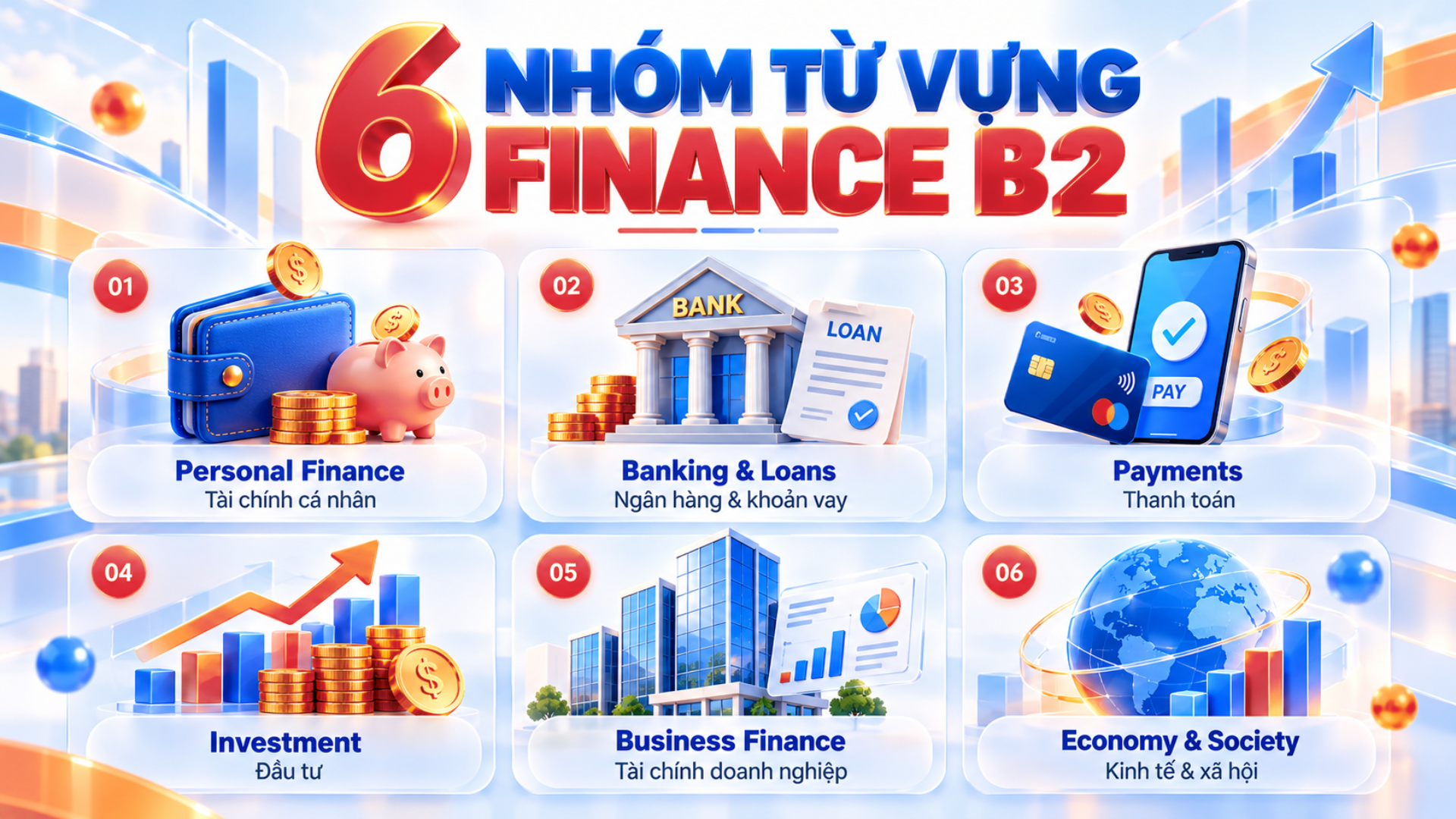
Nhóm 1: Personal Finance – Tài chính cá nhân
| Từ/cụm từ | Nghĩa tiếng Việt |
|---|---|
| Personal finance | Tài chính cá nhân |
| Disposable income | Thu nhập khả dụng |
| Household budget | Ngân sách gia đình |
| Living expenses | Chi phí sinh hoạt |
| Essential spending | Chi tiêu thiết yếu |
| Non-essential spending | Chi tiêu không thiết yếu |
| Emergency fund | Quỹ dự phòng khẩn cấp |
| Financial security | Sự an toàn tài chính |
| Purchasing power | Sức mua |
| Make ends meet | Trang trải đủ chi phí sinh hoạt |
Nhóm từ này giúp diễn đạt thói quen quản lý tiền, khả năng chi trả và những khó khăn tài chính trong đời sống.
Ví dụ:
Many young workers find it difficult to build an emergency fund because their living expenses take up most of their income.
(Nhiều người lao động trẻ gặp khó khăn khi xây dựng quỹ dự phòng vì chi phí sinh hoạt chiếm phần lớn thu nhập.)
Nhóm 2: Banking and Loans – Ngân hàng và khoản vay
| Từ/cụm từ | Nghĩa tiếng Việt |
|---|---|
| Interest rate | Lãi suất |
| Fixed rate | Lãi suất cố định |
| Variable rate | Lãi suất thay đổi |
| Mortgage | Khoản vay thế chấp |
| Loan repayment | Việc trả nợ vay |
| Outstanding debt | Khoản nợ chưa thanh toán |
| Credit score | Điểm tín dụng |
| Repayment period | Kỳ hạn trả nợ |
| Monthly instalment | Khoản trả góp hằng tháng |
| Default on a loan | Không thực hiện nghĩa vụ trả nợ vay |
Nhóm từ này thường xuất hiện trong thông tin ngân hàng, hợp đồng vay, các cuộc trao đổi về mua nhà hoặc lập kế hoạch trả nợ.
Ví dụ:
Before applying for a mortgage, borrowers should compare interest rates and consider whether they can afford the monthly instalments.
(Trước khi đăng ký vay thế chấp, người vay cần so sánh lãi suất và cân nhắc liệu họ có đủ khả năng trả góp hằng tháng hay không.)
Nhóm 3: Payments and Financial Services – Thanh toán và dịch vụ tài chính
| Từ/cụm từ | Nghĩa tiếng Việt |
|---|---|
| Bank statement | Sao kê ngân hàng |
| Transaction fee | Phí giao dịch |
| Online transfer | Chuyển tiền trực tuyến |
| Direct debit | Trích nợ tự động |
| Exchange rate | Tỷ giá hối đoái |
| Service charge | Phí dịch vụ |
| Refund policy | Chính sách hoàn tiền |
| Payment deadline | Hạn thanh toán |
| Overdraft | Khoản thấu chi |
| Account balance | Số dư tài khoản |
Các từ thuộc nhóm này được sử dụng khi thanh toán hóa đơn, chuyển tiền, sử dụng tài khoản ngân hàng hoặc giải quyết vấn đề liên quan đến giao dịch.
Ví dụ:
I checked my bank statement and noticed that an unexpected transaction fee had been deducted from my account.
(Tôi kiểm tra sao kê ngân hàng và phát hiện một khoản phí giao dịch không mong đợi đã bị trừ khỏi tài khoản.)
Nhóm 4: Investment and Risk – Đầu tư và rủi ro
| Từ/cụm từ | Nghĩa tiếng Việt |
|---|---|
| Investment portfolio | Danh mục đầu tư |
| Financial asset | Tài sản tài chính |
| Financial risk | Rủi ro tài chính |
| Potential return | Mức sinh lời tiềm năng |
| Long-term investment | Khoản đầu tư dài hạn |
| Diversify investments | Đa dạng hóa các khoản đầu tư |
| Stock market | Thị trường chứng khoán |
| Investment strategy | Chiến lược đầu tư |
| Risk tolerance | Mức độ chấp nhận rủi ro |
| Lose value | Giảm giá trị |
Ở trình độ B2, nhóm từ đầu tư tập trung vào cách đánh giá lợi ích, rủi ro và đưa ra quyết định có cân nhắc.
Ví dụ:
Diversifying an investment portfolio may help reduce financial risk, although it does not guarantee a profit.
(Đa dạng hóa danh mục đầu tư có thể giúp giảm rủi ro tài chính, mặc dù không bảo đảm mang lại lợi nhuận.)
Nhóm 5: Business Finance – Tài chính doanh nghiệp
| Từ/cụm từ | Nghĩa tiếng Việt |
|---|---|
| Revenue | Doanh thu |
| Operating expenses | Chi phí vận hành |
| Profit margin | Biên lợi nhuận |
| Cash flow | Dòng tiền |
| Break even | Hòa vốn |
| Financial forecast | Dự báo tài chính |
| Funding | Nguồn vốn |
| Raise capital | Huy động vốn |
| Budget deficit | Thâm hụt ngân sách |
| Cost-cutting measure | Biện pháp cắt giảm chi phí |
Nhóm này phù hợp với những tình huống đọc báo cáo kinh doanh, phân tích kết quả tài chính hoặc trao đổi về kế hoạch hoạt động của doanh nghiệp. Budget deficit cũng thường được dùng trong bối cảnh tài chính công.
Ví dụ:
Although the company generated more revenue, its profit margin fell because operating expenses increased.
(Mặc dù doanh nghiệp tạo ra nhiều doanh thu hơn, biên lợi nhuận vẫn giảm do chi phí vận hành tăng.)
Nhóm 6: Finance and Society – Tài chính và các vấn đề xã hội
| Từ/cụm từ | Nghĩa tiếng Việt |
|---|---|
| Inflation | Lạm phát |
| Cost of living | Chi phí sinh hoạt |
| Income inequality | Bất bình đẳng thu nhập |
| Financial literacy | Hiểu biết tài chính |
| Economic uncertainty | Sự bất ổn kinh tế |
| Financial pressure | Áp lực tài chính |
| Public spending | Chi tiêu công |
| Tax revenue | Nguồn thu từ thuế |
| Financial support | Hỗ trợ tài chính |
| Sustainable growth | Tăng trưởng bền vững |
Nhóm từ này giúp người học phát triển câu trả lời có lập luận về chính sách xã hội, giáo dục tài chính, mức sống và tác động của kinh tế tới người dân.
Ví dụ:
Improving financial literacy can help young adults make better decisions during periods of economic uncertainty.
(Nâng cao hiểu biết tài chính có thể giúp người trẻ đưa ra quyết định tốt hơn trong những giai đoạn kinh tế bất ổn.)
Word family cần nhớ trong chủ đề Finance
Word family là nhóm từ có cùng gốc hoặc có mối liên hệ về cấu tạo từ. Ở trình độ B2, việc nắm chắc word family giúp người học chuyển đổi linh hoạt giữa danh từ, động từ, tính từ và trạng từ.
| Từ gốc | Danh từ | Động từ | Tính từ | Trạng từ | Ví dụ ứng dụng |
|---|---|---|---|---|---|
| finance | finance, financing | finance | financial | financially | The business is financially stable. |
| invest | investment, investor | invest | invested | — | Investors are interested in long-term investments. |
| save | savings, saver | save | saved | — | She saves part of her salary every month. |
| borrow | borrowing, borrower | borrow | borrowed | — | Borrowers must repay their loans on time. |
| repay | repayment | repay | repayable | — | The loan is repayable over five years. |
| consume | consumption, consumer | consume | consumable | — | Consumer spending has declined. |
| profit | profit, profitability | profit | profitable | profitably | The company operates profitably. |
| economy | economy, economics, economist | — | economic, economical | economically | Inflation can affect economic stability. |
| inflate | inflation | inflate | inflated, inflationary | — | Rising inflation reduces purchasing power. |
| afford | affordability | afford | affordable, unaffordable | affordably | Housing affordability is a major concern. |
| depend | dependence | depend | dependent | — | Many families depend on a single income. |
| risk | risk | risk | risky | — | Investing in shares can be risky. |
Những điểm dễ nhầm cần ghi nhớ:
- Finance – financial – financially: Finance chỉ lĩnh vực tài chính hoặc hành động cấp vốn; financial là tính từ; financially là trạng từ.
- Invest – investment – investor: Invest là hành động đầu tư; investment là khoản đầu tư hoặc hoạt động đầu tư; investor chỉ nhà đầu tư.
- Save – savings: Save là động từ tiết kiệm; savings thường chỉ số tiền đã tiết kiệm được.
- Profit – profitable: Profit có thể là danh từ hoặc động từ; profitable là tính từ chỉ khả năng tạo lợi nhuận.
- Economic – economical: Economic thuộc về kinh tế; economical mô tả sự tiết kiệm, ít tốn kém.
- Afford – affordable: Afford là có đủ khả năng chi trả; affordable mô tả mức giá có thể chi trả được.
Ví dụ:
The company made a significant profit last year.
(Doanh nghiệp đạt lợi nhuận đáng kể vào năm ngoái.)
The company has become more profitable.
(Doanh nghiệp đã trở nên có khả năng sinh lời tốt hơn.)
Hai câu cùng nói về lợi nhuận nhưng yêu cầu loại từ khác nhau.
Tham khảo thêm: Word Form là gì? Cấu trúc và cách sử dụng Word Formation
Collocations và cụm từ tự nhiên chủ đề Finance
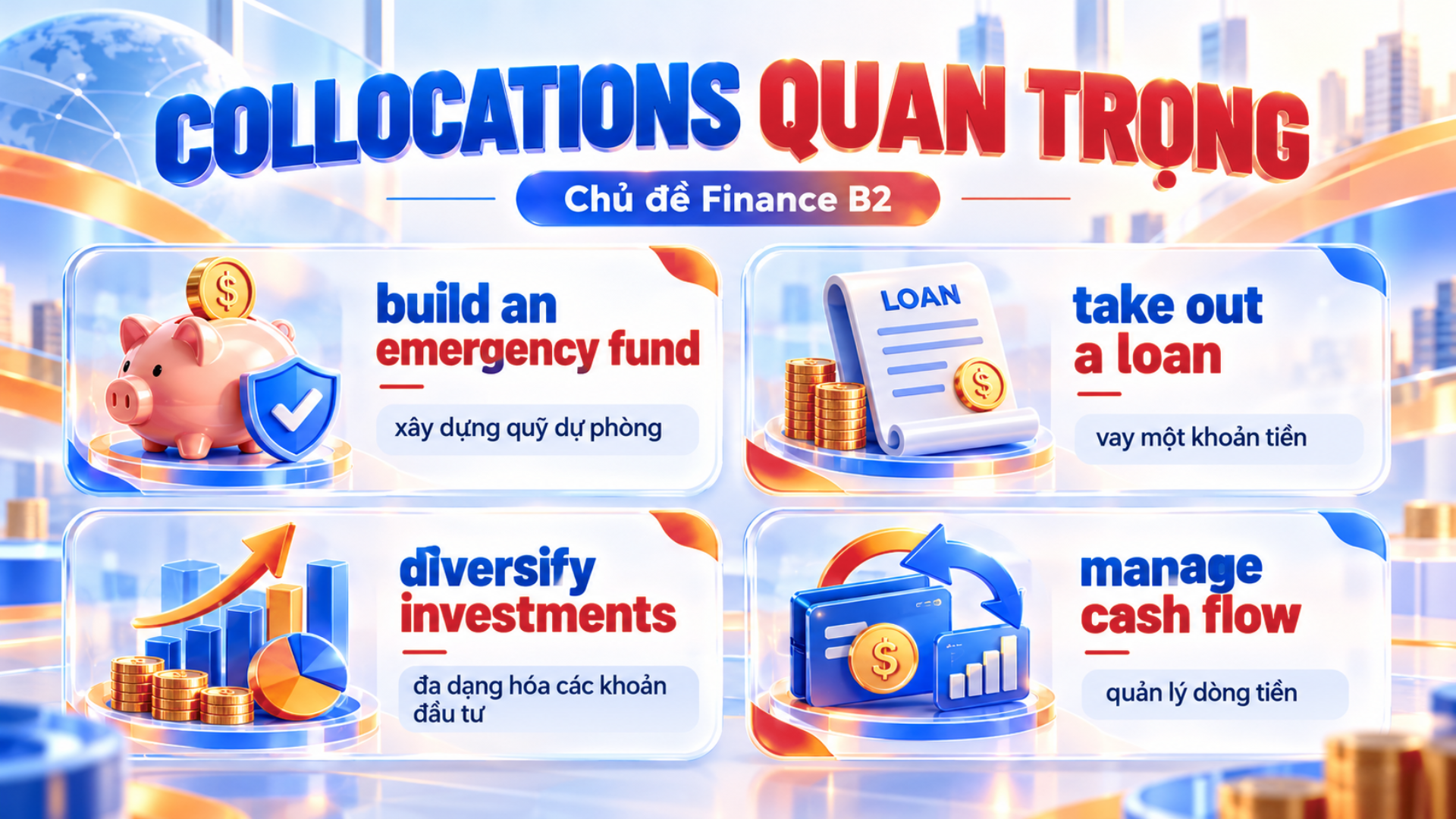
Collocations giúp người học sử dụng từ vựng Finance một cách chính xác và tự nhiên. Đây cũng là yếu tố quan trọng trong IELTS Writing, VSTEP Writing và giao tiếp công việc.
| Collocation/Phrase | Nghĩa tiếng Việt | Dùng trong ngữ cảnh nào? | Ví dụ |
|---|---|---|---|
| manage personal finances | quản lý tài chính cá nhân | Thảo luận quản lý tiền bạc | Young adults should learn to manage personal finances. |
| draw up a budget | lập ngân sách | Lập kế hoạch chi tiêu | We drew up a budget for the coming year. |
| stick to a budget | tuân thủ ngân sách | Kiểm soát chi tiêu | It’s difficult to stick to a budget during holidays. |
| cut back on spending | cắt giảm chi tiêu | Giảm các khoản mua sắm | Families may cut back on spending when prices rise. |
| cover living expenses | trang trải chi phí sinh hoạt | Thu nhập và mức sống | Her part-time job helps cover living expenses. |
| build an emergency fund | xây dựng quỹ dự phòng | Lập kế hoạch tiết kiệm | He is building an emergency fund. |
| make ends meet | xoay xở đủ sống | Khó khăn tài chính | Some households struggle to make ends meet. |
| save for a deposit | tiết kiệm tiền đặt cọc, tiền trả trước | Mục tiêu mua nhà | They are saving for a deposit on a house. |
| take out a loan | vay một khoản tiền | Ngân hàng, tài chính cá nhân | She took out a loan to start a business. |
| apply for a mortgage | đăng ký vay thế chấp | Mua nhà, vay vốn | The couple applied for a mortgage. |
| repay a debt | trả khoản nợ | Nghĩa vụ tài chính | He repaid his debt ahead of schedule. |
| fall behind on payments | chậm thanh toán các kỳ hạn | Khó khăn trả nợ | Some borrowers fall behind on payments. |
| charge interest | tính lãi | Điều khoản vay | Banks charge interest on loans. |
| transfer money | chuyển tiền | Giao dịch ngân hàng | I transferred money to my savings account. |
| pay a transaction fee | trả phí giao dịch | Chuyển tiền, thanh toán | Customers may have to pay a transaction fee. |
| diversify an investment portfolio | đa dạng hóa danh mục đầu tư | Quản lý rủi ro | Investors diversify their portfolios to spread risk. |
| assess financial risk | đánh giá rủi ro tài chính | Ra quyết định đầu tư | It is important to assess financial risk. |
| generate a return | tạo ra lợi nhuận đầu tư | Đánh giá hiệu quả đầu tư | The investment may generate a return over time. |
| raise capital | huy động vốn | Tài chính doanh nghiệp | The company needs to raise capital for expansion. |
| manage cash flow | quản lý dòng tiền | Vận hành doanh nghiệp | Small firms must manage cash flow carefully. |
| reduce operating expenses | giảm chi phí vận hành | Kiểm soát chi phí | The company reduced its operating expenses. |
| make a profit | tạo ra lợi nhuận | Kết quả kinh doanh | The business made a profit in its second year. |
| curb inflation | kiềm chế lạm phát | Chính sách kinh tế | Higher interest rates may help curb inflation. |
| ease financial pressure | giảm áp lực tài chính | Hỗ trợ người dân, sinh viên | Financial assistance can ease pressure on families. |
Một số cấu trúc Finance phù hợp cho IELTS và VSTEP
- One major financial challenge is… – Một thách thức tài chính lớn là…
- This may place financial pressure on… – Điều này có thể tạo áp lực tài chính lên…
- From a financial perspective,… – Xét từ góc độ tài chính,…
- A possible solution would be to… – Một giải pháp khả thi là…
- The long-term financial impact could be… – Tác động tài chính dài hạn có thể là…
Ví dụ:
From a financial perspective, improving public transport could reduce household spending on fuel and ease financial pressure on low-income families.
(Xét từ góc độ tài chính, cải thiện giao thông công cộng có thể giảm chi tiêu nhiên liệu của hộ gia đình và giảm áp lực tài chính đối với các gia đình có thu nhập thấp.)
Lỗi sai thường gặp khi dùng từ vựng Finance
Lỗi 1: Dùng sai giới từ với spend
- Câu sai: I spend too much money for online shopping.
- Câu đúng: I spend too much money on online shopping.
Giải thích: Cấu trúc đúng là spend money on something hoặc spend money doing something.
Lỗi 2: Nhầm borrow và lend
- Câu sai: I lent money from the bank.
- Câu đúng: I borrowed money from the bank.
Giải thích: Borrow money from somebody là vay tiền từ ai, còn lend money to somebody là cho ai vay tiền.
Lỗi 3: Dùng sai collocation với loan
- Câu sai: She made a loan from the bank.
- Câu đúng: She took out a loan from the bank.
Giải thích: Người đi vay thường dùng take out a loan. Cấu trúc make a loan có thể dùng khi ngân hàng hoặc bên cho vay cấp khoản vay cho người khác.
Lỗi 4: Dùng sai giới từ với invest
- Câu sai: He invested on the stock market.
- Câu đúng: He invested in the stock market.
Giải thích: Động từ invest thường đi với giới từ in khi nói về tài sản, thị trường hoặc lĩnh vực đầu tư.
Lỗi 5: Nhầm revenue và profit
- Câu sai: The company’s revenue was $100,000 after deducting all expenses.
- Câu đúng: The company’s profit was $100,000 after deducting all expenses.
Giải thích: Revenue là doanh thu, còn profit là lợi nhuận sau khi trừ chi phí liên quan. Không thể dùng hai từ này thay thế tùy ý.
Lỗi 6: Dùng sai danh từ số nhiều finances
- Câu sai: My finance are improving.
- Câu đúng: My finances are improving.
Giải thích: Finances ở dạng số nhiều chỉ tình hình hoặc nguồn tiền của một cá nhân, tổ chức. Finance thường là danh từ không đếm được khi nói về lĩnh vực hoặc hoạt động quản lý tiền.
Lỗi 7: Nhầm tính từ economic và economical
- Câu sai: The government is facing an economical crisis.
- Câu đúng: The government is facing an economic crisis.
Giải thích: Economic dùng để nói về nền kinh tế. Economical chỉ sự tiết kiệm, chẳng hạn an economical car.
Lỗi 8: Dùng diễn đạt quá khẩu ngữ trong bài viết học thuật
- Câu chưa phù hợp: The government should give poor people more money to help them.
- Câu phù hợp hơn: The government should provide financial assistance to low-income households.
Giải thích: Cả hai câu đều có thể truyền đạt ý nghĩa, nhưng provide financial assistance và low-income households cụ thể, trang trọng hơn, phù hợp với IELTS Writing Task 2 hoặc VSTEP Writing.
Tham khảo thêm: Các lỗi học TOEIC thường gặp và cách khắc phục
Phân biệt các từ dễ nhầm trong chủ đề Finance
| Từ dễ nhầm | Khác nhau thế nào? | Ví dụ đúng |
|---|---|---|
| Income – Revenue – Profit | Income là thu nhập của cá nhân hoặc khoản thu nhập trong ngữ cảnh kế toán; revenue là doanh thu; profit là lợi nhuận sau khi trừ chi phí. | Her income has increased. / The company’s revenue rose. / The firm made a profit. |
| Borrow – Lend | Borrow là vay hoặc mượn; lend là cho vay hoặc cho mượn. | I borrowed money from my friend. / My friend lent me money. |
| Saving – Savings | Saving có thể chỉ hành động tiết kiệm hoặc khoản tiết kiệm trong một trường hợp; savings thường là số tiền tích lũy. | Saving money requires discipline. / She used her savings to pay for the course. |
| Interest – Interest rate | Interest là tiền lãi phải trả hoặc nhận được; interest rate là tỷ lệ lãi suất. | I earned interest on my deposit. / The bank offers a 5% annual interest rate. |
| Economic – Economical – Financial | Economic liên quan nền kinh tế; economical là tiết kiệm; financial liên quan tiền bạc và hoạt động tài chính. | Economic growth is slowing. / This car is economical. / She needs financial support. |
| Expense – Expenditure – Cost | Expense là khoản chi phí; expenditure là hoạt động hoặc số tiền chi, thường trang trọng hơn; cost là giá phải trả hoặc chi phí để có được thứ gì. | Travel expenses increased. / Public expenditure rose. / The cost of housing is high. |
| Debt – Loan | Debt là khoản nợ hoặc tình trạng mắc nợ; loan là khoản tiền được cho vay theo thỏa thuận. | He has a lot of debt. / He took out a loan to buy a car. |
| Invest – Investment | Invest là động từ đầu tư; investment là danh từ chỉ hoạt động hoặc khoản đầu tư. | Many people invest in shares. / Property can be a long-term investment. |
Lưu ý về paraphrase trong ngữ cảnh tài chính
Không phải những từ gần nghĩa đều có thể thay thế hoàn toàn.
Ví dụ:
The company increased its revenue.
Doanh nghiệp tăng doanh thu.
Không thể tự động thay revenue bằng profit, vì doanh thu tăng không có nghĩa lợi nhuận chắc chắn tăng.
Tương tự, high income không đồng nghĩa với financial security. Một người có thu nhập cao vẫn có thể gặp khó khăn tài chính nếu chi tiêu quá mức hoặc có nhiều khoản nợ.
Đoạn mẫu sử dụng từ vựng Finance level B2
Topic: Why Financial Literacy Matters for Young Adults
Many university students in Vietnam are becoming more interested in personal finance, especially as the cost of living continues to rise. For someone with a limited disposable income, a realistic household budget can make daily decisions easier.
Instead of spending everything they earn, students can set aside money each month and gradually build an emergency fund. This also helps them avoid taking out loans for unexpected expenses.
However, saving alone is not always enough. If prices rise faster than income, people may lose purchasing power and struggle to make ends meet.
Some decide to invest their savings, but every investment involves financial risk. Before making a decision, they should compare the potential return with the possibility of losing money.
In my view, improving financial literacy is just as important as increasing income because it allows young adults to plan ahead, manage debt responsibly and achieve financial security over time.
Giải thích các từ và cụm từ quan trọng:
| Từ/cụm từ | Nghĩa tiếng Việt |
|---|---|
| Personal finance | Tài chính cá nhân |
| Cost of living | Chi phí sinh hoạt |
| Disposable income | Thu nhập khả dụng |
| Household budget | Ngân sách gia đình |
| Set aside money | Dành riêng một khoản tiền |
| Emergency fund | Quỹ dự phòng khẩn cấp |
| Purchasing power | Sức mua |
| Make ends meet | Trang trải đủ chi phí sinh hoạt |
| Financial risk | Rủi ro tài chính |
| Potential return | Mức sinh lời tiềm năng |
| Financial literacy | Hiểu biết tài chính |
| Financial security | Sự an toàn tài chính |
Điểm cần học từ đoạn mẫu:
Đoạn văn triển khai theo hướng vấn đề → giải pháp → giới hạn của giải pháp → quan điểm cá nhân.
Các từ nối như especially as, instead of, however, if và because giúp thể hiện quan hệ nguyên nhân, tương phản và kết quả.
Đây là cách tổ chức ý phù hợp với bài viết nêu quan điểm ở trình độ B2.
Bài tập từ vựng Finance level B2
Task 1: Match words with meanings
Nối từ hoặc cụm từ ở cột A với nghĩa phù hợp ở cột B.
| Cột A | Cột B |
|---|---|
| 1. Disposable income | A. Biên lợi nhuận |
| 2. Overdraft | B. Kỳ hạn trả nợ |
| 3. Mortgage | C. Hiểu biết tài chính |
| 4. Cash flow | D. Thu nhập khả dụng |
| 5. Inflation | E. Thâm hụt ngân sách |
| 6. Risk tolerance | F. Khoản thấu chi |
| 7. Repayment period | G. Mức độ chấp nhận rủi ro |
| 8. Profit margin | H. Lạm phát |
| 9. Financial literacy | I. Dòng tiền |
| 10. Budget deficit | J. Khoản vay thế chấp |
Task 2: Fill in the blanks
Điền từ hoặc cụm từ thích hợp vào chỗ trống. Mỗi đáp án chỉ sử dụng một lần.
Word bank: emergency fund – repayment period – interest rate – bank statement – financial forecast – operating expenses – purchasing power – exchange rate – revenue – default on a loan
- The company needs to prepare a __________ before launching its new product.
- Rising inflation has reduced consumers’ __________.
- She checks her __________ every month to identify unusual transactions.
- The café’s __________ include rent, electricity and staff salaries.
- A higher __________ can make borrowing more expensive.
- The company generated more __________ after expanding its online sales.
- The couple decided to extend the __________ to reduce their monthly payments.
- An __________ can help cover unexpected medical bills or urgent repairs.
- Travellers should compare the __________ before converting currencies.
- Borrowers who cannot make the required repayments may __________.
Task 3: Choose the correct answer
Chọn đáp án đúng nhất A, B, C hoặc D.
1. The company decided to ______ a loan to finance its expansion.
A. make
B. take out
C. do
D. borrow out
2. Many students struggle to make ends ______ because living costs are increasing.
A. meet
B. join
C. connect
D. reach
3. The company’s ______ increased, but its profit fell because production costs rose sharply.
A. savings
B. debt
C. revenue
D. mortgage
4. The project is ______ sustainable and does not require additional funding.
A. finance
B. financial
C. finances
D. financially
5. Borrowers who fail to repay their loans may default ______ their debt.
A. at
B. on
C. in
D. for
6. Government expenditure exceeded revenue, resulting in a budget ______.
A. surplus
B. profit
C. deficit
D. investment
7. The business hopes to ______ its outstanding debt within three years.
A. repay
B. earn
C. generate
D. invest
8. A general increase in prices over time is known as ______.
A. expenditure
B. depreciation
C. inflation
D. revenue
9. Many people prefer to invest ______ a range of assets rather than put all their money into one company.
A. at
B. on
C. for
D. in
10. The company’s profit margin fell because it could not reduce its ______.
A. operating expenses
B. purchasing power
C. credit score
D. financial literacy
Task 4: Vocabulary in context
Đọc đoạn văn và trả lời các câu hỏi theo ngữ cảnh.
Managing the Finances of a Small Business
Consider a small café in Hanoi that has recently experienced rising operating expenses. The cost of ingredients, electricity and rent has increased, making it difficult for the owner to maintain a healthy profit margin. Although customer numbers remain stable, the café’s cash flow has become less predictable because several suppliers now require earlier payments.
To address these challenges, the owner prepares a monthly financial forecast and reviews the business budget. She also introduces cost-cutting measures, such as reducing food waste and negotiating better prices with suppliers.
However, she decides against taking out another loan because higher interest rates could increase the business’s financial pressure. Instead, she focuses on improving cash flow and building a small emergency fund.
By managing expenses carefully, the café hopes to achieve greater financial stability without increasing prices for customers.
Questions:
- What has caused the café’s operating expenses to increase?
- What does maintain a healthy profit margin mean in this passage?
- Why has the café’s cash flow become less predictable?
- What two actions does the owner take to reduce financial difficulties?
- Why does the owner decide against taking out another loan?
Task 5: Application practice
Trả lời mỗi câu hỏi bằng 3–5 câu tiếng Anh. Sử dụng ít nhất hai từ hoặc collocations đã học trong mỗi câu trả lời.
1. Personal Finance
Why is it important for university students to learn how to manage their personal finances?
2. Saving and Spending
What are the benefits of building an emergency fund?
3. Banking and Borrowing
What should people consider before taking out a large loan?
4. Investment and Risk
Do you think young adults should invest their savings in the stock market? Why or why not?
5. Finance and Society
How does rising inflation affect low-income households?
Tham khảo thêm: Từ vựng Shopping B2 và bài tập vận dụng
Đáp án bài tập từ vựng Finance level B2
Task 1: Match words with meanings
| Câu | Đáp án |
|---|---|
| 1 | D |
| 2 | F |
| 3 | J |
| 4 | I |
| 5 | H |
| 6 | G |
| 7 | B |
| 8 | A |
| 9 | C |
| 10 | E |
Task 2: Fill in the blanks
- Financial forecast: Dự báo tài chính giúp doanh nghiệp lập kế hoạch trước khi triển khai sản phẩm mới.
- Purchasing power: Lạm phát làm giảm sức mua của người tiêu dùng.
- Bank statement: Sao kê ngân hàng giúp kiểm tra và đối chiếu giao dịch.
- Operating expenses: Tiền thuê mặt bằng, điện và lương là các chi phí vận hành.
- Interest rate: Lãi suất tăng thường khiến chi phí vay cao hơn.
- Revenue: Doanh thu có thể tăng khi doanh nghiệp mở rộng hoạt động bán hàng.
- Repayment period: Kéo dài kỳ hạn trả nợ có thể giảm số tiền phải trả mỗi tháng, dù tổng lãi có thể tăng.
- Emergency fund: Quỹ dự phòng được dùng để xử lý các khoản chi tiêu bất ngờ.
- Exchange rate: Tỷ giá cho biết giá trị tương đối giữa hai đồng tiền.
- Default on a loan: Cấu trúc đúng là default on a loan, chỉ việc không thực hiện nghĩa vụ trả nợ.
Task 3: Choose the correct answer
| Câu | Đáp án | Giải thích |
|---|---|---|
| 1 | B. take out | Collocation đúng là take out a loan. |
| 2 | A. meet | Thành ngữ chính xác là make ends meet. |
| 3 | C. revenue | Doanh thu tăng không có nghĩa lợi nhuận tăng nếu chi phí cũng tăng. |
| 4 | D. financially | Cần trạng từ bổ nghĩa cho tính từ sustainable. |
| 5 | B. on | Cấu trúc đúng là default on a debt/loan. |
| 6 | C. deficit | Budget deficit chỉ thâm hụt ngân sách. |
| 7 | A. repay | Repay outstanding debt là trả nợ chưa thanh toán. |
| 8 | C. inflation | Inflation chỉ sự tăng lên của mức giá chung theo thời gian. |
| 9 | D. in | Cấu trúc đúng là invest in something. |
| 10 | A. operating expenses | Chi phí vận hành cao có thể làm giảm biên lợi nhuận. |
Task 4: Vocabulary in context
1. What has caused the café’s operating expenses to increase?
The rising costs of ingredients, electricity and rent.
Giải thích: Operating expenses là các chi phí duy trì hoạt động kinh doanh.
2. What does maintain a healthy profit margin mean?
It means keeping a reasonable proportion of revenue as profit after covering costs.
Giải thích: Profit margin phản ánh tỷ lệ lợi nhuận so với doanh thu. Healthy trong ngữ cảnh này mang nghĩa tốt hoặc ở mức hợp lý, không phải nghĩa sức khỏe.
3. Why has the café’s cash flow become less predictable?
Because several suppliers now require earlier payments.
Giải thích: Các khoản chi phải thanh toán sớm ảnh hưởng đến thời điểm tiền ra khỏi doanh nghiệp.
4. What two actions does the owner take to reduce financial difficulties?
She reduces food waste and negotiates better prices with suppliers.
Giải thích: Đây là hai ví dụ về cost-cutting measures nhằm kiểm soát chi phí.
5. Why does the owner decide against taking out another loan?
Because higher interest rates could increase the business’s financial pressure.
Giải thích: Decide against doing something nghĩa là quyết định không thực hiện một hành động.
Task 5: Application practice – Bài trả lời tham khảo
1. Personal Finance
I believe university students should learn to manage their personal finances because this helps them control their spending. By creating a realistic budget, they can cover essential expenses and avoid unnecessary debt. Financial literacy also helps them prepare for unexpected situations.
2. Saving and Spending
Building an emergency fund provides financial security during difficult times. It can help people cover unexpected expenses without taking out a loan. In addition, saving regularly encourages responsible spending habits.
3. Banking and Borrowing
Before taking out a large loan, people should compare interest rates and repayment periods. They also need to consider their monthly income and outstanding debt. A loan can create financial pressure if the monthly instalments are too high.
4. Investment and Risk
I think young adults can consider investing if they understand the financial risks involved. They should develop a suitable investment strategy and avoid investing money they need for essential expenses. Diversifying investments may help reduce risk, although it cannot eliminate it completely.
5. Finance and Society
Rising inflation reduces the purchasing power of low-income households. When the cost of living increases, many families have to cut back on non-essential spending. Governments can consider targeted financial support to ease financial pressure on vulnerable groups.
Ứng dụng từ vựng Finance level B2 vào giao tiếp và bài thi
Từ vựng Finance được sử dụng trong nhiều tình huống thực tế, từ quản lý chi tiêu cá nhân đến thảo luận các vấn đề kinh tế hoặc đọc báo cáo doanh nghiệp.
| Mục tiêu học | Cách ứng dụng | Ví dụ |
|---|---|---|
| Giao tiếp hằng ngày | Nói về thu nhập, chi phí sinh hoạt, khoản vay, ngân sách và kế hoạch tiết kiệm. | I try to stick to a monthly budget and set aside money for emergencies. |
| IELTS Speaking/Writing | Phân tích ảnh hưởng của lạm phát, mức sống, bất bình đẳng thu nhập và giáo dục tài chính. | Improving financial literacy may help young adults avoid unnecessary debt and achieve financial security. |
| TOEIC Reading/Listening | Hiểu email ngân hàng, thông báo thanh toán, báo cáo doanh thu và trao đổi về ngân sách công ty. | The finance department has revised its budget forecast due to rising operating expenses. |
| VSTEP Speaking/Writing | Nêu quan điểm, so sánh giải pháp và thảo luận về thói quen chi tiêu, tiết kiệm, chính sách hỗ trợ tài chính. | I believe financial education should be introduced at school because it promotes responsible spending habits. |
Ứng dụng trong IELTS Speaking Part 3
Câu hỏi:
Do you think schools should teach students how to manage money?
Câu trả lời:
Yes, I strongly believe that financial literacy should be part of the school curriculum. Many young adults struggle to manage their personal finances because they lack basic knowledge about budgeting, saving and borrowing. Teaching these skills at school could help students make informed financial decisions and avoid unnecessary debt.
Ứng dụng trong IELTS Writing Task 2
Chủ đề:
Some people believe that governments should provide greater financial support to low-income families. To what extent do you agree or disagree?
Câu triển khai:
Providing targeted financial assistance could ease the financial pressure on low-income households, particularly during periods of rising inflation. However, long-term measures such as education and employment opportunities are also necessary to improve financial security.
Ứng dụng trong TOEIC Reading
Ví dụ:
The finance department has reviewed the company’s cash flow and identified several opportunities to reduce operating expenses.
Trong câu này, ba nhóm thông tin cần nhận diện gồm:
- Finance department: phòng tài chính.
- Cash flow: dòng tiền.
- Operating expenses: chi phí vận hành.
Ứng dụng trong VSTEP Writing
Câu hỏi:
Should young people focus more on saving money or enjoying life?
Câu trả lời:
Although enjoying life is important, I believe young people should develop responsible financial habits. Setting aside a portion of their income can help them build an emergency fund and achieve long-term financial security.
Tham khảo thêm: Paraphrase People trong IELTS Writing và cách diễn đạt đúng ngữ cảnh
FAQ về từ vựng Finance level B2
1. Chủ đề Finance ở level B2 cần học bao nhiêu từ?
Khoảng 50–65 từ và cụm từ trọng tâm là phạm vi phù hợp cho một bài học theo chủ đề. Quan trọng hơn số lượng là khả năng sử dụng từ đúng ngữ cảnh, kết hợp collocations và diễn đạt ý kiến bằng câu hoàn chỉnh.
2. Học từ vựng Finance B2 có cần ghi nhớ collocations không?
Có. Những cụm như manage finances, take out a loan, repay a debt và reduce expenses giúp người học diễn đạt tự nhiên và tránh lỗi dịch từng từ từ tiếng Việt sang tiếng Anh.
3. Từ vựng Finance B2 có sử dụng được trong IELTS không?
Có. Những nhóm từ về chi phí sinh hoạt, bất bình đẳng thu nhập, lạm phát, tiết kiệm và quản lý tài chính phù hợp với các chủ đề thảo luận trong IELTS Speaking Part 3 và IELTS Writing Task 2.
4. Từ vựng Finance có xuất hiện trong TOEIC và VSTEP không?
Có. TOEIC thường sử dụng từ vựng tài chính trong email, báo cáo, thông báo ngân hàng và hoạt động kinh doanh. VSTEP có thể khai thác các vấn đề về tiêu dùng, tiết kiệm và chính sách tài chính trong Speaking hoặc Writing.
5. Làm sao để ghi nhớ từ vựng Finance lâu hơn?
Học từ theo nhóm nghĩa, ghi nhớ collocations, đặt câu với tình huống thực tế và ôn lại theo từng khoảng thời gian. Việc luyện nói hoặc viết đoạn ngắn giúp chuyển từ vựng từ mức nhận biết sang sử dụng chủ động.
6. Có cần học idioms về Finance ở trình độ B2 không?
Người học B2 chỉ cần nắm một số idioms thông dụng như make ends meet hoặc be in the red. Trong bài viết học thuật, những collocations rõ nghĩa như face financial difficulties và manage financial risks thường phù hợp hơn.
Kết luận
Từ vựng Finance B2 giúp người học nâng cao khả năng diễn đạt về thu nhập, chi tiêu, ngân hàng, đầu tư và các vấn đề kinh tế. Khi kết hợp 60 từ và cụm từ trọng tâm với word family, collocations và cách paraphrase, người học sẽ sử dụng tiếng Anh tự nhiên, chính xác hơn trong giao tiếp cũng như trong bài thi.
Hãy ôn lại các nhóm từ, làm lại bài tập sau vài ngày và thử viết một đoạn văn về cách quản lý tài chính của bản thân.
Cùng Anh Ngữ SEC tiếp tục xây dựng vốn từ vựng theo hệ thống, kết hợp kiến thức ngữ pháp và luyện tập theo ngữ cảnh để từng bước nâng cao khả năng sử dụng tiếng Anh.
Xem thêm
- Từ vựng Business and Economy B2: Kinh tế và hoạt động doanh nghiệp
- Từ vựng Shopping B2: Mua sắm, giá cả và hành vi tiêu dùng
- Bộ từ vựng Collocations tiếng Anh thông dụng
- Word Form là gì? Cấu trúc và cách sử dụng Word Formation
- Các lỗi học TOEIC thường gặp và cách khắc phục
- Paraphrase People trong IELTS Writing


Bài viết liên quan
Cách Phát Triển Đoạn Thân Bài Theo Mô Hình PEEL Trong IELTS Writing Task 2
Hướng Dẫn Viết Topic Sentence Trong IELTS Writing Task 2 Mạch Lạc, Dễ Áp Dụng
Hướng Dẫn Cách Viết Thesis Statement Rõ Quan Điểm Trong IELTS Writing Task 2
Cách phân tích đề IELTS Writing Task 2 theo keyword và instruction words
Cách viết Map có sự thay đổi theo thời gian trong IELTS Writing Task 1
Cách đưa ví dụ trong IELTS Writing Task 2 thuyết phục: 3 cách kèm bài mẫu và bài tập