





Từ Vựng Environment B2: 60 Từ Và Cụm Từ Giúp Thảo Luận Về Môi Trường Tự Tin
Chủ đề Environment ở trình độ B2 không chỉ yêu cầu người học biết tên các vấn đề môi trường mà còn phải giải thích nguyên nhân, đánh giá tác động và đề xuất giải pháp bằng tiếng Anh.
Bài học tổng hợp 60 từ và cụm từ Environment B2 theo sáu nhóm nội dung, kèm nghĩa tiếng Việt, ví dụ, collocations, word family, cách paraphrase, lỗi sai thường gặp và bài tập có đáp án. Nội dung phù hợp với người học muốn cải thiện khả năng giao tiếp học thuật nhẹ, luyện IELTS Speaking/Writing, TOEIC Reading hoặc VSTEP B2.
Key takeaways:
- Nắm vững 60 từ và cụm từ B2 về ô nhiễm, biến đổi khí hậu, hệ sinh thái, rác thải, năng lượng và chính sách môi trường.
- Sử dụng collocations tự nhiên như reduce carbon emissions, protect biodiversity và promote sustainable development.
- Hiểu word family của các từ như pollute, conserve, sustain, consume và regulate.
- Biết paraphrase để diễn đạt nguyên nhân, tác động và giải pháp mà không lặp từ.
- Nhận diện lỗi sai về giới từ, từ loại, số ít/số nhiều và cách dùng từ gần nghĩa.
- Luyện năm dạng bài tập và vận dụng từ vựng vào IELTS, TOEIC, VSTEP và giao tiếp thực tế.
Chủ đề Environment ở level B2 cần học những gì?
Ở trình độ A1–A2, người học chủ yếu làm quen với những từ cơ bản như tree (cây), river (sông), forest (rừng), pollution (ô nhiễm) và recycle (tái chế). Các câu thường tập trung vào việc mô tả thiên nhiên, thời tiết hoặc những hành động bảo vệ môi trường đơn giản.
Đến B1, người học bắt đầu giải thích các vấn đề quen thuộc như ô nhiễm không khí, rác thải nhựa và sự cần thiết của việc tiết kiệm năng lượng. Câu trả lời dài hơn, có sự kết nối giữa nguyên nhân và kết quả.
Ở B2, người học cần tiến thêm một bước: phân tích vấn đề môi trường, đánh giá hậu quả, so sánh các giải pháp và bảo vệ quan điểm của mình. Ví dụ:
- B1: Cars cause air pollution.
(Ô tô gây ô nhiễm không khí.) - B2: Heavy reliance on private vehicles contributes to air pollution and increases carbon emissions.
(Việc phụ thuộc nhiều vào phương tiện cá nhân góp phần gây ô nhiễm không khí và làm tăng lượng khí thải carbon.)
Câu B2 không nhất thiết phải sử dụng từ quá khó. Điểm khác biệt nằm ở khả năng kết hợp từ chính xác, diễn đạt rõ quan hệ nguyên nhân – kết quả và phát triển ý tưởng.
Trong chủ đề Environment, sáu nhóm nội dung trọng tâm gồm nguyên nhân ô nhiễm, biến đổi khí hậu, hệ sinh thái, quản lý rác thải, năng lượng và chính sách môi trường. Đây là những nhóm kiến thức giúp người học chuyển từ việc kể tên vấn đề sang thảo luận và đề xuất giải pháp.
Tham khảo thêm: Từ vựng tiếng Anh về môi trường và bảo vệ môi trường
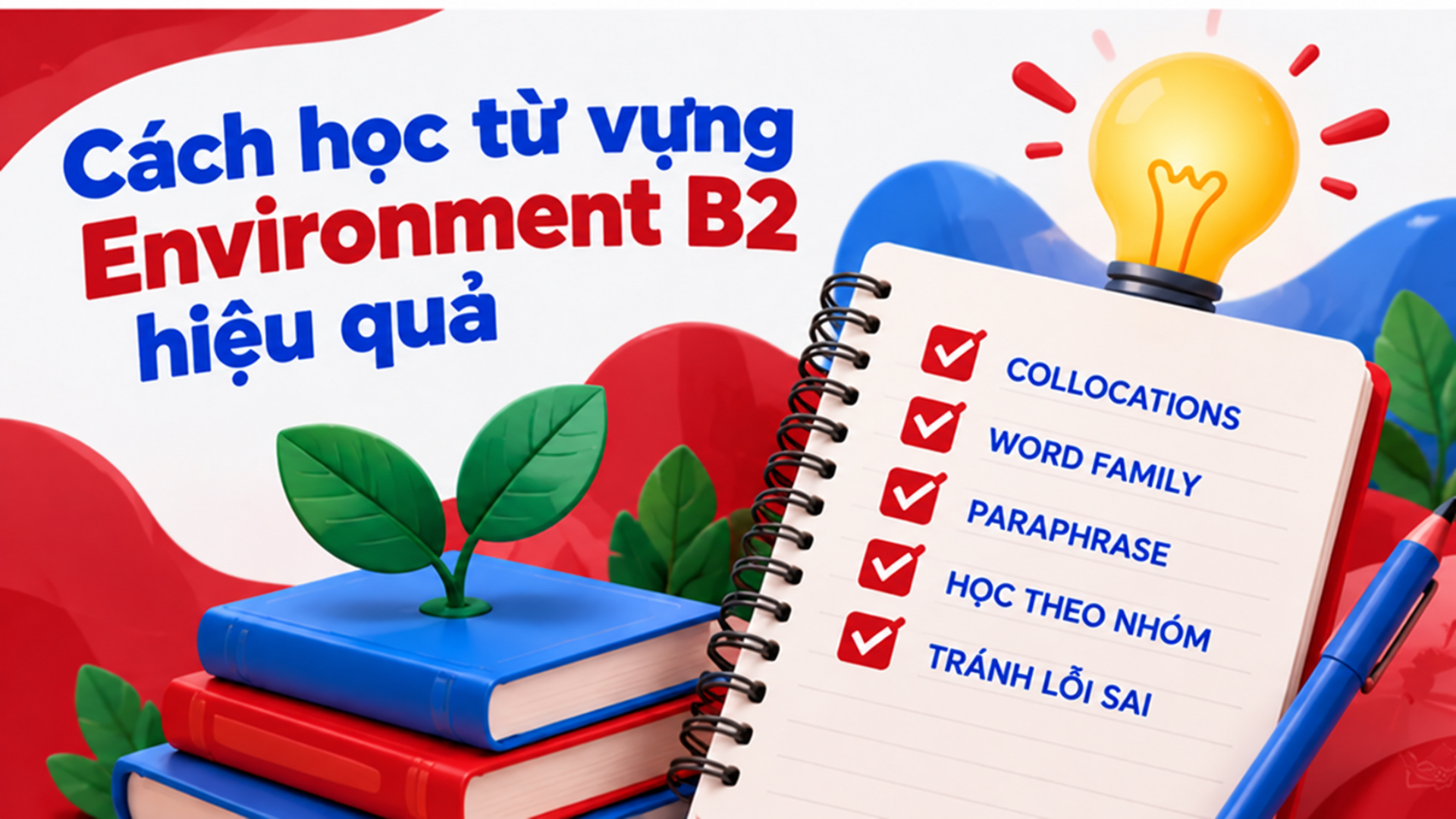
Cách học từ vựng Environment level B2 hiệu quả
Ở trình độ B2, học thuộc nghĩa tiếng Việt của từng từ là chưa đủ. Một từ cần được hiểu qua ngữ cảnh, cấu trúc đi kèm và cách sử dụng trong câu.
1. Học theo nhóm nghĩa thay vì học từ riêng lẻ
Ví dụ, với chủ đề ô nhiễm không khí, người học có thể kết nối các từ:
- Air pollution: ô nhiễm không khí.
- Vehicle emissions: khí thải phương tiện giao thông.
- Fossil fuels: nhiên liệu hóa thạch.
- Air quality: chất lượng không khí.
- Respiratory problems: các vấn đề về hô hấp.
Khi kết nối các từ này, người học sẽ tạo được một câu hoàn chỉnh:
Vehicle emissions contribute to air pollution, which can reduce air quality and cause respiratory problems.
(Khí thải phương tiện giao thông góp phần gây ô nhiễm không khí, làm giảm chất lượng không khí và có thể gây ra các vấn đề về hô hấp.)
2. Ghi nhớ từ cùng collocation
Thay vì chỉ học emissions (lượng khí thải), hãy học:
- Reduce emissions: giảm khí thải.
- Cut carbon emissions: cắt giảm lượng khí thải carbon.
- Vehicle emissions: khí thải phương tiện.
- Greenhouse gas emissions: lượng phát thải khí nhà kính.
Học cả cụm giúp tránh những cách kết hợp thiếu tự nhiên như make pollution khi muốn diễn đạt “gây ô nhiễm”.
3. Học word family để sử dụng đúng từ loại
Ví dụ:
- Pollute (v): làm ô nhiễm.
- Pollution (n): sự ô nhiễm.
- Pollutant (n): chất gây ô nhiễm.
- Polluted (adj): bị ô nhiễm.
So sánh:
Factories pollute rivers.
(Các nhà máy làm ô nhiễm sông ngòi.)
Water pollution is a serious concern.
(Ô nhiễm nguồn nước là vấn đề đáng lo ngại.)
4. Luyện paraphrase nhưng giữ nguyên nghĩa
Ví dụ:
- Reduce plastic waste → Cut down on plastic waste.
- Protect natural habitats → Preserve natural habitats.
- Cause environmental damage → Harm the environment.
- Depend on fossil fuels → Rely on fossil fuels.
Các cách diễn đạt này có thể thay thế trong nhiều ngữ cảnh, nhưng không phải lúc nào cũng tương đương hoàn toàn. Người học cần chú ý sắc thái nghĩa và cấu trúc câu.
5. Luyện từ vựng qua câu hỏi và tình huống thực tế
Một câu hỏi phù hợp với trình độ B2:
What should governments do to reduce environmental pollution?
Câu trả lời:
Governments should enforce stricter environmental regulations and invest in cleaner public transport to reduce carbon emissions.
(Chính phủ cần thực thi các quy định môi trường nghiêm ngặt hơn và đầu tư vào giao thông công cộng sạch hơn để giảm lượng khí thải carbon.)
6. Ôn tập bằng cách sử dụng lại từ
Sau mỗi nhóm từ, hãy thực hiện ba hoạt động: viết câu, diễn đạt lại câu bằng từ gần nghĩa và trả lời một câu hỏi ngắn. Việc sử dụng từ trong nhiều ngữ cảnh giúp chuyển từ vựng từ khả năng nhận biết sang khả năng sử dụng chủ động.
Tham khảo thêm: 11 cách học từ vựng tiếng Anh hiệu quả và nhớ lâu
Bảng từ vựng Environment level B2
Bảng tổng hợp 60 từ và cụm từ trọng tâm, được lựa chọn theo ngữ cảnh sử dụng B2. Những từ quen thuộc được kết hợp thành các cụm giúp người học diễn đạt nguyên nhân, hậu quả, giải pháp và chính sách môi trường một cách chính xác hơn.
Nhóm 1: Nguyên nhân ô nhiễm và áp lực lên môi trường
| Word/Phrase | Level | Loại từ | Nghĩa tiếng Việt | Word family | Collocation/Cụm dùng tự nhiên | Ví dụ |
|---|---|---|---|---|---|---|
| 1. air pollution | B2 | n. phrase | ô nhiễm không khí | pollute, pollutant | tackle air pollution | Better transport can help tackle air pollution. |
| 2. water contamination | B2 | n. phrase | sự nhiễm bẩn nguồn nước | contaminate, contaminated | prevent water contamination | Strict controls help prevent water contamination. |
| 3. industrial emissions | B2 | plural n. | khí thải công nghiệp | emit, emission | reduce industrial emissions | Factories must reduce industrial emissions. |
| 4. vehicle exhaust | B2 | n. phrase | khí thải từ phương tiện | exhaust | exposure to vehicle exhaust | Vehicle exhaust affects urban air quality. |
| 5. fossil fuel | B2 | n. phrase | nhiên liệu hóa thạch | — | burn fossil fuels | Burning fossil fuels releases greenhouse gases. |
| 6. overconsumption | B2 | n. | sự tiêu thụ quá mức | consume, consumption | excessive consumption | Overconsumption puts pressure on natural resources. |
| 7. deforestation | B2 | n. | nạn phá rừng | deforest, deforested | large-scale deforestation | Deforestation destroys natural habitats. |
| 8. intensive farming | B2 | n. phrase | canh tác thâm canh | farm, farmer | intensive farming practices | Intensive farming can damage soil quality. |
| 9. chemical runoff | B2 | n. phrase | dòng chảy mang hóa chất | chemical, runoff | agricultural chemical runoff | Chemical runoff can pollute nearby rivers. |
| 10. environmental degradation | B2 | n. phrase | sự suy thoái môi trường | degrade, degraded | prevent environmental degradation | Poor land management causes environmental degradation. |
Nhóm 2: Biến đổi khí hậu và hậu quả
| Word/Phrase | Level | Loại từ | Nghĩa tiếng Việt | Word family | Collocation/Cụm dùng tự nhiên | Ví dụ |
|---|---|---|---|---|---|---|
| 11. climate change | B2 | n. phrase | biến đổi khí hậu | climatic | address climate change | Governments must address climate change. |
| 12. global warming | B2 | n. phrase | hiện tượng nóng lên toàn cầu | warm, warming | contribute to global warming | Carbon emissions contribute to global warming. |
| 13. greenhouse gases | B2 | plural n. | khí nhà kính | — | greenhouse gas emissions | Human activities increase greenhouse gas emissions. |
| 14. carbon footprint | B2 | n. phrase | dấu chân carbon | — | reduce one’s carbon footprint | Cycling can reduce your carbon footprint. |
| 15. rising sea levels | B2 | plural n. phrase | mực nước biển dâng | rise, rising | affected by rising sea levels | Coastal communities are threatened by rising sea levels. |
| 16. extreme weather | B2 | n. phrase | thời tiết cực đoan | extreme, extremely | extreme weather events | Extreme weather can damage infrastructure. |
| 17. heatwave | B2 | n. | đợt nắng nóng kéo dài | heat, heated | prolonged heatwave | The heatwave increased electricity demand. |
| 18. drought | B2 | n. | hạn hán | drought-prone | severe drought | Severe drought threatens agricultural production. |
| 19. flooding | B2 | n. | tình trạng ngập lụt | flood, flooded | widespread flooding | Heavy rainfall caused widespread flooding. |
| 20. climate-related risk | B2 | n. phrase | rủi ro liên quan đến khí hậu | climate, climatic | assess climate-related risks | Cities need to assess climate-related risks. |
Nhóm 3: Hệ sinh thái và bảo tồn đa dạng sinh học
| Word/Phrase | Level | Loại từ | Nghĩa tiếng Việt | Word family | Collocation/Cụm dùng tự nhiên | Ví dụ |
|---|---|---|---|---|---|---|
| 21. ecosystem | B2 | n. | hệ sinh thái | ecology, ecological | fragile ecosystem | Pollution can damage fragile ecosystems. |
| 22. biodiversity | B2 | n. | đa dạng sinh học | diversity, diverse | protect biodiversity | Forest conservation helps protect biodiversity. |
| 23. habitat loss | B2 | n. phrase | sự mất môi trường sống | habitat, inhabit | suffer from habitat loss | Many animals suffer from habitat loss. |
| 24. endangered species | B2 | n. phrase | loài có nguy cơ tuyệt chủng | endanger, endangered | protect endangered species | National parks protect endangered species. |
| 25. extinction | B2 | n. | sự tuyệt chủng | extinct | face extinction | Some species face extinction because of hunting. |
| 26. wildlife conservation | B2 | n. phrase | bảo tồn động vật hoang dã | conserve, conservation | wildlife conservation programmes | Wildlife conservation requires long-term funding. |
| 27. soil erosion | B2 | n. phrase | xói mòn đất | erode, erosion | prevent soil erosion | Planting trees helps prevent soil erosion. |
| 28. water scarcity | B2 | n. phrase | tình trạng khan hiếm nước | scarce, scarcity | experience water scarcity | Some communities experience water scarcity. |
| 29. reforestation | B2 | n. | hoạt động trồng rừng phục hồi | forest, reforest | reforestation project | Reforestation can restore damaged landscapes. |
| 30. ecological balance | B2 | n. phrase | cân bằng sinh thái | ecology, ecological | maintain ecological balance | Biodiversity helps maintain ecological balance. |
Nhóm 4: Rác thải, tái chế và kinh tế tuần hoàn
| Word/Phrase | Level | Loại từ | Nghĩa tiếng Việt | Word family | Collocation/Cụm dùng tự nhiên | Ví dụ |
|---|---|---|---|---|---|---|
| 31. household waste | B2 | n. phrase | rác thải sinh hoạt | waste, wasteful | manage household waste | Cities need to manage household waste effectively. |
| 32. single-use plastic | B2 | n. phrase | nhựa dùng một lần | plastic | reduce single-use plastic | Shops are reducing single-use plastic packaging. |
| 33. landfill | B2 | n. | bãi chôn lấp rác | — | send waste to landfill | Too much recyclable waste is sent to landfill. |
| 34. waste separation | B2 | n. phrase | hoạt động phân loại rác | separate, separation | improve waste separation | Waste separation makes recycling more effective. |
| 35. recycling scheme | B2 | n. phrase | chương trình tái chế | recycle, recyclable | introduce a recycling scheme | The school introduced a recycling scheme. |
| 36. recyclable material | B2 | n. phrase | vật liệu có thể tái chế | recycle, recycling | collect recyclable materials | Volunteers collect recyclable materials every week. |
| 37. reusable packaging | B2 | n. phrase | bao bì có thể tái sử dụng | reuse, reusable | switch to reusable packaging | Businesses are switching to reusable packaging. |
| 38. biodegradable | B2 | adj. | có khả năng phân hủy sinh học | biodegrade, biodegradation | biodegradable packaging | The company uses biodegradable packaging. |
| 39. composting | B2 | n. | quá trình ủ phân hữu cơ | compost | composting food waste | Composting food waste reduces household rubbish. |
| 40. circular economy | B2 | n. phrase | kinh tế tuần hoàn | economy, economic | support a circular economy | Repairing products supports a circular economy. |
Nhóm 5: Năng lượng và sử dụng tài nguyên
| Word/Phrase | Level | Loại từ | Nghĩa tiếng Việt | Word family | Collocation/Cụm dùng tự nhiên | Ví dụ |
|---|---|---|---|---|---|---|
| 41. renewable energy | B2 | n. phrase | năng lượng tái tạo | renew, renewable | invest in renewable energy | Many countries invest in renewable energy. |
| 42. clean energy | B2 | n. phrase | năng lượng sạch | clean | transition to clean energy | Cities are encouraging a transition to clean energy. |
| 43. solar power | B2 | n. phrase | năng lượng mặt trời | solar | generate solar power | Solar panels generate electricity from sunlight. |
| 44. wind power | B2 | n. phrase | năng lượng gió | wind, windy | produce wind power | Coastal regions can produce wind power. |
| 45. energy efficiency | B2 | n. phrase | hiệu quả sử dụng năng lượng | efficient, efficiently | improve energy efficiency | Better insulation improves energy efficiency. |
| 46. energy consumption | B2 | n. phrase | mức tiêu thụ năng lượng | consume, consumption | reduce energy consumption | Smart lighting can reduce energy consumption. |
| 47. resource depletion | B2 | n. phrase | sự cạn kiệt tài nguyên | deplete, depleted | prevent resource depletion | Excessive mining contributes to resource depletion. |
| 48. sustainable transport | B2 | n. phrase | giao thông bền vững | sustain, sustainable | promote sustainable transport | Cycling lanes promote sustainable transport. |
| 49. energy-saving device | B2 | n. phrase | thiết bị tiết kiệm năng lượng | save, saving | install energy-saving devices | Offices can install energy-saving devices. |
| 50. dependence on fossil fuels | B2 | n. phrase | sự phụ thuộc vào nhiên liệu hóa thạch | depend, dependent | reduce dependence on fossil fuels | Renewable power can reduce dependence on fossil fuels. |
Nhóm 6: Giải pháp, chính sách và trách nhiệm môi trường
| Word/Phrase | Level | Loại từ | Nghĩa tiếng Việt | Word family | Collocation/Cụm dùng tự nhiên | Ví dụ |
|---|---|---|---|---|---|---|
| 51. sustainable development | B2 | n. phrase | phát triển bền vững | sustain, sustainability | promote sustainable development | Governments should promote sustainable development. |
| 52. environmental regulation | B2 | n. phrase | quy định về môi trường | regulate, regulation | strict environmental regulations | Factories must follow environmental regulations. |
| 53. emission standards | B2 | plural n. phrase | tiêu chuẩn phát thải | emit, emission | meet emission standards | Vehicles must meet emission standards. |
| 54. public awareness | B2 | n. phrase | nhận thức của cộng đồng | aware, awareness | raise public awareness | Campaigns can raise public awareness. |
| 55. environmental impact | B2 | n. phrase | tác động đến môi trường | impact, environmental | assess environmental impact | The project must assess its environmental impact. |
| 56. corporate responsibility | B2 | n. phrase | trách nhiệm của doanh nghiệp | responsible, responsibility | demonstrate corporate responsibility | Reducing waste demonstrates corporate responsibility. |
| 57. government incentive | B2 | n. phrase | chính sách khuyến khích của chính phủ | incentivise, incentive | provide government incentives | Government incentives can encourage cleaner technology. |
| 58. enforce regulations | B2 | v. phrase | thực thi quy định | enforce, enforcement | strictly enforce regulations | Authorities must enforce pollution regulations. |
| 59. green initiative | B2 | n. phrase | sáng kiến thân thiện với môi trường | initiative, initiate | launch a green initiative | The company launched a green initiative to save energy. |
| 60. long-term solution | B2 | n. phrase | giải pháp dài hạn | solve, solution | develop long-term solutions | Public investment can provide long-term solutions. |
Các nhóm từ vựng quan trọng trong chủ đề Environment
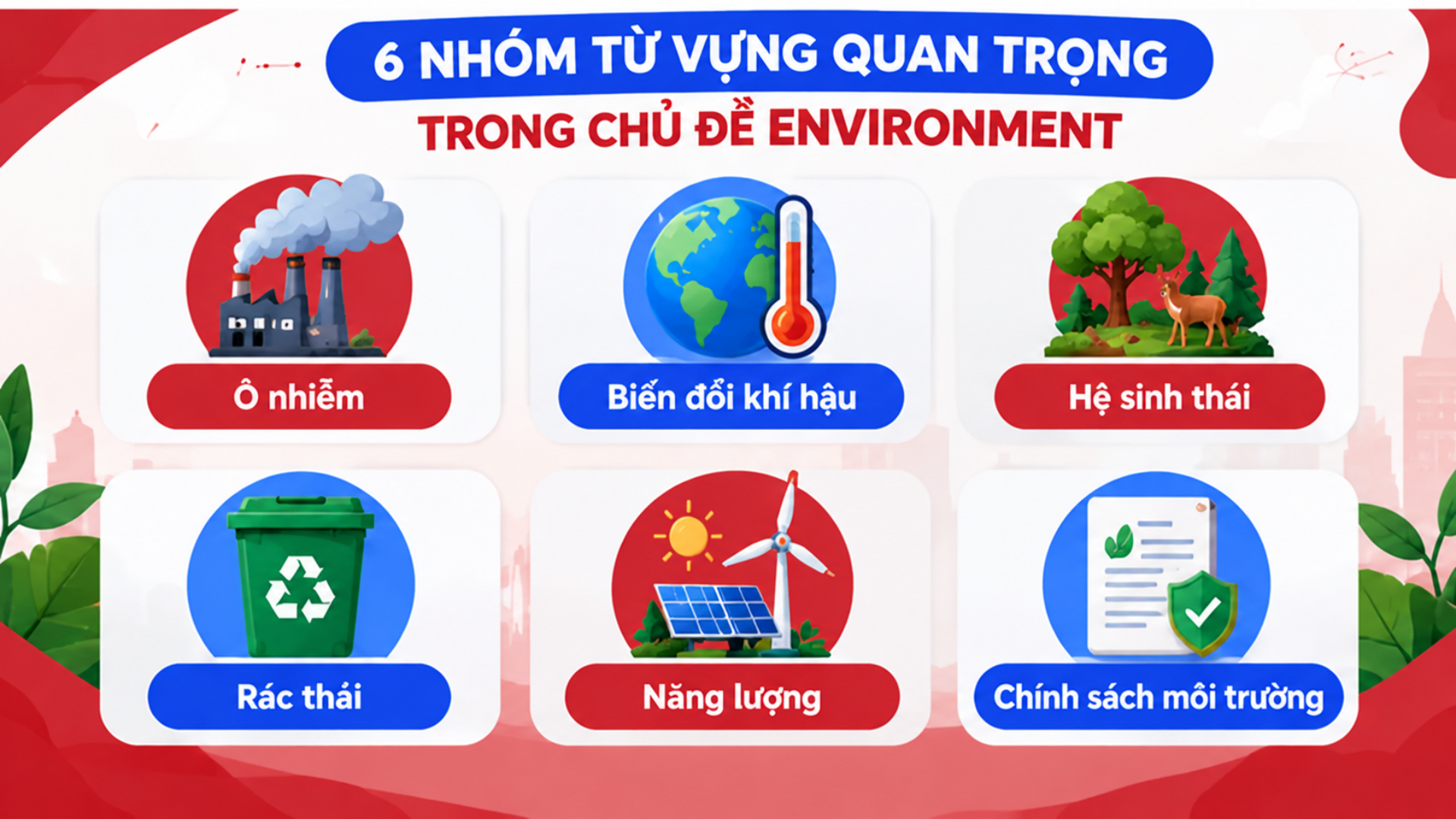
Sáu nhóm từ vựng không tồn tại riêng biệt mà thường kết nối với nhau theo trình tự: nguyên nhân → tác động → giải pháp. Nhận biết mối liên hệ này giúp người học xây dựng câu trả lời mạch lạc hơn.
1. Environmental problems and causes – Vấn đề và nguyên nhân ô nhiễm
- Air pollution: ô nhiễm không khí.
- Water contamination: sự nhiễm bẩn nguồn nước.
- Industrial emissions: khí thải công nghiệp.
- Vehicle exhaust: khí thải phương tiện.
- Fossil fuel: nhiên liệu hóa thạch.
- Overconsumption: tiêu thụ quá mức.
- Deforestation: phá rừng.
- Intensive farming: canh tác thâm canh.
- Chemical runoff: dòng chảy mang hóa chất.
- Environmental degradation: suy thoái môi trường.
Example: Excessive consumption and industrial emissions are major contributors to environmental degradation.
(Tiêu thụ quá mức và khí thải công nghiệp là những yếu tố quan trọng góp phần gây suy thoái môi trường.)
2. Climate change and consequences – Biến đổi khí hậu và hậu quả
- Climate change: biến đổi khí hậu.
- Global warming: nóng lên toàn cầu.
- Greenhouse gases: khí nhà kính.
- Carbon footprint: dấu chân carbon.
- Rising sea levels: mực nước biển dâng.
- Extreme weather: thời tiết cực đoan.
- Heatwave: đợt nắng nóng kéo dài.
- Drought: hạn hán.
- Flooding: ngập lụt.
- Climate-related risk: rủi ro liên quan đến khí hậu.
Example: Climate change increases the risks associated with extreme weather, including prolonged droughts and severe flooding.
(Biến đổi khí hậu làm gia tăng những rủi ro liên quan đến thời tiết cực đoan, bao gồm hạn hán kéo dài và ngập lụt nghiêm trọng.)
3. Ecosystems and biodiversity – Hệ sinh thái và đa dạng sinh học
- Ecosystem: hệ sinh thái.
- Biodiversity: đa dạng sinh học.
- Habitat loss: mất môi trường sống.
- Endangered species: loài có nguy cơ tuyệt chủng.
- Extinction: sự tuyệt chủng.
- Wildlife conservation: bảo tồn động vật hoang dã.
- Soil erosion: xói mòn đất.
- Water scarcity: khan hiếm nước.
- Reforestation: trồng rừng phục hồi.
- Ecological balance: cân bằng sinh thái.
Example: Reforestation and wildlife conservation can help restore ecological balance and protect endangered species.
(Trồng rừng phục hồi và bảo tồn động vật hoang dã có thể giúp khôi phục cân bằng sinh thái và bảo vệ các loài có nguy cơ tuyệt chủng.)
4. Waste and recycling – Rác thải và tái chế
- Household waste: rác thải sinh hoạt.
- Single-use plastic: nhựa dùng một lần.
- Landfill: bãi chôn lấp.
- Waste separation: phân loại rác.
- Recycling scheme: chương trình tái chế.
- Recyclable material: vật liệu có thể tái chế.
- Reusable packaging: bao bì tái sử dụng.
- Biodegradable: có thể phân hủy sinh học.
- Composting: ủ phân hữu cơ.
- Circular economy: kinh tế tuần hoàn.
Example: Effective waste separation and recycling schemes can reduce the amount of rubbish sent to landfill.
(Phân loại rác hiệu quả và các chương trình tái chế có thể giảm lượng rác được đưa đến bãi chôn lấp.)
5. Energy and resource use – Năng lượng và sử dụng tài nguyên
- Renewable energy: năng lượng tái tạo.
- Clean energy: năng lượng sạch.
- Solar power: năng lượng mặt trời.
- Wind power: năng lượng gió.
- Energy efficiency: hiệu quả sử dụng năng lượng.
- Energy consumption: mức tiêu thụ năng lượng.
- Resource depletion: cạn kiệt tài nguyên.
- Sustainable transport: giao thông bền vững.
- Energy-saving device: thiết bị tiết kiệm năng lượng.
- Dependence on fossil fuels: sự phụ thuộc vào nhiên liệu hóa thạch.
Example: Investing in renewable energy and improving energy efficiency can reduce dependence on fossil fuels.
(Đầu tư vào năng lượng tái tạo và cải thiện hiệu quả sử dụng năng lượng có thể giảm sự phụ thuộc vào nhiên liệu hóa thạch.)
6. Environmental solutions and policies – Giải pháp và chính sách môi trường
- Sustainable development: phát triển bền vững.
- Environmental regulation: quy định môi trường.
- Emission standards: tiêu chuẩn phát thải.
- Public awareness: nhận thức cộng đồng.
- Environmental impact: tác động môi trường.
- Corporate responsibility: trách nhiệm doanh nghiệp.
- Government incentive: chính sách khuyến khích của chính phủ.
- Enforce regulations: thực thi quy định.
- Green initiative: sáng kiến xanh.
- Long-term solution: giải pháp dài hạn.
Example: Governments should enforce environmental regulations and provide incentives for businesses to adopt sustainable practices.
(Chính phủ cần thực thi các quy định môi trường và đưa ra chính sách khuyến khích doanh nghiệp áp dụng những hoạt động bền vững.)
Word family cần nhớ trong chủ đề Environment
Word family là tập hợp các từ có chung gốc hoặc có mối quan hệ cấu tạo từ. Ở trình độ B2, hiểu word family giúp người học chọn đúng từ loại trong câu, đồng thời nhận diện cách diễn đạt lại thông tin trong Reading.
| Từ gốc | Danh từ | Động từ | Tính từ | Trạng từ | Ví dụ ứng dụng |
|---|---|---|---|---|---|
| pollute | pollution, pollutant | pollute | polluted, polluting | — | Air pollution affects public health. |
| emit | emission | emit | emitted | — | Factories emit harmful gases. |
| conserve | conservation, conservationist | conserve | — | — | Water conservation is essential during droughts. |
| sustain | sustainability | sustain | sustainable | sustainably | Cities need sustainable transport systems. |
| consume | consumption, consumer | consume | consumable | — | Energy consumption is increasing. |
| regulate | regulation, regulator | regulate | regulatory, regulated | — | Strict regulations can reduce pollution. |
| recycle | recycling | recycle | recyclable, recycled | — | This packaging is fully recyclable. |
| renew | renewal | renew | renewable | — | Solar energy is a renewable resource. |
| depend | dependence, dependency | depend | dependent | — | Many industries depend on fossil fuels. |
| contaminate | contamination, contaminant | contaminate | contaminated | — | Contaminated water may threaten public health. |
Những cách dùng dễ nhầm cần nhớ:
- Pollution – pollutant: Pollution là tình trạng ô nhiễm; pollutant là chất gây ô nhiễm. Ví dụ: Air pollution is caused by various pollutants.
- Emission – emit: Emission là danh từ; emit là động từ. Ví dụ: Cars emit gases and produce emissions.
- Sustainable – sustainability: Sustainable là tính từ, dùng trong sustainable development; sustainability là danh từ, dùng trong environmental sustainability.
- Consumption – consume: Consumption đi với các cụm như energy consumption; consume là động từ trong consume electricity.
- Recyclable – recycled: Recyclable là có thể tái chế; recycled là đã được tái chế.
- Depend – dependent: Dùng depend on hoặc be dependent on, không dùng depend of.
- Contaminated – contaminant: Contaminated water là nước bị nhiễm bẩn; a contaminant là chất gây nhiễm bẩn.
Ví dụ về cách thay đổi từ loại trong bài viết:
Factories contaminate water sources.
→ Industrial activities can lead to water contamination.
Hai câu cùng thể hiện mối liên hệ giữa hoạt động công nghiệp và ô nhiễm nguồn nước, nhưng câu thứ hai sử dụng danh từ contamination để diễn đạt theo cách trang trọng hơn.
Tham khảo thêm: Bộ từ vựng Collocations tiếng Anh và cách kết hợp từ tự nhiên
Collocations và cụm từ tự nhiên chủ đề Environment
Collocation là cách các từ thường kết hợp với nhau trong tiếng Anh. Đây là phần đặc biệt quan trọng ở trình độ B2 vì một câu có thể đúng ngữ pháp nhưng vẫn thiếu tự nhiên nếu kết hợp từ chưa chính xác.
Bảng sau gồm 25 collocations và topic-specific phrases giúp diễn đạt vấn đề, nguyên nhân, hậu quả và giải pháp môi trường.
| Collocation/Phrase | Nghĩa tiếng Việt | Dùng trong ngữ cảnh nào? | Ví dụ |
|---|---|---|---|
| 1. tackle air pollution | giải quyết ô nhiễm không khí | Giải pháp cho đô thị | Cities must tackle air pollution effectively. |
| 2. reduce carbon emissions | giảm lượng khí thải carbon | Biến đổi khí hậu | Public transport helps reduce carbon emissions. |
| 3. contribute to global warming | góp phần gây nóng lên toàn cầu | Phân tích nguyên nhân | Burning fossil fuels contributes to global warming. |
| 4. rely on fossil fuels | phụ thuộc vào nhiên liệu hóa thạch | Năng lượng | Many industries still rely on fossil fuels. |
| 5. switch to renewable energy | chuyển sang năng lượng tái tạo | Chuyển đổi năng lượng | Factories should switch to renewable energy. |
| 6. improve energy efficiency | nâng cao hiệu quả sử dụng năng lượng | Công nghệ, tiết kiệm năng lượng | Modern buildings can improve energy efficiency. |
| 7. reduce energy consumption | giảm mức tiêu thụ năng lượng | Sinh hoạt, sản xuất | Offices should reduce energy consumption. |
| 8. protect endangered species | bảo vệ loài có nguy cơ tuyệt chủng | Bảo tồn động vật | Stronger laws can protect endangered species. |
| 9. preserve natural habitats | bảo tồn môi trường sống tự nhiên | Bảo vệ hệ sinh thái | National parks preserve natural habitats. |
| 10. prevent soil erosion | ngăn chặn xói mòn đất | Rừng, nông nghiệp | Trees help prevent soil erosion. |
| 11. restore ecological balance | khôi phục cân bằng sinh thái | Phục hồi môi trường | Reforestation can restore ecological balance. |
| 12. face extinction | đối mặt với nguy cơ tuyệt chủng | Động vật hoang dã | Some species face extinction. |
| 13. sort household waste | phân loại rác sinh hoạt | Đời sống hằng ngày | Residents should sort household waste. |
| 14. send waste to landfill | đưa rác đến bãi chôn lấp | Quản lý chất thải | Less waste should be sent to landfill. |
| 15. reduce single-use plastic | giảm nhựa dùng một lần | Tiêu dùng | Shops should reduce single-use plastic. |
| 16. promote recycling | thúc đẩy hoạt động tái chế | Cộng đồng, trường học | Schools can promote recycling. |
| 17. adopt sustainable practices | áp dụng các hoạt động bền vững | Doanh nghiệp, tổ chức | Businesses should adopt sustainable practices. |
| 18. raise environmental awareness | nâng cao nhận thức môi trường | Giáo dục, truyền thông | Campaigns raise environmental awareness. |
| 19. enforce environmental regulations | thực thi quy định về môi trường | Chính phủ, pháp luật | Authorities should enforce environmental regulations. |
| 20. meet emission standards | đáp ứng tiêu chuẩn phát thải | Công nghiệp, giao thông | New vehicles must meet emission standards. |
| 21. assess environmental impact | đánh giá tác động môi trường | Dự án, quy hoạch | Developers must assess environmental impact. |
| 22. promote sustainable development | thúc đẩy phát triển bền vững | Chính sách, phát triển | Investment can promote sustainable development. |
| 23. provide financial incentives | đưa ra ưu đãi tài chính | Chính sách hỗ trợ | Governments can provide financial incentives for clean energy. |
| 24. mitigate the effects of climate change | giảm nhẹ tác động của biến đổi khí hậu | IELTS/VSTEP Writing | Better infrastructure can mitigate the effects of climate change. |
| 25. strike a balance between growth and protection | cân bằng giữa tăng trưởng và bảo vệ | Tranh luận về phát triển | Governments must strike a balance between economic growth and environmental protection. |
Cách dùng collocations để phát triển ý ở B2
Người học thường bắt đầu bằng một câu đơn giản:
Air pollution is a serious problem.
Có thể phát triển thành:
Air pollution is a serious problem in major cities because of heavy traffic and industrial emissions.
Sau đó đưa ra giải pháp:
To tackle this issue, governments should improve public transport and enforce stricter emission standards.
Khi ghép các câu này lại, người học đã hình thành một đoạn trả lời có nguyên nhân và giải pháp rõ ràng.
Các mẫu câu nguyên nhân – kết quả quan trọng:
| Cấu trúc | Ý nghĩa | Ví dụ |
|---|---|---|
| A contributes to B | A góp phần gây ra B | Vehicle emissions contribute to air pollution. |
| A leads to B | A dẫn đến B | Deforestation leads to habitat loss. |
| A results in B | A dẫn đến B | Overconsumption results in resource depletion. |
| B results from A | B bắt nguồn từ A | Water contamination may result from chemical runoff. |
| A has an impact on B | A tác động đến B | Pollution has a negative impact on public health. |
| A poses a threat to B | A gây ra mối đe dọa đối với B | Plastic waste poses a threat to marine life. |
Cần đặc biệt phân biệt result in và result from:
- Deforestation results in habitat loss. (Phá rừng dẫn đến mất môi trường sống.)
- Habitat loss results from deforestation. (Mất môi trường sống bắt nguồn từ nạn phá rừng.)
Hai cấu trúc diễn đạt cùng một quan hệ nhân quả nhưng theo hai hướng khác nhau.
Lỗi sai thường gặp khi dùng từ vựng Environment
Ở trình độ B2, nhiều lỗi không xuất phát từ việc không biết nghĩa của từ mà từ cách kết hợp từ, dùng giới từ hoặc lựa chọn từ loại.
1. Dùng sai collocation với pollution
- Câu sai: Factories make serious pollution.
- Câu đúng: Factories cause serious pollution.
- Giải thích: Khi diễn đạt “gây ô nhiễm”, dùng cause pollution hoặc pollute. Không dùng make pollution.
2. Nhầm giới từ với contribute
- Câu sai: Vehicle emissions contribute for climate change.
- Câu đúng: Vehicle emissions contribute to climate change.
- Giải thích: Contribute to + noun/V-ing nghĩa là góp phần vào hoặc góp phần gây ra điều gì.
3. Dùng sai giới từ sau impact
- Câu sai: Plastic waste has a negative impact to marine life.
- Câu đúng: Plastic waste has a negative impact on marine life.
- Giải thích: Cấu trúc chuẩn là have an impact on something.
4. Nhầm raise và rise
- Câu sai: Schools should rise environmental awareness.
- Câu đúng: Schools should raise environmental awareness.
- Giải thích: Raise là ngoại động từ, có thể đi trực tiếp với awareness. Rise là nội động từ, thường diễn đạt sự tăng lên của chủ ngữ.
5. Dùng danh từ không đếm được sai cách
- Câu sai: Factories produce many industrial waste.
- Câu đúng: Factories produce a large amount of industrial waste.
- Giải thích: Waste khi chỉ chất thải nói chung thường là danh từ không đếm được. Dùng much waste hoặc a large amount of waste.
6. Thêm đuôi số nhiều sai cho species
- Câu sai: Several animal specieses are endangered.
- Câu đúng: Several animal species are endangered.
- Giải thích: Species có hình thức giống nhau ở số ít và số nhiều.
7. Nhầm renewable và reusable
- Câu sai: Solar power is a reusable source of energy.
- Câu đúng: Solar power is a renewable source of energy.
- Giải thích: Renewable dùng với tài nguyên hoặc nguồn năng lượng có thể được bổ sung tự nhiên. Reusable chỉ vật có thể sử dụng lại nhiều lần.
8. Chọn sai từ loại trong văn viết
- Câu sai: The government should encourage sustainability development.
- Câu đúng: The government should encourage sustainable development.
- Giải thích: Development là danh từ nên cần tính từ sustainable đứng trước. Sustainability là danh từ, không thay thế trực tiếp cho tính từ trong cấu trúc này.
Tham khảo thêm: Cách chọn từ vựng chính xác trong bài Writing tiếng Anh
Phân biệt các từ dễ nhầm trong chủ đề Environment
Một số từ về môi trường có nghĩa gần giống nhau nhưng được sử dụng trong những tình huống khác nhau. Nhầm lẫn những từ này có thể khiến câu trả lời thiếu chính xác, đặc biệt trong Reading và Writing.
| Từ dễ nhầm | Khác nhau thế nào? | Ví dụ đúng |
|---|---|---|
| climate / weather | Climate là khí hậu trong thời gian dài; weather là điều kiện thời tiết tại một thời điểm. | The region has a tropical climate, but the weather is cool today. |
| global warming / climate change | Global warming nói về xu hướng tăng nhiệt độ trung bình Trái Đất; climate change rộng hơn, bao gồm các thay đổi dài hạn khác của khí hậu. | Global warming is one aspect of climate change. |
| pollution / contamination | Pollution là ô nhiễm nói chung; contamination nhấn mạnh sự hiện diện của chất không mong muốn hoặc có hại. | Air pollution is a major issue. / Chemicals caused water contamination. |
| conserve / preserve / protect | Conserve là bảo tồn hoặc sử dụng tiết kiệm; preserve là giữ gìn; protect là bảo vệ khỏi nguy cơ hoặc tổn hại. | Conserve water. / Preserve forests. / Protect wildlife. |
| renewable / reusable / recyclable | Renewable có thể được bổ sung tự nhiên; reusable dùng lại được; recyclable có thể tái chế. | Solar energy is renewable. / This bottle is reusable. / Glass is recyclable. |
| endangered / extinct | Endangered là có nguy cơ tuyệt chủng; extinct là đã tuyệt chủng. | Tigers are endangered, while dinosaurs are extinct. |
| emission / pollution | Emission là sự phát thải hoặc lượng phát thải; pollution là tình trạng ô nhiễm. | Vehicle emissions contribute to air pollution. |
| sustainable / environmentally friendly | Sustainable nhấn mạnh khả năng duy trì lâu dài về môi trường, xã hội và kinh tế; environmentally friendly nhấn mạnh việc hạn chế gây hại cho môi trường. | The city needs sustainable transport. / The company uses environmentally friendly packaging. |
Paraphrase cơ bản trong chủ đề Environment B2
Paraphrase là diễn đạt lại một ý bằng cách dùng từ hoặc cấu trúc khác mà vẫn giữ nội dung chính.
| Cách diễn đạt ban đầu | Cách paraphrase | Ví dụ |
|---|---|---|
| reduce pollution | cut down on pollution | Cities should cut down on pollution. |
| cause environmental damage | harm the environment | Illegal dumping can harm the environment. |
| protect wildlife | safeguard wild animals | Protected areas help safeguard wild animals. |
| increase energy efficiency | improve energy efficiency | Better technology can improve energy efficiency. |
| depend on fossil fuels | rely on fossil fuels | Many countries rely on fossil fuels. |
| a serious environmental problem | a major environmental challenge | Plastic waste is a major environmental challenge. |
| reduce the negative effects | mitigate the adverse effects | New policies may mitigate the adverse effects of pollution. |
| encourage sustainable behaviour | promote environmentally responsible behaviour | Schools promote environmentally responsible behaviour. |
Lưu ý về sắc thái nghĩa: Clean energy và renewable energy thường liên quan nhưng không hoàn toàn đồng nghĩa. Một nguồn năng lượng có thể được đánh giá là sạch theo mức phát thải nhưng không nhất thiết là nguồn tái tạo. Tương tự, biodegradable không đồng nghĩa với recyclable.
Trong IELTS hoặc VSTEP Writing, paraphrase hiệu quả không phải là thay mọi từ bằng một từ khó hơn. Quan trọng nhất là giữ đúng nghĩa, đúng cấu trúc và phù hợp ngữ cảnh.
Đoạn mẫu sử dụng từ vựng Environment level B2
Topic: Should individuals or governments take greater responsibility for environmental protection?
Environmental protection is a shared responsibility, but I believe governments should play a leading role in addressing major environmental challenges. In many cities, air pollution is largely caused by vehicle emissions and industrial activities, which also contribute to climate change. Although individuals can reduce their carbon footprint by using public transport and avoiding single-use plastic, personal efforts alone may not be sufficient.
Governments have the authority to enforce environmental regulations, introduce stricter emission standards, and invest in renewable energy. These measures could reduce our dependence on fossil fuels and encourage sustainable development. Meanwhile, schools and businesses should raise environmental awareness and promote responsible consumption.
In my opinion, effective environmental protection requires cooperation between individuals, companies, and policymakers. By combining practical lifestyle changes with long-term solutions, societies can reduce environmental damage and create a healthier future for the next generation.
Giải thích nhanh các từ/cụm từ quan trọng:
- Air pollution: ô nhiễm không khí.
- Vehicle emissions: khí thải phương tiện giao thông.
- Climate change: biến đổi khí hậu.
- Reduce their carbon footprint: giảm dấu chân carbon của họ.
- Single-use plastic: nhựa dùng một lần.
- Enforce environmental regulations: thực thi các quy định môi trường.
- Emission standards: tiêu chuẩn phát thải.
- Renewable energy: năng lượng tái tạo.
- Dependence on fossil fuels: sự phụ thuộc vào nhiên liệu hóa thạch.
- Sustainable development: phát triển bền vững.
- Raise environmental awareness: nâng cao nhận thức môi trường.
- Responsible consumption: tiêu dùng có trách nhiệm.
- Long-term solutions: các giải pháp dài hạn.
Đoạn văn thể hiện ba phần quan trọng của một bài trình bày quan điểm ở mức B2: nêu lập trường, phân tích nguyên nhân và đề xuất giải pháp. Các collocations được sử dụng trong câu hoàn chỉnh thay vì liệt kê rời rạc.
Bài tập từ vựng Environment level B2
Phần bài tập gồm năm task, kiểm tra khả năng nhận diện nghĩa, chọn từ theo ngữ cảnh, sử dụng collocations, đọc hiểu và diễn đạt quan điểm.
Task 1: Match words with meanings
Nối từ hoặc cụm từ ở cột A với nghĩa tương ứng ở cột B.
| Cột A | Cột B |
|---|---|
| 1. Biodiversity | a. Sự cạn kiệt tài nguyên |
| 2. Deforestation | b. Sự đa dạng sinh học |
| 3. Renewable energy | c. Sự phá rừng |
| 4. Carbon footprint | d. Sự suy thoái môi trường |
| 5. Landfill | e. Năng lượng tái tạo |
| 6. Resource depletion | f. Bãi chôn lấp rác |
| 7. Environmental degradation | g. Dấu chân carbon |
| 8. Water scarcity | h. Quy định môi trường |
| 9. Ecological balance | i. Tình trạng khan hiếm nước |
| 10. Environmental regulation | j. Sự cân bằng sinh thái |
Task 2: Fill in the blanks
Điền từ phù hợp vào chỗ trống. Mỗi từ chỉ được sử dụng một lần.
Word bank: biodiversity – regulations – composting – efficiency – landfill – deforestation – emissions – reusable – overconsumption – renewable
- Governments should introduce stricter environmental __________ to control industrial pollution.
- Solar and wind power are examples of __________ energy sources.
- Large-scale __________ can destroy wildlife habitats.
- Using public transport can reduce carbon __________.
- Protecting forests helps maintain __________.
- Modern buildings are designed to improve energy __________.
- __________ is a practical way to turn food waste into useful material for soil.
- Many businesses have replaced disposable containers with __________ packaging.
- Excessive shopping and __________ put pressure on natural resources.
- Recycling helps reduce the amount of rubbish sent to __________.
Task 3: Choose the correct answer
Chọn đáp án A, B, C hoặc D.
1. Industrial emissions contribute ______ air pollution in major cities.
A. for
B. with
C. to
D. at
2. Governments should ______ stricter environmental regulations.
A. perform
B. enforce
C. make
D. produce
3. Solar power is a ______ source of energy.
A. reusable
B. recycled
C. renewable
D. biodegradable
4. Large-scale deforestation can result ______ habitat loss.
A. in
B. from
C. on
D. with
5. Schools should ______ environmental awareness among students.
A. rise
B. arise
C. lift
D. raise
6. Several endangered species are facing ______ because of habitat destruction.
A. extinction
B. pollution
C. consumption
D. efficiency
7. Businesses should adopt more ______ production methods.
A. sustainability
B. sustainably
C. sustainable
D. sustain
8. Governments should encourage companies to reduce their environmental ______.
A. affect
B. effecting
C. impacted
D. impact
9. Effective recycling programmes can reduce the amount of waste sent to ______.
A. climate
B. landfill
C. ecosystem
D. emission
10. The government should invest in public transport to reduce its ______ on fossil fuels.
A. dependent
B. depend
C. dependence
D. independently
Task 4: Vocabulary in context
Đọc đoạn văn và trả lời năm câu hỏi.
Reading passage: A Greener University Campus
Universities can play an important role in promoting environmental responsibility. Consider a campus where students regularly use disposable cups and food containers. If these products are not properly sorted, much of the waste may end up in landfill, even when some materials are recyclable.
One possible solution is to introduce a recycling scheme alongside reusable packaging. The university could also encourage students to reduce unnecessary consumption and participate in composting programmes. These measures would help reduce waste and raise environmental awareness.
However, recycling alone cannot address every environmental challenge. The university should also improve energy efficiency, invest in renewable energy where practical, and promote sustainable transport. Such changes could reduce its carbon footprint.
Ultimately, long-term progress depends on cooperation between university administrators, students, and suppliers. Environmental responsibility should become part of everyday decision-making rather than a temporary campaign.
Questions:
- What does the phrase end up in landfill mean in the passage?A. Be recycled into new products
B. Be sent to a waste disposal site
C. Be reused several times
D. Be converted into electricity - Why does the passage suggest introducing reusable packaging?
- What does these measures refer to in the second paragraph?
- Which two actions could help the university reduce its carbon footprint?
- According to the passage, what is necessary for long-term environmental progress?
Task 5: Application practice
Trả lời các câu hỏi bằng tiếng Anh. Mỗi câu trả lời cần sử dụng ít nhất ba từ hoặc collocations đã học.
1. Everyday communication
What environmental problems are most common in your local area?
Gợi ý nội dung: Nêu vấn đề, giải thích nguyên nhân và một tác động cụ thể.
2. IELTS Speaking Part 3
Do you think individuals can make a significant difference in protecting the environment?
Gợi ý nội dung: Đưa ra quan điểm, giải thích trách nhiệm cá nhân và lấy ví dụ thực tế.
3. IELTS Writing Task 2
Some people believe that governments should be mainly responsible for environmental protection, while others think individuals should take greater responsibility. Discuss both views and give your opinion.
Yêu cầu: Viết đoạn văn 120–150 từ, sử dụng ít nhất năm collocations trong bài.
4. VSTEP Speaking B2
What measures should cities take to reduce air pollution?
Yêu cầu: Trình bày hai giải pháp, nêu lợi ích và giải thích vì sao chúng có thể hiệu quả.
5. VSTEP Writing B2
Should companies be required to adopt environmentally friendly production methods?
Yêu cầu: Viết đoạn văn nêu quan điểm, một lý do chính, ví dụ và kết luận.
Tham khảo thêm: Bộ từ vựng IELTS Reading theo chủ đề và kỹ năng paraphrase
Đáp án bài tập từ vựng Environment level B2
Task 1: Match words with meanings
| Câu | Đáp án | Câu | Đáp án |
|---|---|---|---|
| 1 | b | 6 | a |
| 2 | c | 7 | d |
| 3 | e | 8 | i |
| 4 | g | 9 | j |
| 5 | f | 10 | h |
Task 2: Fill in the blanks
| Câu | Đáp án | Giải thích |
|---|---|---|
| 1 | regulations | Environmental regulations là các quy định về môi trường. |
| 2 | renewable | Renewable energy sources là các nguồn năng lượng tái tạo. |
| 3 | deforestation | Large-scale deforestation là nạn phá rừng trên quy mô lớn. |
| 4 | emissions | Collocation đúng là carbon emissions. |
| 5 | biodiversity | Maintain biodiversity nghĩa là duy trì đa dạng sinh học. |
| 6 | efficiency | Energy efficiency là hiệu quả sử dụng năng lượng. |
| 7 | composting | Composting là quá trình ủ rác hữu cơ thành phân. |
| 8 | reusable | Reusable packaging là bao bì có thể sử dụng lại. |
| 9 | overconsumption | Overconsumption diễn đạt sự tiêu thụ quá mức. |
| 10 | landfill | Send waste to landfill nghĩa là đưa rác tới bãi chôn lấp. |
Lưu ý câu 2: Renewable là tính từ bổ nghĩa cho energy sources. Không thể dùng renew vì đó là động từ.
Ở câu 6, efficiency là danh từ. Không dùng efficient trong cụm energy efficiency vì efficient là tính từ.
Task 3: Choose the correct answer
| Câu | Đáp án | Giải thích |
|---|---|---|
| 1 | C. to | Cấu trúc đúng là contribute to something. |
| 2 | B. enforce | Dùng enforce regulations khi nói về thực thi quy định. |
| 3 | C. renewable | Năng lượng mặt trời thuộc nhóm năng lượng tái tạo. |
| 4 | A. in | Result in diễn đạt hậu quả; result from diễn đạt nguyên nhân. |
| 5 | D. raise | Collocation đúng là raise awareness. |
| 6 | A. extinction | Face extinction nghĩa là đối mặt với nguy cơ tuyệt chủng. |
| 7 | C. sustainable | Cần tính từ đứng trước production methods. |
| 8 | D. impact | Environmental impact là cụm danh từ chỉ tác động môi trường. |
| 9 | B. landfill | Landfill là bãi chôn lấp chất thải. |
| 10 | C. dependence | Dependence on nghĩa là sự phụ thuộc vào. |
Task 4: Vocabulary in context
1. B. Be sent to a waste disposal site.
End up in landfill nghĩa là cuối cùng bị đưa đến bãi chôn lấp rác. Cụm end up nhấn mạnh kết quả cuối cùng của một quá trình.
2. The university should introduce reusable packaging to reduce unnecessary waste and encourage more sustainable consumption habits.
Giải thích: Bao bì tái sử dụng giúp hạn chế đồ dùng một lần và giảm lượng rác thải.
3. These measures refers to introducing a recycling scheme, using reusable packaging, reducing unnecessary consumption and participating in composting programmes.
Giải thích: These measures thay thế cho các giải pháp được đề cập trước đó, giúp tránh lặp từ.
4. The university could improve energy efficiency and invest in renewable energy.
Giải thích: Hai biện pháp này có thể giảm lượng năng lượng tiêu thụ và sự phụ thuộc vào các nguồn năng lượng phát thải cao.
5. Long-term environmental progress requires cooperation between university administrators, students and suppliers.
Giải thích: Đoạn cuối nhấn mạnh tầm quan trọng của hợp tác và việc đưa trách nhiệm môi trường vào các quyết định hằng ngày.
Task 5: Application practice
Đây là bài luyện nói và viết mở, vì vậy không có một đáp án duy nhất. Các đoạn sau là câu trả lời tham khảo ở trình độ B2.
1. Everyday communication – Sample answer
Air pollution and household waste are two common environmental problems in my area. Heavy traffic contributes to poor air quality, while improper waste management creates additional pollution. I think local authorities should improve public transport and encourage residents to sort household waste.
2. IELTS Speaking Part 3 – Sample answer
I believe individuals can make a meaningful contribution to environmental protection. For example, people can reduce their carbon footprint by using public transport, avoiding single-use plastic and reducing energy consumption. However, government policies are also essential because large-scale environmental problems require coordinated action.
3. IELTS Writing Task 2 – Sample paragraph
Environmental protection requires both government intervention and individual responsibility. On the one hand, governments have the authority to enforce environmental regulations, introduce stricter emission standards and invest in renewable energy. These measures can significantly reduce industrial pollution and dependence on fossil fuels. On the other hand, individuals influence the environment through their daily consumption habits. By avoiding single-use plastic, using sustainable transport and reducing household waste, people can help limit environmental damage. Moreover, responsible consumer behaviour may encourage businesses to adopt more sustainable practices. In my view, neither governments nor individuals can solve environmental problems independently. Effective progress depends on cooperation between policymakers, companies and citizens. Combining environmental regulations with responsible lifestyles is likely to produce more sustainable long-term results.
4. VSTEP Speaking B2 – Sample answer
Cities should take two major steps to tackle air pollution. First, local authorities should improve public transport to reduce the number of private vehicles on the roads. This would help lower vehicle emissions. Second, they should enforce stricter environmental regulations for factories. These measures could improve air quality and protect public health.
5. VSTEP Writing B2 – Sample paragraph
I believe companies should be required to adopt environmentally friendly production methods. Industrial activities often generate significant amounts of waste and emissions, so businesses have a responsibility to reduce their environmental impact. For example, manufacturers can improve energy efficiency, switch to renewable energy and use recyclable materials. Although these changes may require investment, they can support sustainable development and reduce long-term environmental damage. Therefore, environmental responsibility should be an essential part of business operations.
Ứng dụng từ vựng Environment level B2 vào giao tiếp và bài thi
Chủ đề Environment xuất hiện trong nhiều tình huống giao tiếp cũng như bài thi tiếng Anh. Tuy nhiên, cách sử dụng từ vựng cần thay đổi theo mục tiêu.
| Mục tiêu học | Cách ứng dụng | Ví dụ |
|---|---|---|
| Giao tiếp hằng ngày | Thảo luận về rác thải, phương tiện đi lại, tiết kiệm năng lượng và bảo vệ môi trường tại địa phương. | I try to reduce my carbon footprint by using public transport. |
| IELTS Speaking | Trình bày quan điểm về ô nhiễm, khí hậu, trách nhiệm cá nhân và chính sách môi trường. | Governments should encourage sustainable lifestyles and invest in renewable energy. |
| IELTS Writing Task 2 | Phân tích nguyên nhân, hậu quả, giải pháp và so sánh trách nhiệm các bên. | Excessive reliance on fossil fuels contributes to climate change and environmental degradation. |
| TOEIC Reading | Đọc hiểu email, thông báo, báo cáo doanh nghiệp về năng lượng, quy định và hoạt động môi trường. | All employees must follow the company’s new waste separation guidelines. |
| TOEIC Listening | Hiểu thông báo về tiết kiệm điện, xử lý rác, sử dụng thiết bị và hoạt động xanh tại nơi làm việc. | The building will introduce new recycling bins next month. |
| VSTEP Speaking B2 | Trình bày quan điểm và giải thích các giải pháp cho vấn đề xã hội. | Improving public transport is one effective way to tackle urban air pollution. |
| VSTEP Writing B2 | Viết đoạn văn hoặc bài luận có luận điểm, lý do và ví dụ. | Stricter emission standards could encourage industries to adopt cleaner technologies. |
Ứng dụng trong IELTS Writing Task 2
Với chủ đề môi trường, một cách triển khai đoạn văn là trình bày vấn đề → nguyên nhân → hậu quả → giải pháp.
Ví dụ:
One major environmental challenge is air pollution in large cities. This problem is largely caused by vehicle emissions and industrial activities. As a result, urban residents may face serious health risks. To address this issue, governments should promote sustainable transport and enforce stricter emission standards.
Đoạn văn sử dụng các collocations quan trọng và mối liên hệ nhân quả rõ ràng mà không cần dùng từ vựng quá phức tạp.
Ứng dụng trong IELTS Speaking và VSTEP Speaking B2
Cấu trúc Point – Reason – Example giúp câu trả lời mạch lạc:
- Point: I believe renewable energy should receive more government investment.
- Reason: It can reduce dependence on fossil fuels and lower carbon emissions.
- Example: For example, installing solar panels on public buildings can support cleaner energy production.
Khi luyện nói, cần chú ý phát âm chính xác các từ như environmental, emissions, sustainable và biodiversity, đồng thời sử dụng ngữ điệu tự nhiên thay vì đọc như học thuộc lòng.
Ứng dụng trong TOEIC Reading
Trong các văn bản công việc, từ vựng môi trường thường gắn với thông báo hoặc chính sách vận hành, chẳng hạn:
The company has introduced a new recycling programme to reduce waste and improve environmental performance.
Người học cần nhận diện được hành động chính (introduced a programme) và mục đích (to reduce waste and improve environmental performance).
Tham khảo thêm: Từ vựng IELTS Reading chủ đề Energy & Natural Resources
FAQ về từ vựng Environment level B2
1. Chủ đề Environment ở level B2 cần học bao nhiêu từ?
Không có số lượng từ cố định áp dụng cho mọi người học B2. Bộ 60 từ và cụm từ trong bài tập trung vào sáu nhóm nội dung thiết thực, giúp người học có đủ vốn từ để phân tích nguyên nhân, hậu quả và giải pháp môi trường.
2. Có cần học collocations khi học từ vựng Environment B2 không?
Có. Collocations giúp diễn đạt tự nhiên và chính xác. Những cụm như reduce carbon emissions, protect biodiversity, enforce environmental regulations và promote sustainable development đặc biệt hữu ích trong nói và viết.
3. Từ vựng Environment B2 có dùng được cho IELTS không?
Có. Chủ đề này phù hợp với IELTS Speaking Part 3 và IELTS Writing Task 2, đặc biệt ở các câu hỏi liên quan đến biến đổi khí hậu, ô nhiễm, năng lượng và trách nhiệm bảo vệ môi trường.
4. Từ vựng Environment B2 có hữu ích cho TOEIC và VSTEP không?
Có. Với TOEIC, người học sử dụng vốn từ để hiểu thông báo, email và báo cáo liên quan đến hoạt động môi trường tại nơi làm việc. Với VSTEP B2, từ vựng giúp trình bày quan điểm, phân tích vấn đề và đề xuất giải pháp trong Speaking và Writing.
5. Làm sao để ghi nhớ từ vựng Environment lâu hơn?
Hãy học từng nhóm nhỏ, ghi nhớ từ cùng collocation và word family, sau đó viết câu liên quan đến đời sống thực tế. Việc ôn lại qua bài tập và sử dụng từ trong các đoạn nói, viết giúp củng cố khả năng ghi nhớ.
6. Có cần học idioms về môi trường ở trình độ B2 không?
Idioms không phải trọng tâm bắt buộc. Ở B2, người học cần ưu tiên collocations, từ vựng theo chủ đề và các mẫu câu nguyên nhân – kết quả. Khi sử dụng idioms, điều quan trọng là phải hiểu chính xác nghĩa và mức độ trang trọng.
Kết luận
Từ vựng Environment B2 giúp người học chuyển từ việc mô tả các hiện tượng môi trường sang khả năng phân tích vấn đề, diễn đạt quan điểm và đề xuất giải pháp bằng tiếng Anh.
Trọng tâm cần ghi nhớ là sáu nhóm từ về ô nhiễm, biến đổi khí hậu, hệ sinh thái, rác thải, năng lượng và chính sách môi trường. Bên cạnh đó, collocations, word family và paraphrase đóng vai trò quan trọng trong việc sử dụng từ vựng chính xác và tự nhiên.
Hãy làm lại các bài tập sau vài ngày, tự viết một đoạn văn về môi trường nơi mình sinh sống và thử sử dụng ít nhất 10 collocations đã học.
Với người học đang muốn củng cố nền tảng từ vựng, phát triển khả năng diễn đạt hoặc xây dựng lộ trình học tiếng Anh phù hợp, buổi học thử miễn phí tại Anh Ngữ SEC là cơ hội để trải nghiệm phương pháp học từ theo hệ thống và ứng dụng kiến thức vào thực tế.
Xem thêm
- Từ vựng Environment Basics B2: 55 từ và cụm từ về môi trường
- Từ vựng Tourism B2: Du lịch, tác động môi trường và phát triển bền vững
- Từ vựng Volunteering B1: Hoạt động cộng đồng và bảo vệ môi trường
- Từ vựng Data B2: Phân tích dữ liệu, đánh giá tác động và trình bày thông tin
- Common European Framework of Reference for Languages (CEFR) – Council of Europe
- IELTS Academic Writing Test Format – IELTS Official
- TOEIC Listening and Reading Test – ETS Official


Bài viết liên quan
Cách Phát Triển Đoạn Thân Bài Theo Mô Hình PEEL Trong IELTS Writing Task 2
Hướng Dẫn Viết Topic Sentence Trong IELTS Writing Task 2 Mạch Lạc, Dễ Áp Dụng
Hướng Dẫn Cách Viết Thesis Statement Rõ Quan Điểm Trong IELTS Writing Task 2
Cách phân tích đề IELTS Writing Task 2 theo keyword và instruction words
Cách viết Map có sự thay đổi theo thời gian trong IELTS Writing Task 1
Cách đưa ví dụ trong IELTS Writing Task 2 thuyết phục: 3 cách kèm bài mẫu và bài tập