




Từ Vựng Education B2: 60 Từ Và Cụm Từ Giúp Thảo Luận Về Giáo Dục Tự Nhiên Hơn
Chủ đề Education (Giáo dục) ở trình độ B2 không chỉ dừng lại ở những từ quen thuộc như school, teacher hay student. Người học cần biết cách thảo luận về hệ thống giáo dục, phương pháp giảng dạy, chất lượng đào tạo, cơ hội học tập và những vấn đề giáo dục trong xã hội.
Bài học tổng hợp 60 từ và cụm từ Education B2, kèm ví dụ thực tế, word family, collocations, cách paraphrase, lỗi sai thường gặp và bài tập có đáp án. Nội dung phù hợp với người học muốn nâng cao khả năng giao tiếp và chuẩn bị cho IELTS, TOEIC hoặc VSTEP B2.
Key takeaways:
- Nắm vững 60 từ và cụm từ B2 về hệ thống giáo dục, phương pháp học tập, đánh giá, cơ hội học tập và định hướng nghề nghiệp.
- Sử dụng tự nhiên những collocations như pursue higher education, develop critical thinking và bridge the achievement gap.
- Ghi nhớ word family của educate, assess, achieve, qualify và các từ quan trọng khác.
- Phân biệt các từ dễ nhầm, luyện paraphrase và tránh lỗi sai về collocation, giới từ, từ loại.
- Củng cố từ vựng qua 5 dạng bài tập, gồm đọc hiểu ngữ cảnh và hoàn thành câu.
- Ứng dụng từ vựng để trình bày quan điểm trong IELTS Speaking/Writing, VSTEP và đọc hiểu tài liệu đào tạo.
Chủ đề Education ở level B2 cần học những gì?
Ở trình độ A1–A2, người học chủ yếu sử dụng từ vựng Education để gọi tên trường học, môn học, giáo viên, hoạt động trên lớp và các kỳ thi. Đến B1, người học bắt đầu diễn đạt được trải nghiệm học tập, phương pháp ôn thi, kết quả học tập và kế hoạch giáo dục của bản thân.
Tại level B2, phạm vi chủ đề được mở rộng sang những vấn đề có tính xã hội và học thuật hơn. Người học cần diễn đạt được quan điểm về học trực tuyến, giáo dục đại học, chương trình đào tạo, sự bất bình đẳng trong giáo dục và mối liên hệ giữa giáo dục với cơ hội nghề nghiệp.
Chẳng hạn, thay vì chỉ nói:
Online learning is good for students.
Người học B2 cần diễn đạt rõ lợi ích và hạn chế:
Online learning provides greater flexibility, but it may reduce opportunities for face-to-face interaction.
(Học trực tuyến mang lại sự linh hoạt cao hơn nhưng có thể làm giảm cơ hội tương tác trực tiếp.)
Một câu trả lời ở B2 thường cần có quan điểm, lý do và ví dụ hoặc hệ quả. Vì vậy, các từ như curriculum, educational inequality, academic achievement, critical thinking và career prospects sẽ hữu ích hơn việc chỉ ghi nhớ những danh từ đơn giản.
Theo CEFR, B2 thuộc nhóm sử dụng ngôn ngữ độc lập (Independent User). Người học ở trình độ này cần có khả năng trình bày và bảo vệ quan điểm về nhiều chủ đề, bao gồm các vấn đề tương đối trừu tượng.
Tham khảo thêm: Từ vựng Education B1 – nền tảng chủ đề giáo dục
Cách học từ vựng Education level B2 hiệu quả
Để sử dụng từ vựng Education ở trình độ B2, người học cần chuyển từ việc ghi nhớ từng từ riêng lẻ sang học theo nhóm nghĩa, collocations và ngữ cảnh.
1. Học từ theo nhóm nội dung
Thay vì học ngẫu nhiên, hãy chia từ thành những nhóm như hệ thống giáo dục, phương pháp học tập, thành tích, cơ hội và vấn đề xã hội.
Ví dụ, khi học về chất lượng giáo dục, có thể kết nối:
- Academic standards: tiêu chuẩn học thuật
- Learning outcomes: kết quả đầu ra của quá trình học
- Assessment: hoạt động đánh giá
- Academic achievement: thành tích học tập
Những từ này thường xuất hiện cùng nhau khi thảo luận về hiệu quả của một chương trình đào tạo.
2. Ghi nhớ collocation thay vì chỉ học nghĩa
Biết nghĩa của access là khả năng tiếp cận chưa đủ. Người học cần biết cách kết hợp từ này trong câu.
Ví dụ:
- Have access to education: có cơ hội tiếp cận giáo dục
- Improve access to education: cải thiện khả năng tiếp cận giáo dục
- Limited access to education: khả năng tiếp cận giáo dục hạn chế
3. Mở rộng bằng word family
Một từ gốc có thể tạo thành nhiều dạng từ với chức năng khác nhau.
Ví dụ:
- Educate (v): giáo dục
- Education (n): sự giáo dục
- Educator (n): nhà giáo dục
- Educational (adj): thuộc về giáo dục
So sánh:
Education plays an important role in social development.
(Giáo dục đóng vai trò quan trọng trong sự phát triển xã hội.)
Educational opportunities should be available to all children.
(Cơ hội giáo dục cần được dành cho mọi trẻ em.)
4. Luyện paraphrase để diễn đạt linh hoạt
Paraphrase là diễn đạt lại cùng một ý bằng từ ngữ hoặc cấu trúc khác mà vẫn giữ nguyên nội dung cốt lõi.
Ví dụ:
- Students need useful skills.
- Students need to acquire practical skills.
- Schools should equip students with skills that are relevant to their future careers.
Câu thứ ba mở rộng nội dung, đồng thời sử dụng cấu trúc thường gặp trong các bài thảo luận giáo dục.
5. Ôn từ trong ngữ cảnh thực tế
Sau mỗi nhóm từ, hãy viết một đoạn văn khoảng 80–100 từ về một vấn đề giáo dục, chẳng hạn học trực tuyến hay áp lực thi cử. Việc sử dụng từ trong câu hoàn chỉnh giúp rèn luyện khả năng diễn đạt thay vì chỉ nhận biết nghĩa.
Tham khảo thêm: 11 cách học từ vựng tiếng Anh hiệu quả
Bảng từ vựng Education level B2
Bảng sau tổng hợp 60 từ và cụm từ trọng tâm, được chia thành sáu nhóm phù hợp với những vấn đề người học B2 thường gặp trong giao tiếp, bài đọc và bài viết về giáo dục.
Một số từ gốc có thể đã xuất hiện ở B1, nhưng được đưa vào đây dưới dạng cụm từ hoặc cách sử dụng có yêu cầu diễn đạt cao hơn, phù hợp với mục tiêu B2.
Nhóm 1: Hệ thống giáo dục và chính sách
| Word/Phrase | Level | Loại từ | Nghĩa tiếng Việt | Word family | Collocation/Cụm dùng tự nhiên | Ví dụ |
|---|---|---|---|---|---|---|
| 1. compulsory education | B2 | n. phrase | giáo dục bắt buộc | compel, compulsory | provide compulsory education | Compulsory education ensures that children attend school for a required period. |
| 2. higher education | B2 | n. phrase | giáo dục đại học | educate, education | pursue higher education | Many students move to large cities to pursue higher education. |
| 3. vocational education | B2 | n. phrase | giáo dục nghề nghiệp | vocation, vocational | vocational education programme | Vocational education prepares learners for specific careers. |
| 4. lifelong learning | B2 | n. phrase | học tập suốt đời | learn, learner | promote lifelong learning | Technology has created more opportunities for lifelong learning. |
| 5. inclusive education | B2 | n. phrase | giáo dục hòa nhập | include, inclusion, inclusive | promote inclusive education | Inclusive education aims to support learners with different needs. |
| 6. equal access to education | B2 | n. phrase | cơ hội tiếp cận giáo dục bình đẳng | equality, equal, equally | ensure equal access to education | Governments should work towards equal access to education. |
| 7. educational inequality | B2 | n. phrase | bất bình đẳng trong giáo dục | equal, equality, inequality | reduce educational inequality | Educational inequality can limit opportunities for disadvantaged children. |
| 8. education policy | B2 | n. phrase | chính sách giáo dục | policy, policymaker | develop an education policy | The new education policy focuses on improving teaching quality. |
| 9. curriculum | B2 | n. | chương trình giảng dạy | curricular | revise the curriculum | Schools should regularly review their curriculum. |
| 10. educational reform | B2 | n. phrase | cải cách giáo dục | reform, reformer | implement educational reforms | Educational reform may require changes in teacher training. |
Nhóm 2: Phương pháp học tập và kỹ năng
| Word/Phrase | Level | Loại từ | Nghĩa tiếng Việt | Word family | Collocation/Cụm dùng tự nhiên | Ví dụ |
|---|---|---|---|---|---|---|
| 11. student-centred learning | B2 | n. phrase | phương pháp học lấy người học làm trung tâm | centre, centred | adopt student-centred learning | Student-centred learning encourages learners to take an active role. |
| 12. blended learning | B2 | n. phrase | học kết hợp trực tiếp và trực tuyến | blend, blended | adopt blended learning | Our university combines online lectures with classroom discussions. |
| 13. distance learning | B2 | n. phrase | học từ xa | distance, distant | offer distance learning | Distance learning helps people study without travelling to campus. |
| 14. independent learning | B2 | n. phrase | học tập độc lập | independence, independent | encourage independent learning | Independent learning requires discipline and clear goals. |
| 15. collaborative learning | B2 | n. phrase | học tập hợp tác | collaborate, collaboration | encourage collaborative learning | Collaborative learning allows students to exchange ideas. |
| 16. critical thinking | B2 | n. phrase | tư duy phản biện | criticise, critical, critically | develop critical thinking | Debates can help students develop critical thinking skills. |
| 17. problem-solving skills | B2 | n. phrase | kỹ năng giải quyết vấn đề | solve, solution | develop problem-solving skills | Project work helps learners develop problem-solving skills. |
| 18. learning outcomes | B2 | n. phrase | kết quả đầu ra của quá trình học | learn, learner | achieve learning outcomes | Teachers assess whether students have achieved the learning outcomes. |
| 19. practical application | B2 | n. phrase | sự áp dụng vào thực tế | apply, application, practical | practical application of knowledge | Students need opportunities for the practical application of knowledge. |
| 20. digital literacy | B2 | n. phrase | năng lực sử dụng và đánh giá thông tin số | literate, literacy | improve digital literacy | Digital literacy is essential for online learning. |
Nhóm 3: Thành tích và đánh giá học tập
| Word/Phrase | Level | Loại từ | Nghĩa tiếng Việt | Word family | Collocation/Cụm dùng tự nhiên | Ví dụ |
|---|---|---|---|---|---|---|
| 21. academic achievement | B2 | n. phrase | thành tích học tập | academia, academic, achieve | improve academic achievement | Family support can influence academic achievement. |
| 22. academic performance | B2 | n. phrase | kết quả học tập tổng thể | perform, performance | monitor academic performance | Schools monitor students’ academic performance throughout the year. |
| 23. assessment | B2 | n. | sự đánh giá | assess, assessable | carry out an assessment | Teachers use several methods to assess student progress. |
| 24. continuous assessment | B2 | n. phrase | đánh giá liên tục trong quá trình học | assess, assessment | use continuous assessment | Continuous assessment reduces reliance on a single final examination. |
| 25. standardised testing | B2 | n. phrase | kiểm tra theo tiêu chuẩn thống nhất | standard, standardise | rely on standardised testing | Standardised testing can make comparisons easier, but it has limitations. |
| 26. constructive feedback | B2 | n. phrase | phản hồi mang tính xây dựng | construct, constructive | provide constructive feedback | Constructive feedback helps students improve their writing. |
| 27. learning objectives | B2 | n. phrase | mục tiêu học tập cụ thể | object, objective | set learning objectives | Each lesson should have clear learning objectives. |
| 28. academic standards | B2 | n. phrase | tiêu chuẩn học thuật | academia, academic | maintain academic standards | Universities must maintain academic standards. |
| 29. qualification | B2 | n. | bằng cấp, chứng chỉ hoặc trình độ chuyên môn | qualify, qualified | obtain a qualification | Relevant qualifications may improve employment opportunities. |
| 30. admission requirements | B2 | n. phrase | yêu cầu tuyển sinh | admit, admission | meet admission requirements | Applicants must meet the university’s admission requirements. |
Nhóm 4: Cơ hội và khó khăn trong giáo dục
| Word/Phrase | Level | Loại từ | Nghĩa tiếng Việt | Word family | Collocation/Cụm dùng tự nhiên | Ví dụ |
|---|---|---|---|---|---|---|
| 31. tuition fees | B2 | n. phrase | học phí | tuition | pay tuition fees | High tuition fees may discourage students from applying. |
| 32. scholarship | B2 | n. | học bổng | scholar, scholarly | receive a scholarship | She received a scholarship to study abroad. |
| 33. financial aid | B2 | n. phrase | hỗ trợ tài chính | finance, financial, financially | provide financial aid | Financial aid can help students from low-income families. |
| 34. educational resources | B2 | n. phrase | tài nguyên phục vụ giáo dục | educate, educational | access educational resources | Rural schools may have limited educational resources. |
| 35. disadvantaged background | B2 | n. phrase | hoàn cảnh có nhiều bất lợi | disadvantage, disadvantaged | come from a disadvantaged background | Students from disadvantaged backgrounds may need additional support. |
| 36. dropout rate | B2 | n. phrase | tỷ lệ bỏ học | drop out, dropout | reduce the dropout rate | Better student support may help reduce the dropout rate. |
| 37. achievement gap | B2 | n. phrase | khoảng cách về thành tích học tập | achieve, achievement | narrow the achievement gap | Targeted support can help narrow the achievement gap. |
| 38. academic pressure | B2 | n. phrase | áp lực học tập | pressure | experience academic pressure | Excessive academic pressure can affect students’ well-being. |
| 39. student engagement | B2 | n. phrase | mức độ tham gia tích cực của người học | engage, engagement | increase student engagement | Interactive lessons can increase student engagement. |
| 40. learning difficulties | B2 | n. phrase | khó khăn trong học tập | difficult, difficulty | experience learning difficulties | Teachers should identify students who experience learning difficulties. |
Nhóm 5: Môi trường đại học và phát triển cá nhân
| Word/Phrase | Level | Loại từ | Nghĩa tiếng Việt | Word family | Collocation/Cụm dùng tự nhiên | Ví dụ |
|---|---|---|---|---|---|---|
| 41. undergraduate | B2 | n./adj. | sinh viên đại học chưa tốt nghiệp; thuộc bậc đại học | graduate, graduation | undergraduate student | She is an undergraduate studying economics. |
| 42. postgraduate | B2 | n./adj. | học viên sau đại học; thuộc bậc sau đại học | graduate, postgraduate | postgraduate programme | He plans to apply for a postgraduate programme. |
| 43. academic staff | B2 | n. phrase | đội ngũ giảng viên, nhân sự học thuật | academia, academic | support academic staff | Academic staff are involved in teaching and research. |
| 44. lecturer | B2 | n. | giảng viên | lecture | university lecturer | The lecturer encouraged students to ask questions. |
| 45. academic adviser | B2 | n. phrase | cố vấn học tập | advise, advice, adviser | consult an academic adviser | Students can consult an academic adviser before choosing courses. |
| 46. peer support | B2 | n. phrase | sự hỗ trợ từ bạn bè hoặc người cùng nhóm | support, supportive | provide peer support | Peer support can help new students settle into university life. |
| 47. mentoring | B2 | n. | hoạt động cố vấn, hướng dẫn | mentor, mentee | mentoring programme | The university offers a mentoring programme for first-year students. |
| 48. extracurricular activities | B2 | n. phrase | hoạt động ngoại khóa | activity, extracurricular | participate in extracurricular activities | Extracurricular activities help students develop social skills. |
| 49. professional development | B2 | n. phrase | phát triển chuyên môn | profession, professional, develop | support professional development | Regular training supports teachers’ professional development. |
| 50. career prospects | B2 | n. phrase | triển vọng nghề nghiệp | career, prospective | improve career prospects | Relevant work experience may improve graduates’ career prospects. |
Nhóm 6: Cụm từ diễn đạt quan điểm và giải pháp giáo dục
| Word/Phrase | Level | Loại từ | Nghĩa tiếng Việt | Word family | Collocation/Cụm dùng tự nhiên | Ví dụ |
|---|---|---|---|---|---|---|
| 51. broaden access to | B2 | v. phrase | mở rộng khả năng tiếp cận | broad, broaden | broaden access to education | Online courses can broaden access to education. |
| 52. bridge the gap | B2 | v. phrase | thu hẹp khoảng cách | gap, bridge | bridge the gap between theory and practice | Internships help bridge the gap between theory and practice. |
| 53. address inequality | B2 | v. phrase | giải quyết tình trạng bất bình đẳng | equal, inequality | address educational inequality | Governments need effective policies to address inequality. |
| 54. enhance employability | B2 | v. phrase | nâng cao khả năng tìm được việc làm | employ, employment, employable | enhance graduate employability | Practical training can enhance graduate employability. |
| 55. foster creativity | B2 | v. phrase | thúc đẩy sự sáng tạo | create, creativity, creative | foster creativity among students | Open-ended projects can foster creativity. |
| 56. develop transferable skills | B2 | v. phrase | phát triển kỹ năng có thể áp dụng ở nhiều môi trường | develop, development, transfer | develop transferable skills | Group projects help students develop transferable skills. |
| 57. gain practical experience | B2 | v. phrase | tích lũy kinh nghiệm thực tế | practise, practice, practical | gain practical experience through internships | Students gain practical experience through internships. |
| 58. promote equal opportunities | B2 | v. phrase | thúc đẩy cơ hội bình đẳng | equality, equal, equally | promote equal educational opportunities | Scholarship schemes can promote equal opportunities. |
| 59. invest in education | B2 | v. phrase | đầu tư vào giáo dục | invest, investment | invest in public education | Governments should invest in education and teacher training. |
| 60. equip students with skills | B2 | v. phrase | trang bị kỹ năng cho học sinh, sinh viên | equip, equipment | equip students with essential skills | Schools should equip students with essential digital skills. |
Các nhóm từ vựng quan trọng trong chủ đề Education
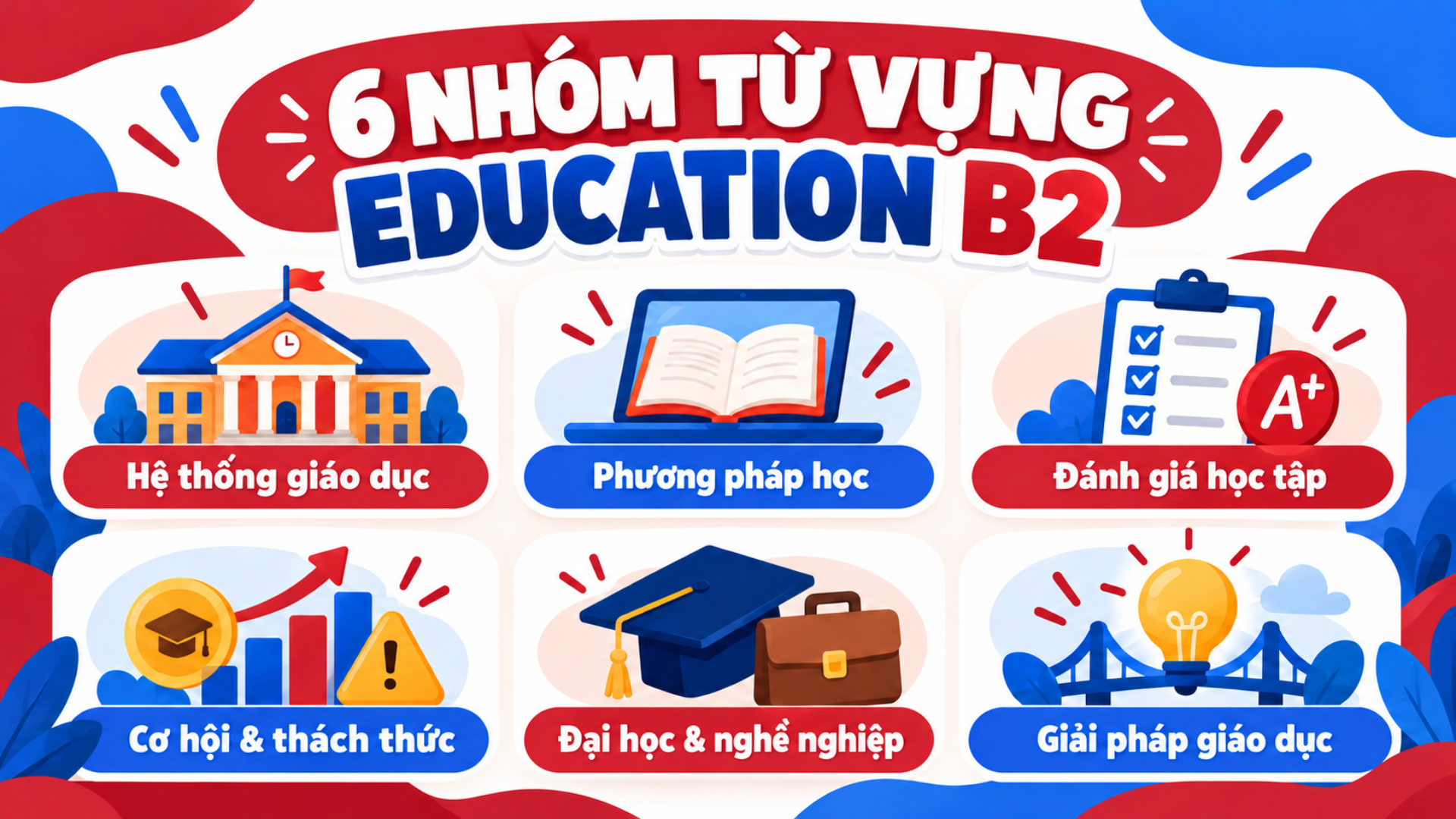
Để ghi nhớ 60 từ và cụm từ trong bảng, người học cần hiểu vai trò của từng nhóm trong một cuộc thảo luận về giáo dục.
Nhóm 1: Educational systems and policies – Hệ thống và chính sách giáo dục
- Compulsory education: giáo dục bắt buộc
- Higher education: giáo dục đại học
- Vocational education: giáo dục nghề nghiệp
- Lifelong learning: học tập suốt đời
- Inclusive education: giáo dục hòa nhập
- Education policy: chính sách giáo dục
- Educational inequality: bất bình đẳng giáo dục
- Educational reform: cải cách giáo dục
Ví dụ:
Educational reform should focus on improving access to quality education.
(Cải cách giáo dục cần tập trung vào việc cải thiện khả năng tiếp cận giáo dục có chất lượng.)
Nhóm 2: Teaching and learning methods – Phương pháp dạy và học
- Student-centred learning: học lấy người học làm trung tâm
- Blended learning: học kết hợp
- Distance learning: học từ xa
- Independent learning: học tập độc lập
- Collaborative learning: học tập hợp tác
- Critical thinking: tư duy phản biện
- Learning outcomes: kết quả đầu ra
- Digital literacy: năng lực số
Ví dụ:
Blended learning gives students greater flexibility while allowing them to interact with teachers in person.
(Học kết hợp giúp học sinh linh hoạt hơn nhưng vẫn có cơ hội tương tác trực tiếp với giáo viên.)
Nhóm 3: Academic assessment and achievement – Đánh giá và thành tích
- Academic achievement: thành tích học tập
- Academic performance: kết quả học tập
- Assessment: hoạt động đánh giá
- Continuous assessment: đánh giá liên tục
- Standardised testing: kiểm tra tiêu chuẩn hóa
- Constructive feedback: phản hồi mang tính xây dựng
- Learning objectives: mục tiêu học tập
- Academic standards: tiêu chuẩn học thuật
Ví dụ:
Continuous assessment allows teachers to monitor students’ progress throughout the course.
(Đánh giá liên tục giúp giáo viên theo dõi tiến bộ của học sinh trong suốt khóa học.)
Nhóm 4: Educational opportunities and challenges – Cơ hội và thách thức
- Tuition fees: học phí
- Scholarship: học bổng
- Financial aid: hỗ trợ tài chính
- Educational resources: tài nguyên giáo dục
- Disadvantaged background: hoàn cảnh bất lợi
- Dropout rate: tỷ lệ bỏ học
- Achievement gap: khoảng cách thành tích
- Academic pressure: áp lực học tập
Ví dụ:
Financial aid can make higher education more accessible to students from disadvantaged backgrounds.
(Hỗ trợ tài chính có thể giúp sinh viên có hoàn cảnh khó khăn tiếp cận giáo dục đại học dễ dàng hơn.)
Nhóm 5: University life and career development – Môi trường đại học và nghề nghiệp
- Undergraduate: sinh viên đại học chưa tốt nghiệp
- Postgraduate: học viên sau đại học
- Academic staff: đội ngũ giảng viên
- Academic adviser: cố vấn học tập
- Peer support: hỗ trợ từ bạn bè
- Mentoring: hoạt động cố vấn
- Professional development: phát triển chuyên môn
- Career prospects: triển vọng nghề nghiệp
Ví dụ:
Participating in internships and mentoring programmes can improve students’ career prospects.
(Tham gia thực tập và các chương trình cố vấn có thể cải thiện triển vọng nghề nghiệp của sinh viên.)
Nhóm 6: Discussing educational solutions – Thảo luận giải pháp giáo dục
- Broaden access to: mở rộng khả năng tiếp cận
- Bridge the gap: thu hẹp khoảng cách
- Address inequality: giải quyết bất bình đẳng
- Enhance employability: nâng cao khả năng có việc làm
- Foster creativity: thúc đẩy sáng tạo
- Develop transferable skills: phát triển kỹ năng có thể chuyển đổi
- Invest in education: đầu tư vào giáo dục
- Promote equal opportunities: thúc đẩy cơ hội bình đẳng
Ví dụ:
Schools should invest in digital resources and practical training to equip students with relevant skills.
(Các trường cần đầu tư vào tài nguyên số và đào tạo thực hành để trang bị cho học sinh những kỹ năng phù hợp.)
Word family cần nhớ trong chủ đề Education
Word family là nhóm các từ có chung gốc nhưng khác nhau về loại từ và chức năng ngữ pháp. Ở trình độ B2, người học cần nhận diện được dạng danh từ, động từ và tính từ để sử dụng chính xác trong câu.
| Từ gốc | Danh từ | Động từ | Tính từ | Trạng từ | Ví dụ ứng dụng |
|---|---|---|---|---|---|
| Educate | education, educator | educate | educational, educated | — | Education can create better opportunities. |
| Assess | assessment | assess | assessable | — | Teachers assess students’ progress regularly. |
| Achieve | achievement | achieve | achievable | — | Students should set achievable goals. |
| Qualify | qualification | qualify | qualified | — | Qualified teachers play an important role in education. |
| Admit | admission | admit | admitted | — | The university admitted more students this year. |
| Engage | engagement | engage | engaging, engaged | — | Interactive lessons are more engaging. |
| Include | inclusion | include | inclusive | — | Inclusive classrooms support diverse learners. |
| Motivate | motivation | motivate | motivated, motivational | — | Constructive feedback can motivate learners. |
| Collaborate | collaboration | collaborate | collaborative | collaboratively | Students worked collaboratively on the project. |
| Employ | employment, employability | employ | employable | — | Practical skills can improve employability. |
| Develop | development | develop | developmental | — | Professional development benefits teachers. |
| Access | access, accessibility | access | accessible | — | Online materials make education more accessible. |
Những lỗi về word family cần chú ý:
1. Education và educational
- Education (danh từ): giáo dục
- Educational (tính từ): thuộc về giáo dục, có tính giáo dục
Sai: Schools should provide education opportunities.
Tự nhiên hơn: Schools should provide educational opportunities.
2. Achievement và achieve
- Achievement (danh từ): thành tựu, thành tích
- Achieve (động từ): đạt được
Sai: Students want to achievement better results.
Đúng: Students want to achieve better results.
3. Qualification và qualified
- Qualification (danh từ): bằng cấp, trình độ chuyên môn
- Qualified (tính từ): có đủ trình độ, đủ điều kiện
Ví dụ:
The position requires a teaching qualification.
The school is looking for qualified teachers.
4. Accessible và access
- Accessible (tính từ): dễ tiếp cận, có thể tiếp cận
- Access (danh từ/động từ): khả năng tiếp cận; truy cập
Ví dụ:
Educational resources should be accessible to all students.
Students need access to reliable learning materials.
5. Employable và employability
- Employable (tính từ): có khả năng được tuyển dụng
- Employability (danh từ): khả năng đáp ứng yêu cầu tuyển dụng
Ví dụ:
Internships can make graduates more employable.
Practical training can improve graduate employability.
Khi làm bài điền từ, hãy quan sát vị trí ngữ pháp trước khi chọn đáp án: sau mạo từ thường cần danh từ hoặc cụm danh từ, trước danh từ có thể cần tính từ, còn sau động từ khiếm khuyết thường cần động từ nguyên mẫu.
Collocations và cụm từ tự nhiên chủ đề Education
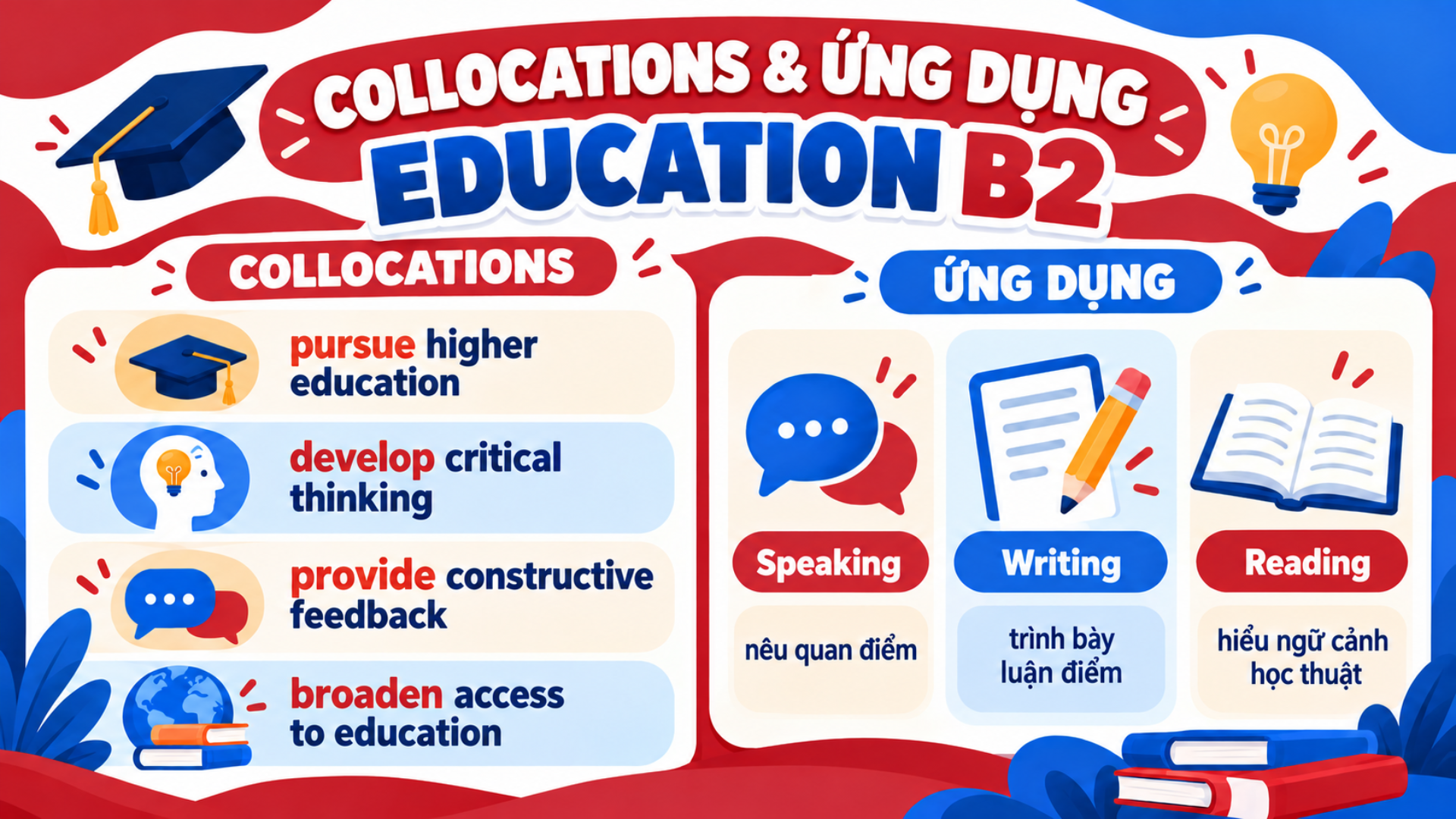
Ở trình độ B2, collocations giúp câu nói và bài viết chính xác, tự nhiên hơn. Đặc biệt, các cụm về giáo dục thường được sử dụng khi thảo luận nguyên nhân, tác động và giải pháp cho các vấn đề xã hội.
| Collocation/Phrase | Nghĩa tiếng Việt | Dùng trong ngữ cảnh nào? | Ví dụ |
|---|---|---|---|
| pursue higher education | theo học bậc đại học | Nói về lựa chọn sau THPT | More young people want to pursue higher education. |
| complete compulsory education | hoàn thành giáo dục bắt buộc | Mô tả hệ thống giáo dục | Children must complete compulsory education. |
| enrol in a vocational programme | đăng ký chương trình học nghề | Nói về lựa chọn học nghề | She enrolled in a vocational programme after school. |
| promote lifelong learning | thúc đẩy học tập suốt đời | Thảo luận về giáo dục liên tục | Governments should promote lifelong learning. |
| introduce curriculum changes | đưa ra thay đổi chương trình học | Nói về cải cách giáo dục | The school introduced curriculum changes this year. |
| implement educational reforms | triển khai cải cách giáo dục | Bàn về chính sách | Educational reforms need careful implementation. |
| address educational inequality | giải quyết bất bình đẳng giáo dục | Thảo luận giải pháp xã hội | More funding is needed to address educational inequality. |
| broaden access to education | mở rộng khả năng tiếp cận giáo dục | Nói về cơ hội học tập | Digital courses can broaden access to education. |
| adopt student-centred learning | áp dụng học lấy người học làm trung tâm | So sánh phương pháp giảng dạy | More teachers are adopting student-centred learning. |
| encourage independent learning | khuyến khích tự học | Nói về trách nhiệm người học | Teachers should encourage independent learning. |
| engage in collaborative learning | tham gia học tập hợp tác | Nói về học nhóm | Students engage in collaborative learning through projects. |
| develop critical thinking skills | phát triển tư duy phản biện | Nói về kỹ năng cần thiết | Debates help develop critical thinking skills. |
| achieve learning outcomes | đạt kết quả đầu ra | Đánh giá hiệu quả khóa học | Students achieved the expected learning outcomes. |
| apply theoretical knowledge | áp dụng kiến thức lý thuyết | Liên hệ học tập với thực tế | Internships help students apply theoretical knowledge. |
| assess student progress | đánh giá tiến bộ của học sinh | Nói về phương pháp đánh giá | Teachers assess student progress through regular tasks. |
| provide constructive feedback | đưa ra phản hồi mang tính xây dựng | Nói về vai trò giáo viên | Good teachers provide constructive feedback. |
| maintain academic standards | duy trì tiêu chuẩn học thuật | Nói về chất lượng đào tạo | Universities must maintain academic standards. |
| meet admission requirements | đáp ứng yêu cầu tuyển sinh | Nói về đăng ký trường, khóa học | Applicants must meet admission requirements. |
| award a scholarship | trao học bổng | Nói về hỗ trợ thành tích | The university awarded her a scholarship. |
| reduce academic pressure | giảm áp lực học tập | Thảo luận sức khỏe và học tập | Schools should help reduce academic pressure. |
| bridge the achievement gap | thu hẹp khoảng cách thành tích | Thảo luận chênh lệch kết quả học tập | Additional support can bridge the achievement gap. |
| enhance career prospects | cải thiện triển vọng nghề nghiệp | Nói về lợi ích giáo dục | Practical experience can enhance career prospects. |
| foster creativity | nuôi dưỡng, thúc đẩy sáng tạo | Nói về môi trường giáo dục | Project-based learning can foster creativity. |
| equip students with practical skills | trang bị kỹ năng thực tế cho học sinh | Đề xuất giải pháp giáo dục | Schools should equip students with practical skills. |
Một số cách paraphrase thông dụng:
| Diễn đạt đơn giản | Diễn đạt B2 |
|---|---|
| Students learn useful things. | Students acquire valuable knowledge and skills. |
| Education is important for jobs. | Education can improve employment opportunities. |
| Many students cannot afford university. | High tuition fees may prevent students from pursuing higher education. |
| Online learning is flexible. | Online learning offers greater flexibility in terms of time and location. |
| Teachers help students improve. | Teachers support students’ progress through constructive feedback. |
| Schools should teach practical things. | Schools should equip learners with practical, transferable skills. |
Khi paraphrase, cần giữ đúng ý nghĩa của câu gốc. Một câu dài hơn hoặc nhiều từ học thuật hơn không tự động trở thành câu tốt hơn nếu làm thay đổi thông tin cần truyền đạt.
Tham khảo thêm: Bộ từ vựng Collocations tiếng Anh
Lỗi sai thường gặp khi dùng từ vựng Education
Lỗi 1: Dùng sai collocation với research
- Câu sai: Students should make research before writing an essay.
- Câu đúng: Students should conduct research before writing an essay.
Giải thích: Conduct research hoặc do research là những cách kết hợp tự nhiên. Không dùng make research khi muốn nói thực hiện nghiên cứu.
Lỗi 2: Nhầm giới từ sau access
- Câu sai: Many children do not have access of quality education.
- Câu đúng: Many children do not have access to quality education.
Giải thích: Cấu trúc đúng là have access to something. Giới từ to cần đi sau danh từ access trong cấu trúc này.
Lỗi 3: Dùng sai giới từ với participate
- Câu sai: Students should participate extracurricular activities.
- Câu đúng: Students should participate in extracurricular activities.
Giải thích: Participate in something là cấu trúc chuẩn khi nói về việc tham gia hoạt động.
Lỗi 4: Nhầm education và educational
- Câu sai: The government should improve education opportunities.
- Câu đúng: The government should improve educational opportunities.
Giải thích: Educational là tính từ bổ nghĩa cho opportunities, thể hiện ý nghĩa các cơ hội liên quan đến giáo dục.
Lỗi 5: Dùng sai dạng danh từ không đếm được
- Câu sai: Students need more practical knowledges.
- Câu đúng: Students need more practical knowledge.
Giải thích: Knowledge là danh từ không đếm được khi nói về kiến thức nói chung, vì vậy không thêm -s.
Lỗi 6: Dịch từng từ sang tiếng Anh
- Câu sai: The university gives students many knowledges.
- Câu đúng: The university provides students with valuable knowledge.
Giải thích: Provide someone with something là cấu trúc phù hợp. Knowledge không đếm được, đồng thời provide students with knowledge tự nhiên hơn trong văn phong học thuật.
Lỗi 7: Dùng sai giới từ với responsible
- Câu sai: Students should be responsible of their learning.
- Câu đúng: Students should be responsible for their learning.
Giải thích: Responsible for something là cấu trúc chỉ trách nhiệm đối với một công việc hoặc hoạt động.
Lỗi 8: Dùng ngôn ngữ quá suồng sã trong bài viết học thuật
- Câu chưa phù hợp: Schools should give kids loads of cool stuff to learn.
- Câu phù hợp hơn: Schools should provide students with a wide range of valuable learning opportunities.
Giải thích: Những từ như kids, loads of và cool stuff có thể xuất hiện trong giao tiếp thân mật nhưng không phù hợp bằng students, a wide range of và learning opportunities trong bài luận học thuật.
Phân biệt các từ dễ nhầm trong chủ đề Education
Một số từ Education có nghĩa gần nhau nhưng không thể thay thế hoàn toàn trong mọi ngữ cảnh. Hiểu sự khác biệt giúp người học chọn từ chính xác hơn khi nói, viết và làm bài đọc hiểu.
| Từ dễ nhầm | Khác nhau thế nào? | Ví dụ đúng |
|---|---|---|
| Education – Training | Education nói về quá trình giáo dục, phát triển kiến thức và năng lực rộng hơn. Training tập trung vào việc đào tạo kỹ năng cụ thể. | University education provides broad knowledge, while vocational training develops job-specific skills. |
| Curriculum – Syllabus | Curriculum là chương trình giảng dạy tổng thể. Syllabus thường là đề cương hoặc nội dung của một môn học, khóa học. | The university revised its curriculum, and each lecturer updated the course syllabus. |
| Assessment – Examination | Assessment là hoạt động đánh giá nói chung, bao gồm nhiều phương pháp. Examination là một kỳ thi hoặc bài thi cụ thể. | Continuous assessment includes projects, while the final examination tests students’ knowledge. |
| Qualification – Certificate | Qualification là bằng cấp, trình độ hoặc năng lực chuyên môn được công nhận. Certificate là giấy chứng nhận cụ thể. | She has a teaching qualification and received a certificate after the training course. |
| Knowledge – Skills | Knowledge là kiến thức, hiểu biết. Skills là khả năng thực hiện một công việc hoặc nhiệm vụ. | Students need both theoretical knowledge and practical skills. |
| Achievement – Performance | Achievement nhấn mạnh thành tựu đã đạt được. Performance phản ánh mức độ thể hiện hoặc kết quả trong một giai đoạn. | Winning the scholarship was a major achievement, while her overall academic performance remained strong. |
| Scholarship – Financial aid | Scholarship là học bổng, thường gắn với thành tích hoặc tiêu chí cụ thể. Financial aid là khái niệm rộng hơn về hỗ trợ tài chính. | He received a merit-based scholarship, while other students qualified for financial aid. |
| Undergraduate – Postgraduate | Undergraduate là người đang học chương trình đại học đầu tiên và chưa hoàn thành bằng cử nhân. Postgraduate là người học bậc sau đại học. | She is an undergraduate student, while her brother is studying for a postgraduate degree. |
Lưu ý về sắc thái nghĩa ở B2:
Trong IELTS Writing hoặc VSTEP Writing, education và training thường mang trọng tâm khác nhau. Khi nói về phát triển tư duy, kiến thức tổng quát và giá trị xã hội, education thường phù hợp. Khi nói về việc chuẩn bị kỹ năng cho một nghề cụ thể, training thường chính xác hơn.
Tương tự, academic achievement và academic performance có thể liên quan nhưng không hoàn toàn đồng nghĩa. Việc đạt học bổng là một achievement, còn kết quả học tập trong cả học kỳ phản ánh performance.
Đoạn mẫu sử dụng từ vựng Education level B2
Topic: Should universities focus more on practical skills?
In my opinion, universities should place greater emphasis on learning outcomes rather than examination scores alone. A well-designed curriculum needs to combine theoretical knowledge with practical application. For example, business students could complete projects with local companies and receive constructive feedback from lecturers. Such experiences can strengthen critical thinking and help students develop transferable skills.
However, not everyone has the same access to education. Students from a disadvantaged background may struggle with tuition fees or limited educational resources. Universities could address these challenges by providing financial aid and affordable learning materials.
I also believe that blended learning offers a useful balance between flexibility and face-to-face interaction. Nevertheless, universities must maintain academic standards and ensure that students receive adequate support.
Overall, higher education should prepare learners for employment while helping them become independent thinkers with better long-term career prospects.
Giải thích nhanh các từ/cụm từ nổi bật:
- Learning outcomes: kết quả đầu ra mà người học cần đạt.
- Curriculum: chương trình giảng dạy.
- Practical application: việc áp dụng kiến thức vào thực tế.
- Constructive feedback: phản hồi giúp người học cải thiện.
- Critical thinking: tư duy phản biện.
- Transferable skills: kỹ năng áp dụng được trong nhiều bối cảnh.
- Access to education: cơ hội tiếp cận giáo dục.
- Disadvantaged background: hoàn cảnh có nhiều bất lợi.
- Tuition fees: học phí.
- Educational resources: tài nguyên giáo dục.
- Financial aid: hỗ trợ tài chính.
- Blended learning: phương pháp kết hợp học trực tiếp và trực tuyến.
- Academic standards: tiêu chuẩn học thuật.
- Career prospects: triển vọng nghề nghiệp.
Đoạn văn sử dụng cấu trúc thường gặp trong bài viết B2: nêu quan điểm, giải thích, đưa ví dụ, trình bày vấn đề và kết luận. Các cụm từ học thuật được sử dụng vừa đủ để làm rõ ý tưởng thay vì khiến câu văn trở nên phức tạp không cần thiết.
Bài tập từ vựng Education level B2
Hoàn thành năm task sau mà không xem lại bảng từ vựng. Các bài tập tập trung vào khả năng nhận diện nghĩa, sử dụng collocation và hiểu từ trong ngữ cảnh.
Task 1: Match words with meanings
Nối từ hoặc cụm từ ở cột A với nghĩa phù hợp ở cột B.
| Cột A | Cột B |
|---|---|
| 1. curriculum | A. triển vọng nghề nghiệp |
| 2. educational inequality | B. học tập suốt đời |
| 3. vocational education | C. chương trình giảng dạy |
| 4. assessment | D. bất bình đẳng trong giáo dục |
| 5. lifelong learning | E. chương trình giáo dục nghề nghiệp |
| 6. tuition fees | F. hoạt động đánh giá |
| 7. constructive feedback | G. học phí |
| 8. critical thinking | H. phản hồi mang tính xây dựng |
| 9. career prospects | I. tư duy phản biện |
| 10. inclusive education | J. giáo dục hòa nhập |
Task 2: Fill in the blanks
Điền từ hoặc cụm từ phù hợp vào chỗ trống. Mỗi đáp án được sử dụng một lần.
Word bank: tuition fees – constructive feedback – lifelong learning – admission requirements – blended learning – achievement gap – practical experience – educational resources – academic pressure – collaborative learning
- The university combines online lectures and classroom discussions through __________.
- Many students work part-time to pay their __________.
- Teachers should provide __________ rather than simply pointing out mistakes.
- Governments should promote __________ so that adults can continue developing their skills.
- Applicants must meet all the __________ before being accepted into the programme.
- Group projects encourage __________ and help students exchange ideas.
- Internships give students an opportunity to gain __________.
- Additional support for disadvantaged learners can help narrow the __________.
- Some students experience significant __________ during examination periods.
- Schools in remote areas may lack suitable __________.
Task 3: Choose the correct answer
Chọn đáp án A, B, C hoặc D.
- Governments should ________ more money in teacher training.
A. invest
B. spend to
C. provide on
D. contribute on
- Students need access ________ reliable digital learning materials.
A. for
B. with
C. to
D. of
- Universities should ________ students with skills relevant to the workplace.
A. prepare
B. equip
C. supply to
D. deliver
- The government introduced a policy to ________ educational inequality.
A. address
B. achieve
C. attend
D. admit
- The university requires students to ________ its admission requirements.
A. make
B. take
C. meet
D. gain
- Project-based learning helps students develop ________ thinking skills.
A. critic
B. criticism
C. critically
D. critical
- Many school-leavers decide to ________ higher education.
A. pursue
B. chase for
C. attend in
D. perform
- The teacher used continuous ________ to monitor student progress.
A. assignment
B. assessment
C. achievement
D. admission
- Practical experience can improve graduate ________.
A. employ
B. employable
C. employability
D. employer
- A balanced ________ should include both theoretical knowledge and practical skills.
A. qualification
B. scholarship
C. curriculum
D. admission
Task 4: Vocabulary in context
Đọc đoạn văn và trả lời năm câu hỏi bên dưới.
Reading passage: Making university education more accessible
A university recently introduced a blended learning programme for first-year students. Lectures are available online, while smaller seminars take place on campus. The aim is to broaden access to education for students who have part-time jobs or long commutes.
However, university staff noticed that some learners lacked suitable devices and reliable internet connections. As a result, the university made digital resources available in its library and created a financial aid fund.
Teachers also replaced one final examination with continuous assessment, including short projects and peer discussions. Early feedback suggested that students were more engaged, although some found it difficult to manage deadlines.
The university plans to review learning outcomes at the end of the academic year before deciding whether to expand the programme. Its main concern is not simply convenience, but whether all students have a fair chance to succeed.
Questions:
- What does broaden access to education mean in the passage?
A. Reduce the number of students
B. Make education available to more people
C. Increase tuition fees
D. Replace all classroom lessons
- Why did the university provide additional digital resources?
A. Some students lacked suitable devices and internet access
B. Teachers wanted to reduce their workload
C. Students refused to attend seminars
D. The university closed its library
- What does continuous assessment refer to in the passage?
A. One final examination only
B. Admission interviews
C. Ongoing evaluation through projects and discussions
D. A national university entrance test
- What does engaged most nearly mean in the passage?
A. Confused
B. Actively involved
C. Financially supported
D. Formally admitted
- Why will the university review learning outcomes?
A. To remove all academic standards
B. To stop providing financial aid
C. To evaluate the programme before expanding it
D. To replace lecturers with technology
Task 5: Application practice
Trả lời mỗi câu hỏi bằng 3–5 câu tiếng Anh. Sử dụng ít nhất hai từ hoặc collocations thuộc chủ đề Education trong mỗi câu trả lời.
- IELTS Speaking Part 3: What are the advantages and disadvantages of online learning?
- VSTEP Speaking: Do you think universities should focus more on theoretical knowledge or practical skills?
- IELTS Writing Task 2: Some people believe university education should be free for everyone. To what extent do you agree or disagree?
- Discussion: How can governments reduce educational inequality between urban and rural areas?
- Personal experience: What skills have you developed through your education, and how will they help your future career?
Tham khảo thêm: Từ vựng Exams B1 – từ vựng về kỳ thi và đánh giá
Đáp án bài tập từ vựng Education level B2
Task 1: Match words with meanings
1–C
2–D
3–E
4–F
5–B
6–G
7–H
8–I
9–A
10–J
Task 2: Fill in the blanks
- blended learning – Hình thức kết hợp học trực tuyến và trực tiếp.
- tuition fees – Khoản học phí sinh viên phải đóng.
- constructive feedback – Phản hồi có tính xây dựng, giúp người học cải thiện.
- lifelong learning – Học tập liên tục trong suốt cuộc đời.
- admission requirements – Các yêu cầu cần đáp ứng để được tuyển sinh.
- collaborative learning – Hình thức học thông qua hợp tác và trao đổi.
- practical experience – Kinh nghiệm thực tế tích lũy khi thực tập hoặc làm việc.
- achievement gap – Khoảng cách thành tích giữa các nhóm người học.
- academic pressure – Áp lực từ yêu cầu học tập, điểm số và kỳ thi.
- educational resources – Tài liệu, công cụ và nguồn lực phục vụ học tập.
Đặc biệt, câu 5 sử dụng collocation meet admission requirements, còn câu 7 sử dụng gain practical experience. Đây là những kết hợp tự nhiên cần ghi nhớ ở trình độ B2.
Task 3: Choose the correct answer
| Câu | Đáp án | Giải thích |
|---|---|---|
| 1 | A. invest | Invest money in something là đầu tư tiền vào lĩnh vực nào đó. |
| 2 | C. to | Cấu trúc cố định: access to something. |
| 3 | B. equip | Equip someone with something: trang bị cho ai thứ gì. |
| 4 | A. address | Address inequality nghĩa là giải quyết vấn đề bất bình đẳng. |
| 5 | C. meet | Meet requirements: đáp ứng yêu cầu. |
| 6 | D. critical | Cần tính từ critical bổ nghĩa cho thinking. |
| 7 | A. pursue | Pursue higher education: theo đuổi giáo dục đại học. |
| 8 | B. assessment | Continuous assessment: đánh giá liên tục. |
| 9 | C. employability | Sau improve graduate cần danh từ employability. |
| 10 | C. curriculum | Curriculum chỉ nội dung và cấu trúc chương trình giảng dạy. |
Giải thích thêm những câu dễ nhầm:
- Câu 3: prepare someone for something cũng đúng, nhưng khi có giới từ with, đáp án phù hợp là equip.
- Câu 6: Critically là trạng từ, không trực tiếp thay thế tính từ critical trong cụm critical thinking.
- Câu 9: Employable là tính từ, còn employability là danh từ chỉ khả năng có việc làm.
- Câu 10: Qualification là bằng cấp hoặc trình độ, không phải chương trình giảng dạy tổng thể.
Task 4: Vocabulary in context
- B. Make education available to more people.
Giải thích: Broaden access nghĩa là mở rộng cơ hội tiếp cận, không phải giảm số lượng người học. - A. Some students lacked suitable devices and internet access.
Giải thích: Đoạn văn cho biết một số sinh viên thiếu thiết bị phù hợp và kết nối internet ổn định. - C. Ongoing evaluation through projects and discussions.
Giải thích: Continuous assessment là hình thức đánh giá xuyên suốt khóa học, thay vì chỉ phụ thuộc vào một bài thi cuối kỳ. - B. Actively involved.
Giải thích: Engaged trong ngữ cảnh học tập nghĩa là tham gia tích cực và chú ý vào hoạt động học. - C. To evaluate the programme before expanding it.
Giải thích: Trường muốn đánh giá kết quả đầu ra trước khi quyết định mở rộng chương trình.
Task 5: Application practice – Sample answers
1. Advantages and disadvantages of online learning
Online learning offers greater flexibility and broadens access to education. However, students may struggle with distractions and limited face-to-face interaction. I think blended learning provides a better balance between convenience and student engagement.
2. Theoretical knowledge or practical skills
Universities should combine theoretical knowledge with practical skills. Academic knowledge helps students understand important concepts, while internships allow them to gain practical experience. Both are essential for improving career prospects.
3. Free university education
I partly agree that university education should be more affordable. High tuition fees can prevent students from disadvantaged backgrounds from pursuing higher education. However, governments also need sufficient funding to maintain academic standards.
4. Reducing educational inequality
Governments should invest more in educational resources for rural schools. They could also provide financial aid and improve digital infrastructure. These measures would help broaden access to education and narrow the achievement gap.
5. Skills developed through education
University education has helped me develop critical thinking and problem-solving skills. Group projects have also improved my ability to work collaboratively. I believe these transferable skills will enhance my future career prospects.
Các câu trả lời mẫu minh họa cách kết hợp quan điểm, lý do và từ vựng theo chủ đề. Trong bài thi, nội dung cần được điều chỉnh cho phù hợp với câu hỏi và trải nghiệm thực tế của người nói.
Ứng dụng từ vựng Education level B2 vào giao tiếp và bài thi
Từ vựng chủ đề Education xuất hiện trong giao tiếp về học tập, môi trường đại học, đào tạo nghề và những cuộc thảo luận liên quan đến phát triển xã hội.
Ở trình độ B2, mục tiêu không chỉ là hiểu từ khi đọc mà còn sử dụng được các cụm từ để trình bày quan điểm một cách rõ ràng.
| Mục tiêu học | Cách ứng dụng | Ví dụ |
|---|---|---|
| Giao tiếp hằng ngày | Chia sẻ trải nghiệm đại học, phương pháp học và định hướng tương lai. | My university encourages independent learning and offers opportunities to gain practical experience. |
| IELTS Speaking | Trình bày quan điểm về giáo viên, phương pháp giảng dạy, học trực tuyến và kỹ năng cần thiết. | I believe schools should place greater emphasis on critical thinking and problem-solving skills. |
| IELTS Writing Task 2 | Phân tích nguyên nhân, hệ quả và giải pháp cho các vấn đề giáo dục. | Governments should address educational inequality by investing in schools in disadvantaged areas. |
| TOEIC Reading/Listening | Hiểu thông báo đào tạo, chính sách khóa học, yêu cầu tuyển sinh và tài liệu về phát triển nhân viên. | Applicants must meet the admission requirements and complete the online assessment. |
| VSTEP Speaking | Thảo luận ưu điểm, hạn chế của phương pháp học và đưa ra lựa chọn phù hợp. | Blended learning offers flexibility, but traditional classes provide more direct interaction. |
| VSTEP Writing | Viết đoạn văn nêu quan điểm, phân tích vấn đề và đề xuất giải pháp. | Educational institutions should equip students with transferable skills to improve their career prospects. |
Ứng dụng vào IELTS Speaking
Với câu hỏi:
Do you think technology has improved education?
Một câu trả lời đơn giản:
Yes, technology makes learning easier.
Câu trả lời phát triển ở B2:
Yes, I believe technology has improved education by broadening access to learning materials. Digital platforms also support independent learning, although excessive screen time can sometimes reduce students’ concentration.
Câu trả lời này thể hiện được quan điểm, giải thích và một hạn chế liên quan.
Ứng dụng vào IELTS Writing và VSTEP Writing
Khi viết về chủ đề Education, người học cần tập trung vào khả năng phát triển ý tưởng và sử dụng từ vựng chính xác.
Ví dụ:
Investing in education can improve employment opportunities and contribute to long-term economic development.
(Đầu tư vào giáo dục có thể cải thiện cơ hội việc làm và đóng góp vào sự phát triển kinh tế dài hạn.)
Hoặc:
One effective way to reduce educational inequality is to provide financial aid to students from disadvantaged backgrounds.
(Một cách hiệu quả để giảm bất bình đẳng giáo dục là hỗ trợ tài chính cho học sinh, sinh viên có hoàn cảnh khó khăn.)
Ứng dụng vào TOEIC Reading
TOEIC thường kiểm tra khả năng hiểu thông tin trong những tình huống như đăng ký đào tạo, thông báo khóa học và phát triển chuyên môn tại nơi làm việc.
Ví dụ:
Employees who complete the professional development programme will receive a certificate of completion.
(Nhân viên hoàn thành chương trình phát triển chuyên môn sẽ nhận được giấy chứng nhận hoàn thành.)
Trong ngữ cảnh này, cần hiểu cụm professional development programme để xác định nội dung chính của thông báo.
Tham khảo thêm: Từ vựng Skills B2 – phát triển kỹ năng và năng lực
FAQ về từ vựng Education level B2
1. Chủ đề Education ở level B2 cần học bao nhiêu từ vựng?
Khoảng 50–65 từ và cụm từ trọng tâm là phạm vi phù hợp cho một bài học theo chủ đề. Quan trọng hơn số lượng là khả năng hiểu nghĩa, sử dụng collocations và áp dụng từ vào câu hoàn chỉnh.
2. Có cần học collocations khi học từ vựng Education B2 không?
Có. Collocations như pursue higher education, provide constructive feedback và develop critical thinking skills giúp diễn đạt tự nhiên, chính xác và phù hợp hơn trong các bài nói, bài viết.
3. Từ vựng Education B2 có sử dụng được trong IELTS không?
Có. Chủ đề Education phù hợp với các câu hỏi IELTS Speaking về trường học, học tập, công nghệ giáo dục và với những đề IELTS Writing Task 2 liên quan đến giáo dục, đào tạo và cơ hội học tập.
4. Học từ vựng Education B2 có giúp ích cho VSTEP không?
Có. Người học có thể sử dụng nhóm từ này trong VSTEP Speaking để trình bày quan điểm và trong VSTEP Writing để thảo luận nguyên nhân, lợi ích, hạn chế hoặc giải pháp giáo dục.
5. Có cần học idioms về Education ở trình độ B2 không?
Không bắt buộc. Ở trình độ B2, sử dụng collocations và topic-specific phrases chính xác thường hữu ích hơn việc cố đưa nhiều idioms vào bài viết. Đặc biệt trong bài luận học thuật, cần ưu tiên ngôn ngữ rõ ràng và phù hợp ngữ cảnh.
6. Làm sao để nhớ từ vựng Education lâu hơn?
Hãy chia từ thành nhóm nghĩa, học theo cụm, đặt câu liên quan đến bản thân và ôn tập theo chu kỳ. Sau khi học, nên viết một đoạn văn ngắn về giáo dục và kiểm tra xem mình đã sử dụng đúng từ loại, collocations và giới từ hay chưa.
Kết luận
Từ vựng Education B2 giúp người học vượt ra khỏi những câu mô tả đơn giản để thảo luận sâu hơn về phương pháp giảng dạy, chất lượng giáo dục, cơ hội học tập và mối liên hệ giữa giáo dục với nghề nghiệp.
Để ghi nhớ và sử dụng hiệu quả, hãy học từ theo nhóm nghĩa, kết hợp collocations, word family và luyện paraphrase trong ngữ cảnh thực tế. Sau khi hoàn thành bài tập, hãy làm lại những câu trả lời sai và tự viết một đoạn văn khoảng 150 từ về vấn đề giáo dục mà mình quan tâm.
Anh Ngữ SEC đồng hành cùng người học trong quá trình xây dựng vốn tiếng Anh có hệ thống, từ hiểu kiến thức đến sử dụng tự nhiên trong giao tiếp và các bài thi.
Xem thêm
- Từ vựng tiếng Anh chủ đề học tập và trường học
- Từ vựng Language Learning B1 – nói về việc học ngoại ngữ
- Từ vựng Study Habits B2 – thói quen và phương pháp học tập
- Từ vựng tiếng Anh chủ đề trường học
- 5 phương pháp học từ vựng tiếng Anh hiệu quả
- British Council – B1–B2 English Vocabulary
- Cambridge Dictionary – Academic


Bài viết liên quan
Bộ ý tưởng IELTS Writing Task 2 chủ đề Technology và AI: Từ vựng, cách triển khai ý và bài mẫu (Band 4.0–6.0)
10 nhóm ý tưởng IELTS Writing Task 2 chủ đề Crime, Law and Punishment (Band 4.0–6.0)
Giải chi tiết TOEIC Part 3: Hội thoại chủ đề tuyển dụng nhân sự
Giải chi tiết TOEIC Part 3: Kỹ thuật vừa nghe vừa quan sát hình ảnh để không bỏ lỡ đáp án
Giải chi tiết TOEIC Part 3: Chủ đề sự cố và giải quyết vấn đề
Giải chi tiết TOEIC Part 3: Hội thoại có 3 người nói (New Format)